


 4 mins read


The difference between a loyal client and a lost one often comes down to a single interaction. Studies show that even a single poor experience can make 1 in 3 customers walk away from your brand. It is important for you to not only be present on all your customers’ preferred communication channels, but also to get maximum insights from them.
This means that robust omnichannel contact center solutions are no longer just support engines. They are strategic revenue enablers, influencing cross-selling, compliance, and customer retention.
Hence, it’s high time leaders asked: Does the communication platform I use unify every channel, scale as I grow, and deliver actionable insights, or is it just another tool with a checklist of features?
This blog explores two of the most popular contact center solutions-Acefone vs TeleCMI. It is not just a simple vendor comparison but a framework to evaluate what truly matters: operational scalability, omnichannel maturity, and long-term ROI.
Read on.
Acefone: A Complete Cloud Communications Solution
Acefone is a cloud-native, omnichannel contact center platform designed for companies that demand more than just voice calling. With a unified dashboard, agents seamlessly manage voice, chat, SMS, email, and WhatsApp interactions without juggling multiple tools.
Unlike legacy systems or point solutions that require costly integrations, Acefone enables rapid deployment, elastic scaling, and compliance-ready operations. This makes it ideal for leaders who want measurable business outcomes, not IT complexity.
Core Strengths That Define Acefone’s Value Proposition
- True Omnichannel Orchestration: One interface for every channel with a complete interaction history.
- Intelligent Call Management: Whispering, barging, and skill-based routing for proactive coaching.
- Zero Infrastructure Investment: No setup fees, no hardware. Both browser and app-based.
- Unlimited Scalability: Handles unlimited concurrent calls, critical for seasonal or rapid growth.
- VoIP-First Architecture: Reliable connectivity from any device, perfect for hybrid or remote teams.
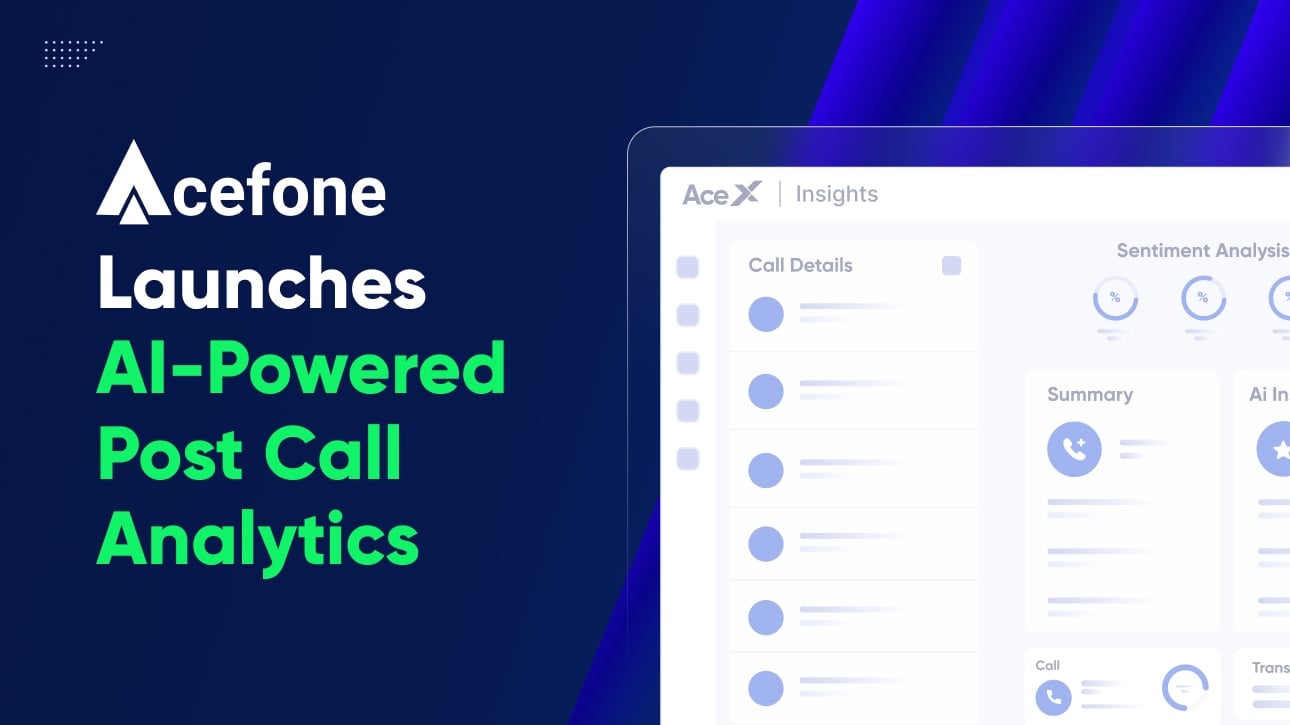
- AI-Powered Post-Call Analytics: Instantly analyzes every conversation for compliance, customer intent, and agent performance.
Understanding TeleCMI’s Approach to Cloud Communication
TeleCMI is an AI-driven cloud contact center catering primarily to startups and SMBs. It offers voice, text, and video meetings through a cloud-based setup that emphasizes quick onboarding.
For businesses new to cloud telephony, TeleCMI provides pre-built CRM integrations for Zoho, Salesforce, and Pipedrive.
The platform promotes 99.9% uptime and flexible domestic/global calling plans ($0.007/minute). However, its strengths remain concentrated in voice communications, with limited omnichannel maturity.
Key Advantages of TeleCMI’s Platform
- AI-Enhanced Features: Basic analytics and routing for smaller teams.
- CRM Integration Capability: Ready connectors for major CRMs.
- Flexible Pricing Tiers: Entry-level affordability with discounts for 30+ users.
- No Hardware Requirements: Accessible via desktop or mobile.
What Decision-Makers Should Remember
- Omnichannel isn’t optional anymore: Customers expect seamless experiences across every channel, making unified engagement the new baseline.
- Scalability defines ROI: A platform’s ability to grow without disruption determines long-term cost efficiency and value.
- Supervisor visibility drives results: Real-time coaching and monitoring directly improve agent performance and customer satisfaction.
- APIs vs. connectors: Open APIs future-proof your stack, while rigid connectors limit flexibility as your tech evolves.
- Total cost matters: Beyond licenses, hidden fees, scalability limits, and migration costs shape true ROI.
Acefone VS TeleCMI: Key Comparison
| Evaluation Criteria | Acefone | TeleCMI | Winner |
| Omnichannel Maturity | Unified omnichannel interface (voice, chat, SMS, email, WhatsApp) | Multi-channel (voice, text, WhatsApp, video), separate interface for each | Acefone |
| Scalability | Unlimited concurrent calls in all plans | Unlimited inbound concurrent calls only in its enterprise / higher-tier plans | Acefone |
| Deployment | Free Trial, easy setup | Free trial, easy setup | Tie |
| Integration Ecosystem | REST APIs, CRM integrations with all communication channels | Pre-built connectors; on the call feature only | Acefone |
| Analytics & Reporting | Real-time dashboards + AI-driven Post-Call Analytics | Standard reports with limited AI | Acefone |
| Agent Experience | Unified workspace, mobile and desktop friendly | Desktop/mobile + CRM access | Acefone |
| Remote Work | VoIP-first global access (Mobile & desktop) | Cloud access (mobile/desktop) | Tie |
Acefone vs TeleCMI: Feature-by-Feature Comparison
Here is Acefone vs Telecmi features comparison:
1. Omnichannel Maturity
Acefone’s strength lies in true omnichannel communication. Agents can manage calls, chat, SMS, email, and WhatsApp from a single workspace, with full interaction history intact. The unified dashboard provides easy channel switching, reducing errors and streamlining resolution.
While TeleCMI supports multiple channels, such as voice, text, and WhatsApp, each channel is managed through a separate interface. This leads to fragmented communication, inconsistent customer experiences, and increased agent workload due to the lack of a unified view.
2. Supervisor Controls & Call Management
Acefone equips you with state-of-the-art coaching tools like whisper, barge, and live monitoring. Beyond this, the latest Acefone launch of AI-powered Post-Call Analytics takes QA to the next level. It automatically analyzes conversations for intent, compliance risks, and agent performance. This empowers managers to shift from reactive reviews to data-driven, proactive coaching.
TeleCMI supports basic routing and recording but lacks the same depth of AI-enabled analysis.
3. Scalability & Architecture
Acefone is designed for elastic scalability, handling unlimited concurrent calls with minimal effort.
TeleCMI sets limits by plan (users, channels, CPS) and offer unlimited inbound concurrent calls only in its enterprise / higher-tier plans.
4. Integrations & APIs
Acefone shines by offering all these integrations along with REST APIs and WebRTC support for all channels of communication. This makes it ideal for companies with evolving stacks.
TeleCMI offers CRM integrations (Zoho, Salesforce, Pipedrive) only for the call feature.
Recommended Read: Best Cloud Contact Center Platform
5. Agent experience & remote work
Acefone’s VoIP-first omnichannel design supports distributed teams and ensures every channel interaction syncs seamlessly with one another.
TeleCMI also supports remote work but is more voice/CRM-centered.
6. Pricing & commercial model
Acefone: no setup fees, transparent subscription pricing, unlimited scalability.
TeleCMI: tiered plans with per-minute charges.
Who Should Choose Acefone vs TeleCMI?
Selecting the right contact center platform isn’t about choosing the one with the longest feature list. It is instead about alignment with your business trajectory, operational complexity, and growth ambitions.
While both Acefone and TeleCMI offer cloud-based communication solutions, they serve distinctly different business profiles. The right choice depends on whether you’re optimizing for basic voice connectivity or building a scalable, intelligence-driven customer engagement engine.
Here’s a practical guide to help you determine which platform aligns with your specific needs:
Choose Acefone if:
- You need true omnichannel capabilities: Your business requires managing voice, chat, SMS, email, and WhatsApp from a single unified interface with complete interaction history.
- You’re scaling rapidly or experience seasonal spikes: You need unlimited concurrent calls and elastic scalability without infrastructure constraints or plan-based limitations.
- Supervisor coaching is a priority: You want advanced tools like whisper, barge, live monitoring, and AI-powered Post-Call Analytics for proactive, data-driven coaching.
- You operate hybrid or remote teams: Your distributed workforce needs reliable VoIP-first architecture that works seamlessly across devices and locations.
- Integration flexibility matters: You require REST APIs and WebRTC support across all communication channels to future-proof your tech stack.
- You want transparent, predictable costs: You prefer no setup fees, clear subscription pricing, and unlimited scalability without hidden charges or per-minute fees.
- Compliance and analytics are critical: You need automated conversation analysis for compliance risks, customer intent, and agent performance insights.
Choose TeleCMI if:
- You’re a startup or SMB with basic voice needs: Your primary requirement is cloud telephony with straightforward calling features rather than complex omnichannel engagement.
- Voice communication is your main focus: You don’t currently need sophisticated cross-channel customer interactions or unified engagement.
- You use specific CRMs heavily: Your operations center around Zoho, Salesforce, or Pipedrive, and voice-CRM integration is your primary concern.
- Budget is the primary constraint: You’re looking for entry-level affordability and can work within tiered plan limitations.
- Your needs are predictable and modest: You have a small team (30+ users for discounts) with stable, voice-centric communication requirements that won’t require significant scaling.
Final Verdict
TeleCMI is a suitable starting point for SMBs with modest voice-first needs. However, Acefone’s omnichannel maturity, unlimited scalability, and AI-powered Post-Call Analytics make it the clear winner. By turning every conversation into actionable intelligence, Acefone empowers leaders to optimize revenue, retention, and compliance at scale.
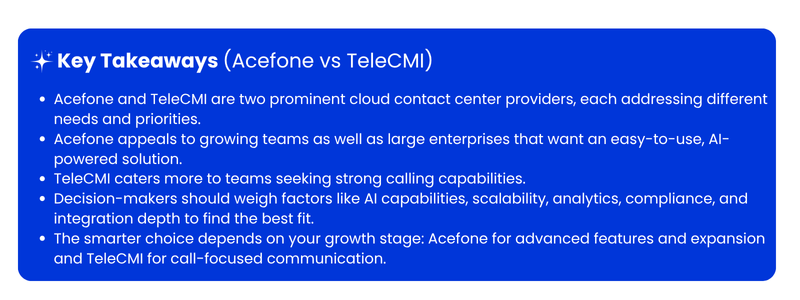
Key Takeaways
FAQs
Acefone is a cloud-native communications and contact center platform that brings together voice, chat, SMS, email and WhatsApp into a unified dashboard, allowing agents to handle all interactions from one place. It also offers AI-powered post-call analytics and intelligent call management features like skill-based routing without requiring upfront infrastructure investment.
TeleCMI provides a cloud communications and contact center solution that emphasizes AI-driven workflows and CRM integration. It delivers features such as call routing, real-time analytics, IVR, live call monitoring, and hashtag support.
Key communication features to check before evaluating a cloud contact center include multichannel support (voice, SMS, WhatsApp), IVR and intelligent routing, real-time monitoring and analytics, and CRM or third-party tool integrations.
• Acefone includes omnichannel orchestration across multiple business channels and AI-driven analytics for compliance and performance insights.
• TeleCMI provides AI-assisted call handling, live dashboards, automated call distribution, and robust CRM support designed to streamline agent workflows.
Acefone’s platform is designed for elastic scaling, allowing businesses to handle large volumes of concurrent interactions without hardware expansion. It supports unlimited concurrent calls and rapid deployment for remote or distributed teams. Additionally, plans can be customized by feature set and CRM integrations so companies can choose capabilities based on their growth plans.
Analytics and reporting help businesses track customer engagement, agent performance, and operational trends.
• Acefone offers AI-powered post-call analytics to surface insights on sentiment, compliance, and patterns across conversations.
• TeleCMI delivers real-time dashboards and reporting that let teams monitor call flows, agent occupancy, key metrics and trends to optimize service delivery.
Both platforms support AI-related enhancements but focus on different aspects: Both solutions include AI-driven capabilities designed to augment communication workflows. If you want support businesses that want to leverage machine-assisted automation, with the choice depending on specific use cases and channel requirements.
• Acefone integrates AI into post-call analytics and intelligent call management to help teams derive insights and improve agent performance.
• TeleCMI incorporates AI in call routing, performance analysis, and workflow automation within its cloud telephony suite.