


 4 mins read


For modern enterprises, communication isn’t merely an operational necessity—it’s an everyday pressure point. Distributed teams, high customer expectations, and tight budgets demand a system that can evolve, scale, and stay resilient. And at the heart of this reality sits a timeless decision: VoIP vs landline.
Landlines still hold their place in many legacy environments, but the communication landscape of 2026 looks fundamentally different from even a few years ago. Cloud models dominate workplace infrastructure, remote work has normalized, and businesses increasingly expect technology to adapt to how they operate—not the other way around.
This blog breaks down the VoIP vs traditional phone system debate with a fresh 2026 lens, helping businesses understand the strengths, gaps, and long-term implications of both.
What is a VoIP Phone System?
A VoIP (Voice over Internet Protocol) phone system enables voice communication using the internet rather than copper wires.
Instead of transmitting analog signals, VoIP converts your voice into digital packets and routes them across IP networks—public or private.
Why this matters for enterprises:
- Works from anywhere with an internet connection
- Eliminates dependency on physical infrastructure
- Offers advanced features by default (IVR, call routing, analytics)
- Enables mobility, remote work, and hybrid collaboration
- Reduces the cost of maintenance and hardware
VoIP is built for modern workflows where teams change locations, devices, and roles frequently.
Check it out: What is a VoIP Phone System?
What Is a Landline (Traditional Phone System)?
A landline uses the Public Switched Telephone Network (PSTN) and transmits analog voice signals through copper or fiber-optic cables.
The system connects to an on-site PBX (Private Branch Exchange) for call routing and internal extensions.
Why some enterprises still use landlines:
- Long-standing reliability
- Consistent call quality in local environments
- Minimal dependence on internet infrastructure
However, landlines lack the flexibility, scalability, and automation that digital-first enterprises now consider baseline requirements.
VoIP vs Landline: How Does Each System Work?
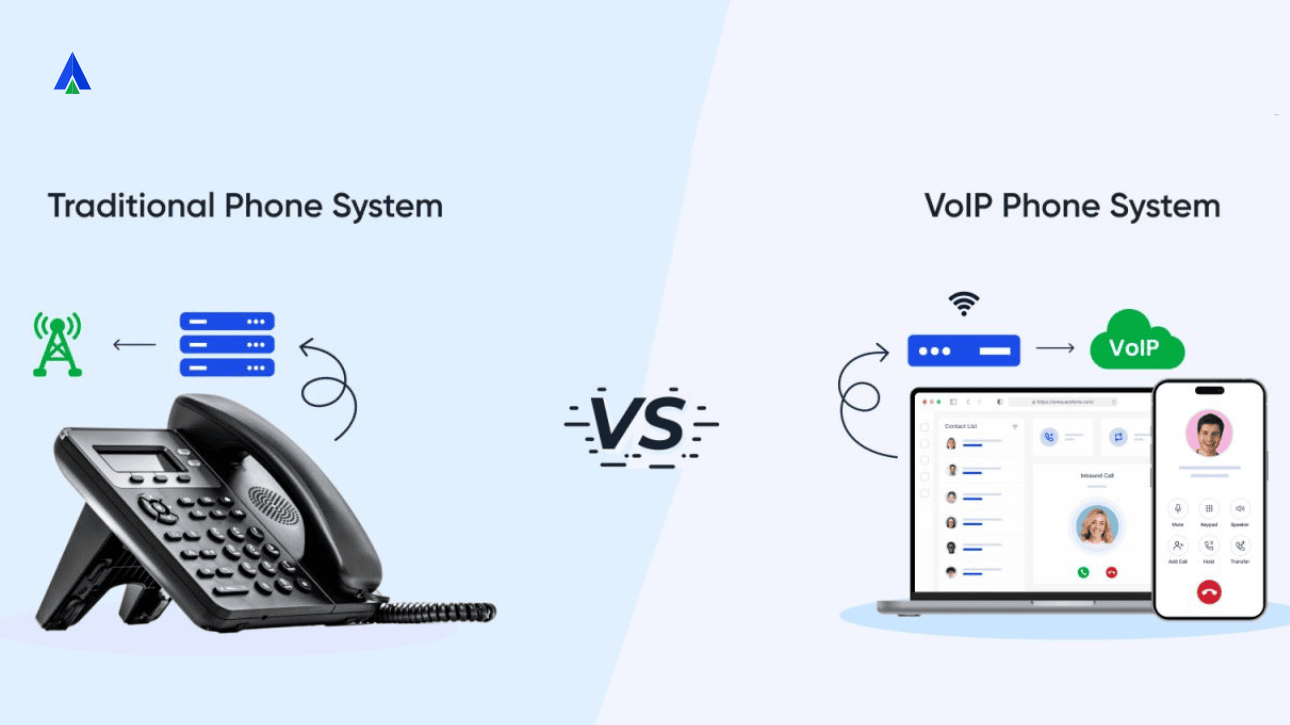
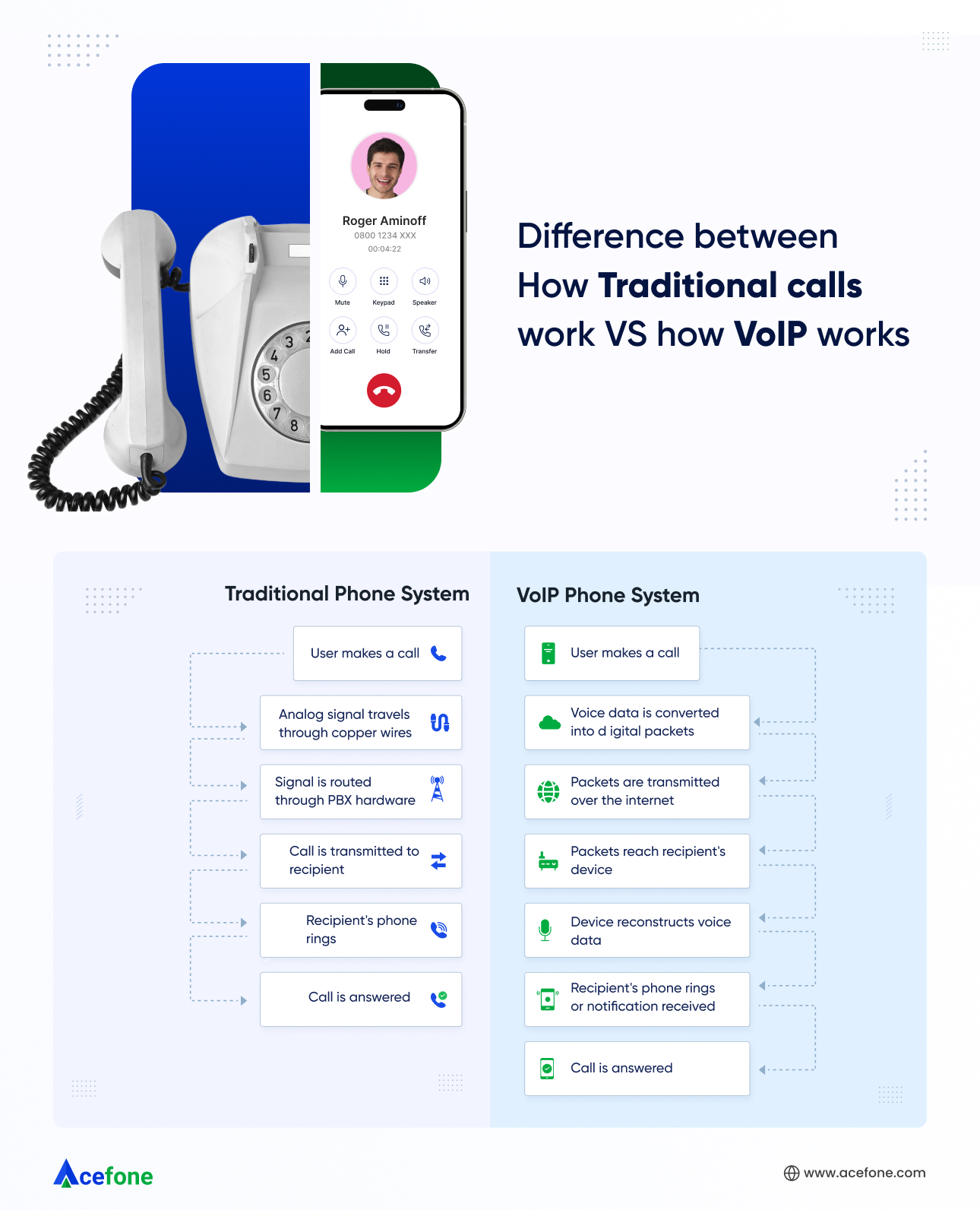
Hosted VoIP phone system work vastly differently from traditional phone systems. When you make a call using a VoIP, your voice is converted into long wave-like electrical signals. Once converted, the ADC chops the signals into small data packets to transmit using VoIP technology.
The Voice over IP-hosted PBX routes the data packets to the designated phone (recipient), where the data packets are converted back to your voice. The receiving VoIP phone/ regular phone rings or notifies the recipient of the incoming voice call, completing the call.
Read in-depth “ What are VoIP Phone Services ” here.
Landline phones rely on a closed network of physical phone lines to transmit voice calls from one location to another. They have been around for decades, completely unchanged, with the same features and difficulties since their launch.
With each call, a landline converts your voice into analog signals, transmitting them over underground copper wires to a Private Branch Exchange (PBX). This PBX routes the analogue signals to the recipient’s landline phone, where the earpiece converts these signals back to your voice.
VoIP vs Landline: A Deep Comparison for 2026 Enterprises
Now that you understand how both of the phone systems work, its time to understand which works best for your business. There are several upsides and only a handful of downsides to using phone systems for modern enterprises. Here is a detailed comparison of VoIP vs landline, highlighting the important advantages of VoIP:
Cost-effective:
Voice over IP systems can be significantly less expensive than traditional phone systems. VoIP phones eliminate the need for expensive copper wiring and PBX hardware. Furthermore, the cost of transferring data across the internet is far less than transmitting signals over copper-wired lines.
Scalable:
Hosted Voice over IP is easily scalable to meet the needs of growing businesses. You can add or remove user extensions at a single click. On the contrary, traditional phone systems need to add new physical lines to add new users or vice versa.
Flexible:
VoIP business phones offer a wider range of telephony features than landlines which are especially beneficial for an inbound call center. Features such as voicemail, auto attendants, IVR, real-time monitoring, call conferencing, call forwarding, and more. These features can improve the efficiency of your enterprise’s communications.
Mobility:
Voice over IP allows employees to make and receive calls from anywhere with an internet connection. This gives businesses with remote or mobile workforces a major upper hand over those with landlines.
Disadvantages of Landline Phone
Here are some limitations of traditional landline phone systems:
Scalability:
Adding or removing phone lines requires handling physical copper wire, which can be expensive, complex, and time-consuming.
Limited Features:
Landlines offer basic functionalities like call waiting and voicemail and lack advanced features such as video conferencing and call forwarding, available in VoIP systems.
Immobility:
Landlines are restricted to the location of their installation. The chances of you missing out on business calls while on the move are close to 100%.
Visit for more details: Contact center software
Limitations of Landlines That Matter in 2026
Business VoIP phone systems are a great solution for enterprises in most situations. Here are a few factors to consider before making the switch to VoIP:
Network Infrastructure:
Hosted VoIP systems require a strong and reliable internet connection to operate. Analyze your existing internet connection to ensure you get consistent connectivity for your calls. Go for business-grade internet connections to avoid call latency, call drops, jitter, and disrupted calls.
Identify Your Needs:
Make a list of the call functionalities, number of users, virtual numbers, and other features you currently need for your communication operations. Once you complete the list, begin prioritizing the ones you find most important and look for Voice over IP providers that offer the services and features you need.
Security:
Look for Voice over IP providers who offer strong data encryption and multi-layered network firewalls for their services. It is important to choose a Voice over IP provider that offers a secure system.
Costs:
Consider both upfront costs and ongoing monthly fees to see whether the VoIP phone service fits your budget or not. Check out the installation fees, license fees, maintenance fees, and other additional charges (if any).
Future Scalability:
Be sure to look for VoIP monthly plans that can accommodate the future growth of your business and evolving usage needs. Search for options like Pay-as-you-go plans and flexible contracts.
If you are considering switching to a Hosted VoIP system, be sure to do your due diligence and choose a VoIP provider that can meet your enterprise’s needs.
VoIP vs Landline: Which is the Best for Your Business?
Traditional phones have served us well, but the future of communication is undeniably moving towards a digital front. Hosted VoIP business phone system offer us a powerful concoction of cost-effective plans, scalable solutions, flexible calling, and advanced telephony features that traditional phone systems simply can’t match.
So, why wait? Leap into the future of communication and unlock the potential of Voice over IP for your enterprise.
FAQs:
VoIP uses the internet to make and receive calls, while landlines rely on physical copper-wire networks. VoIP delivers more features, lower costs, and remote accessibility, whereas landlines provide basic calling with strong reliability but limited flexibility.
Yes. For most businesses, VoIP offers better value because it includes advanced features like call routing, IVR, analytics, voicemail-to-email, and mobility. It also lowers calling expenses. Landlines may still be suitable for businesses in areas with weak internet connectivity or those requiring extremely stable analog lines.
VoIP is very reliable with a stable, high-speed internet connection. Modern providers offer redundancy, QoS (Quality of Service), and uptime SLAs to ensure crystal-clear calls. If your network is optimized, VoIP can be as dependable as any landline.
VoIP phones usually need power and internet, so they may not function during outages unless you have backup solutions like a UPS, generator, or mobile hotspot. Landlines typically continue working since they draw power from the telecom carrier.
Yes, reputable VoIP providers use SIP encryption, TLS protocols, multi-factor authentication, and real-time threat monitoring. As long as you choose a secure provider and follow good network practices, VoIP is safe for business communication.
Generally, yes. VoIP eliminates the cost of copper wiring, on-site PBX hardware, and expensive maintenance. You typically pay a predictable monthly fee with unlimited calling, making it more cost-effective than landline services.
In most cases, 100 kbps per call is enough for high-quality VoIP audio. However, business-grade internet—such as fiber—is recommended for multiple simultaneous calls and to avoid jitter or latency.
Absolutely. VoIP systems integrate with CRMs like Salesforce, HubSpot, Zoho, and ticketing tools like Zendesk. This improves productivity by showing caller details, enabling click-to-call, and logging interactions automatically.
VoIP is ideal for businesses of all sizes. Small businesses benefit from affordability and plug-and-play setup, while large enterprises value scalability and advanced features like call queuing, auto attendants, and monitoring.
Yes. Most providers offer number porting so you can keep your existing business phone number, ensuring continuity for your customers.