




✨Quick Answer
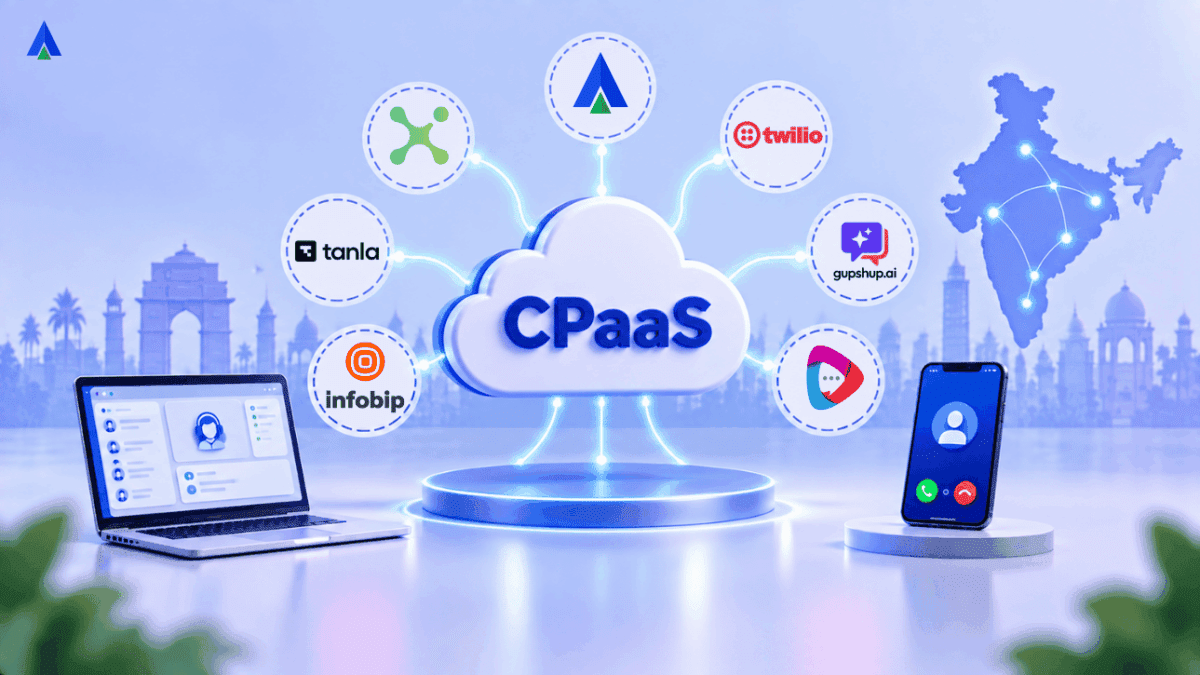
The article compares six pure-play CPaaS vendors: Twilio, Gupshup, Route Mobile, Exotel, Tanla Platforms, and Infobip—and explains where Acefone fits as a managed UCaaS provider with an API layer. The shortlist should be evaluated on channel coverage, pricing currency, TRAI DLT and DPDPA readiness, and written SLA support.
We get the same question from IT heads across BPOs, BFSI teams, and D2C brands. Which CPaaS companies in India actually hold up once you move past the demo?
Most comparison guides answer that with an API feature list and stop there.
We think that misses the two things that actually break an India rollout: rupee-based pricing, TRAI DLT, and DPDPA compliance running in parallel. Neither should be bolted later. Get either wrong, and your OTPs stop delivering, or your data handling draws a regulator’s attention.
This guide takes you through the best CPaaS providers in India, and how their pricing and compliance compare. It also covers where a UCaaS platform like ours fits, instead of a ground-up API build.
How Should You Evaluate CPaaS Companies in India?
We run every shortlist through four filters before we even look at a features page. Those filters are channel coverage, pricing currency, DLT & DPDPA readiness, and written SLA support. Skip any one of these, and it turns into a hidden cost or a compliance gap once you’re past the pilot.
Before you shortlist Communications platform as a service providers, run them through these four filters, not a features page:
- Channel coverage. Does the vendor handle voice, SMS, WhatsApp, and RCS natively, or do you need a third-party bridge for one of them?
- Pricing currency. INR billing avoids the forex swings that hit dollar-billed vendors hard whenever the rupee moves.
- DLT and DPDPA readiness. Ask the vendor to show both separately. One doesn’t cover the other, as we get into it below.
- Support SLA. Get the uptime guarantee in writing. A sales deck line about “reliable service” isn’t an SLA.
We’re asking this at a good time to be shortlisted.
India’s Communications platform as a service market was worth USD 1.12 billion in 2025 and is projected to reach USD 2.36 billion by 2031. That’s a 13.02% CAGR between 2026 and 2031, per Mordor Intelligence’s India Communications platform as a service coverage. That growth is exactly why a name-recognition shortlist isn’t good enough anymore. Newer, India-first specialists are closing the gap on global players fast.
The coverage and pricing filters are easy enough to check on a single demo call. The compliance filter is where most shortlists actually fall apart, so it’s worth slowing down on.
How Do TRAI DLT and DPDPA Apply to CPaaS in India?
Two regulations apply to nearly every commercial message or call you send in India, and they cover different things. TRAI’s DLT framework governs the act of sending: who is allowed to send, and which message template they’re allowed to use.
The DPDPA governs what happens to the customer data your communication generates afterward. A vendor that has one sorted hasn’t automatically sorted the other.
Every business first registers as a Principal Entity, then registers a Header (your sender ID), then registers each message template, all through a telecom operator’s DLT portal, following . Per TRAI’s own published direction, the entity registration step takes a maximum of 7 days from submission.
Skip it, and your SMS or voice campaign gets blocked at the telecom level, not just flagged by an app. Operators also apply a small DLT scrubbing charge per SMS under this regulation, separate from whatever your vendor bills you. Getting Communications platform as a service TRAI DLT compliance sorted before you launch saves you a blocked campaign later. It’s a one-time setup cost, not a recurring headache, once it’s done properly.
DPDPA sits on top of that. Once a message reaches a customer, DPDPA governs how their phone number, consent record, and interaction history get stored and used going forward.
BFSI buyers carry a third layer on top of both: RBI’s sector-specific guidance on data handling for financial communication. A vendor that only shows you DLT registration hasn’t shown you the DPDPA side at all, so ask for both, in writing, before you sign.
Which CPaaS Companies in India Should You Compare?
We compared six pure-play Communications platform as a service vendors here, plus where our own stack fits differently. Twilio, Gupshup, Route Mobile, Exotel, Tanla Platforms, and Infobip are the names IT teams in India evaluate most often. We’re not a seventh name on that list. We’re a UCaaS provider with an API layer, Interactions Hub, built for teams that want managed workflows instead of an API build from scratch.
Acefone:

We built Acefone as a UCaaS provider, Interactions Hub and Contact Center Studio, with a Communications platform as a service-style API layer, API Connect. It’s for teams that want voice, SMS, and WhatsApp integrations without a ground-up build. We’re not trying to out-API Twilio or Gupshup. We’re built for the team that wants the workflow ready on day one.
Twilio

Twilio has the broadest global API surface on this list, with mature SDKs and thorough documentation. It bills in US dollars, which is worth factoring into any India-only cost comparison. DLT setup on Twilio is also self-managed rather than built in. Twilio remains the reference point for Communications platform as a service API India developers reach for first, mainly on documentation depth. Check Twilio’s India pricing directly, since published per-message and per-minute rates vary by route and volume tier.
Gupshup

Gupshup’s CPaaS platform is built around WhatsApp Business API and conversational commerce first, with strong RCS support alongside it. It holds an established Meta Business Solution Provider relationship. Pricing runs custom and volume-based, so you’ll need a quote rather than a public rate card.
Route Mobile

Route Mobile runs on direct carrier connections built for high-volume A2P messaging. It’s now majority owned by Proximus Group, a deal Route Mobile’s own release confirms closed in May 2024. Combined with Proximus’s Telesign business, the group now handles over 10.5 billion messaging transactions a month. That scale suits enterprises sending tens of millions of messages monthly more than a team testing a first campaign.
Exotel

Exotel is a ULVNO-licensed, India-native provider combining voice APIs with contact centre tooling. It carries a 4.3 to 4.4 out of 5 rating across roughly 86 to 89 G2 reviews.
Exotel publishes its Business Phone System bundle pricing on Exotel’s pricing page. Its Enterprise and API tiers run on custom quotes, so confirm current numbers directly before you budget against them.
Tanla Platforms (Wisely)

Tanla is a domestic, DLT-native omnichannel provider and one of India’s largest messaging infrastructure players. Mordor Intelligence attributes that position partly to its acquisition of ValueFirst. Pricing runs on enterprise custom quotes, in line with the rest of the telecom-grade tier.
Infobip

Infobip brings broad multi-channel coverage and genuinely global reach, useful if your India rollout sits alongside EU or APAC operations. Infobip’s footprint makes it a common shortlist name for CPaaS for enterprise India deployments that span more than one region. It tends to price at a premium for India-only use.
Top CPaaS Providers in 2026
| Vendor | Category | Channel Coverage | Pricing Model | Notable Strength |
| Acefone | UCaaS + API | Voice, WhatsApp, SMS via API Connect | Per-user + usage | Managed UCaaS with API extensibility |
| Twilio | CPaaS | Voice, SMS, WhatsApp, RCS | USD, pay-as-you-go | Global API depth |
| Gupshup | CPaaS | WhatsApp, RCS, SMS | Custom, volume-based | WhatsApp-first commerce |
| Route Mobile | CPaaS | SMS, Voice, RCS | Volume-based | Carrier-grade global scale |
| Exotel | CPaaS | Voice, SMS, WhatsApp | Published bundles + custom | India-native, ULVNO licensed |
| Tanla (Wisely) | CPaaS | SMS, Voice, WhatsApp | Enterprise custom | DLT-native infrastructure |
| Infobip | CPaaS | Voice, SMS, WhatsApp, RCS, Email | Enterprise custom | Global omnichannel reach |
How Much Does CPaaS Cost in India?
CPaaS pricing India teams compare on a spec sheet rarely matches the invoice, and WhatsApp is the clearest example of why. On 1 July 2025, Meta replaced conversation-based billing with per- message pricing on the WhatsApp Business Platform. If you’re still comparing vendors on a “per conversation” WhatsApp rate, you’re comparing against a pricing model that no longer exists.
Under the current model, every message is billed individually by category (marketing, utility, or authentication) and by the recipient’s country, not your business location. Industry trackers following Meta’s published rate card put India’s marketing message rate at roughly ₹0.86 per message as of January 2026. That’s up from about ₹0.78 previously, a rise in Meta attributes to sustained demand. On top of that base rate, your BSP, the vendor routing your WhatsApp traffic, adds its own platform fee.
SMS and voice pricing are harder to pin down in a single table. Twilio, Exotel, and most enterprise-tier CPaaS providers quote on request rather than publish a flat card. That’s not evasiveness so much as how volume-based telecom pricing works: your actual rate depends on route, term length, and monthly volume. Pull current numbers from each vendor’s own pricing page before you build a cost model, not from a blended third-party estimate.
How Do You Choose the Right CPaaS Provider in India?
Match the vendor to who’s building the communication flow, not just your budget. Most CPaaS companies in India fall into one of two buckets: developer-led, or managed. A developer-led team building custom flows fits a pure-play CPaaS vendor. An ops-led team that wants ready workflows fits a managed UCaaS platform with an API layer instead.
- SMB, INR-only, voice-first: Exotel, for India-native licensing and support.
- WhatsApp-first at scale: Gupshup, for conversational commerce depth.
- Developer team, multi-country reach: Twilio, for global API maturity.
- Telecom-grade SMS volume: Route Mobile or Tanla Platforms.
- Enterprise omnichannel with EU or APAC reach: Infobip.
- Contact Center Studio API Connect Contact Center Studio Managed UCaaS, want API flexibility without a build: Acefone, through Contact Center Studio and API Connect together.
When Does Managed UCaaS Make More Sense Than a CPaaS Build?
Most of the ops teams we talk to aren’t trying to hire developers to build on raw APIs. They want voice, WhatsApp broadcast, and support routing working on day one, with India compliance already handled underneath it.
That’s the gap our stack is built to close. Interactions Hub covers day-to-day voice and WhatsApp conversations for the team. Contact Center Studio handles structured, high-volume dialing and support routing. AceX Campaigns runs WhatsApp broadcast at scale for outbound marketing. For teams that later need custom integration work, API Connect extends any of these into other systems, without a ground-up CPaaS build. Our Voice AI Agent sits on top for teams automating first-line call handling.
We’ve seen this combination play out directly. Homelane tripled its call capacity without adding agents or rebuilding its telephony stack, running Contact Center Studio alongside our voice automation layer. We document this result on our own product pages, not as an unnamed case study., not as an unnamed case study.
We’re also DoT VNO licensed. We build TRAI-aligned DLT compliance and India data residency into the platform, rather than treating it as a bolt-on. That positioning isn’t just marketing copy either, it’s documented on our own product pages. For a BFSI or BPO team weighing a CPaaS build against a managed platform, the compliance layer usually decides it. The feature list is secondary.For a BFSI or BPO team weighing a CPaaS build against a managed platform, the compliance layer usually decides it. The feature list is secondary.
How Does Acefone Fit Into a CPaaS or UCaaS Communication Stack?
If your team wants managed voice, WhatsApp, and contact center workflows without building on raw APIs, talk to our team. We work with 15,000+ businesses across India on exactly this kind of rollout. We’ll walk through your current stack to show where Interactions Hub and API Connect fit, no CPaaS build required.
Key Takeaways:
Three filters decide CPaaS fit in India: channel coverage, INR pricing, and dual-layer compliance under TRAI DLT and DPDPA. Pure-play CPaaS companies in India, Twilio, Gupshup, Route Mobile, Tanla, Infobip, and Exotel, suit developer-led teams building custom communication flows. Teams that want managed workflows instead of a build fit a UCaaS platform with an API layer, which is where we sit.
Between the six pure-play names above and our own stack, this covers the best CPaaS providers India has to offer, across every buyer type. Whichever path you take, confirm live pricing directly with the vendor. Public rate cards shift often, and WhatsApp pricing alone has changed twice in the past year.
CPaaS FAQs
A CPaaS platform gives your developers direct API access to build custom voice, SMS, and messaging features into your own applications. UCaaS is a ready-made platform for a team’s day-to-day calls, chat, and messaging, with no development required. Some UCaaS platforms, ours included, add an API layer for teams that need both.
Yes. Any business sending commercial SMS or making commercial voice calls in India must register as a Principal Entity. It must also register its message templates on TRAI’s DLT platform. This applies regardless of which CPaaS vendor routes the traffic, and unregistered senders get blocked at the telecom level, not just flagged.
Twilio bills in US dollars, which adds forex exposure that INR-billed Indian CPaaS providers avoid. Exact per-unit rates vary by volume, route, and message type on both sides, and change often. Request current rate cards directly from each vendor rather than relying on published averages.
For teams that need voice, WhatsApp, and contact center workflows without custom development, yes. A UCaaS platform with an API layer, like ours, covers most of this out of the box. Teams building deeply custom, high-volume messaging infrastructure still need a dedicated CPaaS vendor.
Per TRAI’s own published direction, Principal Entity registration takes a maximum of 7 days from submission, provided your documentation is complete. Header and template registration typically run in parallel with entity approval, so most businesses are fully registered within two weeks.
If your team has no dedicated developer resource, skip a raw CPaaS build. The same goes if your needs are voice, WhatsApp, and support routing rather than custom in-app messaging. Either way, it adds maintenance overhead you don’t need. A managed UCaaS platform with an API layer covers the same ground with far less ongoing engineering work.


