


 6 mins read


✨TL;DR
- Cloud customer service software runs your support stack on the vendor’s servers, not yours. No hardware, no IT maintenance load.
- Indian support teams need a different checklist than a global one. DPDPA compliance, local DID numbers, multilingual support, and INR pricing matter as much as features.
- The DPDP Act does not force you to store all data in India. But sector rules, like RBI’s for payment data, can still apply.
- AI customer service software (bots, voice AI) is now a baseline expectation, not an add-on.
- Acefone builds its customer support software around these India-first requirements, including Contact Center Studio and the AI Voice Bot.
Picking cloud customer service software feels simple, until you sit down to shortlist vendors. Every review site ranks the same global platforms on the same checklist. None of it says if that platform can issue a local DID number. None of it says if you can pay in INR.
We’ve sat across the table from enough Indian support managers to know the real evaluation criteria look different here.
This guide covers what matters when choosing cloud-based customer service tools for an Indian team.
What Is Cloud Customer Service Software?
Cloud customer service software is a support platform hosted on a vendor’s infrastructure. It’s delivered over the internet, so you log in through a browser or app. No servers to rack, no PBX hardware to maintain.
That’s the core shift from the on-premises model most Indian call centers grew up on. Your provider handles uptime, security patches, and capacity. You handle configuration, workflows, and your team.
Most cloud customer service software bundles a few core modules. Think ticketing, live chat, voice or call center tools, a knowledge base, and reporting. Some platforms add AI customer service software on top. For example, chatbots that handle first-line queries before a human pick up.
Why Do Indian Support Teams Need Cloud Tools?
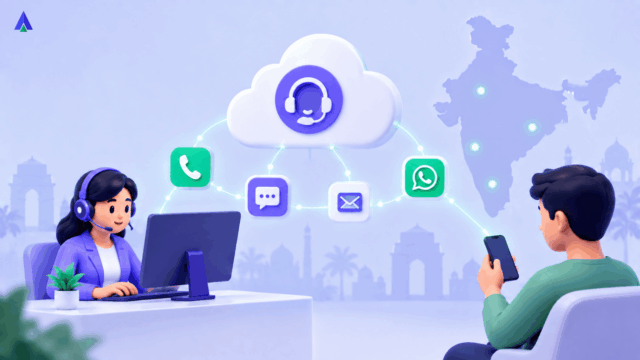
Indian support teams need cloud tools because customer expectations have shifted fast. Legacy phone systems can’t be kept. Customers now reach out over voice, WhatsApp, chat, and email on the same day. They expect one continuous conversation, not five separate ones.
A cloud setup lets a 5-person team in Bengaluru and a 15-person team in Noida share one queue. They see the same customer history and the same reporting dashboard. Scaling up for a festive-season spike is a plan change, not a hardware purchase.
Cost is the other driver. Customer support software on a subscription model means an SMB isn’t sinking capital into a PBX rack. That rack would be outgrown within two years anyway.
Cloud adoption across Indian industry backs this shift at scale. A NASSCOM and Oliver Wyman study puts a number on this. Accelerated cloud adoption could add $310 to $380 billion to India’s GDP by 2026. It could also create roughly 14 million direct and indirect jobs.
For support teams, this means cloud budget is easier to justify to finance than five years ago. The infrastructure argument has already been won at leadership level.
In our own conversations with Indian support leads, the pattern repeats. Teams that switch from a legacy PBX setup usually cite two wins. One is faster agent onboarding. The other is a single, unified view of every customer’s conversation. We don’t have a published figure attached to that pattern yet. But it comes up in nearly every onboarding call we run.
Pricing structure is often the deciding factor in that switch. Our own guide on cloud telephony pricing breaks down what drives cost up or down.
What Features Should Indian Businesses Look For?
Indian businesses should look for features that solve India-specific problems first. General CX features come second. Here’s what to check before any demo call:
- Local DID numbers and telephony coverage: Can the vendor issue numbers across your states, without a reseller in between?
- Multilingual support: Hindi, regional languages, and English, for agents and any AI customer service software layered on top.
- INR pricing: Not a dollar price converted at checkout, which moves every time the rupee does.
- Data residency: Where is customer data actually stored? Can the vendor confirm it in writing?
- Integrations with Indian tools: CRMs, payment gateways, and channels customers already use, like WhatsApp Business.
- Uptime SLA and support hours: that match Indian business hours, not a US or European time zone.
- DoT registration: Any vendor running voice or contact center services in India needs an OSP or VNO registration from the Department of Telecommunications. Ask to see it.
A platform that scores well on a global review site can still fail on every point above. That mismatch is the top reason Indian buyers switch vendors within the first year.
Is Cloud Software Secure for DPDPA Compliance?
Cloud customer service software can meet DPDPA requirements. But the Act does not require you to store all data inside India.
DPDPA: India’s Digital Personal Data Protection Act, 2023 is the country’s primary law on how personal data is collected, stored, and processed.
The DPDPA is administered by the Ministry of Electronics and Information Technology. It takes a “blacklist” approach under Section 16. Personal data can be transferred outside India by default.
The central government can restrict transfers, but only to specific countries it names by notification. As of the latest DPDP Rules update, no country had been restricted this way.
That said, sector-specific rules can be stricter than DPDPA, and they still apply. The RBI’s 2018 directive on payment system data is one example. It requires payment system providers to store that specific data only in India. This sits separately from DPDPA’s more flexible general framework. If your support software touches payment data or card details, this RBI rule can override DPDPA’s stance.
For a support platform, the practical takeaway is simple. Ask your vendor exactly which data sits where. Get it in writing. Then check if any of your workflows touch payment data under RBI’s stricter rule.
Cloud vs On-Premises Help Desks: What Changes?
The core difference is who owns the infrastructure risk. That’s true whether you call it a help desk or customer support software.
With on-premises, your team owns the servers, the PBX, and every patch cycle. Scaling means buying hardware, months ahead of need. A single server failure can take your entire support line down.
With cloud customer service software, the vendor owns that risk. Add or remove seats in a dashboard. Updates roll out without your involvement. Your team can log in from home during a power cut, since the platform doesn’t live in your building.
The trade-off is control. Some regulated teams still prefer on-premises, where they want full physical control over hardware. For most Indian SMB and mid-market teams, the trade-off has tipped toward cloud. It removes upfront capital spend and lets a small team punch above its headcount.
What Does AI Add to a Support Stack?
AI customer service software adds speed and coverage a fixed headcount can’t match alone.
A voice bot or chatbot handles routine queries: order status, password resets, basic troubleshooting. It does this without making the customer wait for a free agent. That frees human agents for calls that need judgement: complaints, negotiations, anything emotionally charged.
Industry forecasting backs the scale of this shift. Gartner projects that conversational AI will cut contact center labour costs by $80 billion by 2026. Automation is expected to handle a growing share of routine interactions. For a lean support team, that’s not a future trend. It’s already showing up in vendor roadmaps today.
The catch: AI customer service software works best on a cloud platform. It needs your customer data, call history, and ticket context in one place. Bolting a bot onto a fragmented, on-premises setup rarely delivers the same result.
General-purpose AI models are a different tool for a different job. See our comparison of ChatGPT vs Claude for customer support if you’re weighing those against a purpose-built voice AI layer.
Acefone’s own AceX Agent Studio is built this way, sitting on top of the same contact center data your agents use.
Comparison Table: Key Evaluation Criteria
| Criterion | What to check |
| Pricing | Quoted in INR, no hidden per-minute or per-DID charges |
| DID/telephony support | Coverage across your operating states, local number porting |
| Multilingual support | Hindi and regional languages, for agents and AI bots |
| Integrations | CRM, WhatsApp Business, payment gateways you already use |
| Uptime SLA | Written guarantee, matched to Indian business hours |
| Compliance | DPDPA-aligned data handling, DoT OSP registration on file |
How to Choose the Right Software for Your Team
Choosing the right customer support software means matching it to your team’s real constraints. A generic feature list won’t do that.
- List your must-have channels (voice, WhatsApp, chat, email) before you look at any vendor.
- Confirm DID and telephony coverage for every state you operate in.
- Ask for data residency details in writing, not a verbal sales-call promise.
- Get an INR quote with every line item spelled out, including any bot add-ons.
- Run a 2-week pilot with your real ticket volume, not a vendor’s demo data.
- Check integration with your CRM and payment tools before you sign.
Skipping the pilot is the most common mistake we see. A platform that looks clean in a demo can behave differently under real ticket volume.
Why Acefone Fits Indian Support Teams
We built Acefone’s cloud customer service software around the checklist above. We ran into the same gaps our customers did when evaluating global platforms.
The AceX Agent Studio is built to handle routine voice queries in multiple languages. Human agents pick up only the calls that need a person. It sits on top of the same customer data your agents already see, not as a bolted-on extra.
Data residency and support hours are matched to Indian operating realities from day one. That’s what a cloud based customer service platform built for India should look like, not one adapted after the fact.
FAQs
Cloud customer service software is a support platform hosted by a vendor and accessed over the internet. It typically bundles ticketing, live chat, voice tools, and reporting, without on-site servers.
No. DPDPA takes a blacklist approach: data can move outside India unless the government names a restricted country. Sector rules, like RBI’s payment data mandate, can still require local storage separately.
Pricing usually runs per-agent, per-month, in INR, with add-ons for AI bots or extra DID numbers billed separately. Always ask for an itemised quote rather than a single bundled figure.
It can be, if the vendor confirms data residency in writing and holds a valid DoT OSP registration. Security depends on the specific vendor’s setup, not the cloud model itself.
It typically automates routine, repeatable queries: order status, password resets, and basic troubleshooting. Complex or emotionally sensitive queries still route to human agents.
Not automatically. Businesses in highly regulated sectors with strict on-premises mandates, or with very low-ticket volumes, may see limited benefit. Most Indian SMB and mid-market teams do.
Glossary
- DPDPA — India’s Digital Personal Data Protection Act, 2023, governing personal data processing.
- DID — Direct Inward Dialing, a local phone number that routes calls into your business system.
- OSP — Other Service Provider, a DoT licence category covering call centres and BPO services.
- SLA — Service Level Agreement, a written commitment on uptime or response times.