


 5 mins read


TL;DR
- A power dialer automates sequential outbound dialing per agent.
- It raises call output from 15 to 20 calls per hour to up to 100 to 120, without increasing headcount.
- Power dialers suit quality-focused outbound teams of 3 to 25 agents.
- Predictive dialers suit high-volume BPOs with 8 or more agents.
- Power dialer pricing in India runs on per-seat, per-minute, or bundled models.
- Acefone’s base licensing often covers dialers, CRM sync, call recording, compliance tools, and onboarding.
- A 10-agent team moving from manual to power dialling can add over 3-4x daily connections.
Most sales managers looking at power dialer pricing compare the wrong number first. They look at the per-seat sticker price, pick the cheapest option, and then spend the next quarter piecing together add-ons that should have been included. Call recording is extra. CRM sync is a higher tier. TRAI compliance is not mentioned at all.
This guide is for sales floors that want the full picture before they commit. We break down how power dialer pricing actually works.
What Is a Power Dialer?
A power dialer is outbound calling software that dials the next contact automatically when an agent finishes a call. The agent is always connected to answered calls only. Dead time between dials drops to seconds.
For agents, this removes manual number entry entirely. Screen pops show the contact record before the line connects. Misdials and manual redial delays disappear from the workflow.
Manual dialing typically yields 15 to 20 calls per agent per hour. A power dialer raises that to up to 100 to 120 calls per hour. This range is widely cited across outbound sales tooling and is not specific to any single vendor.
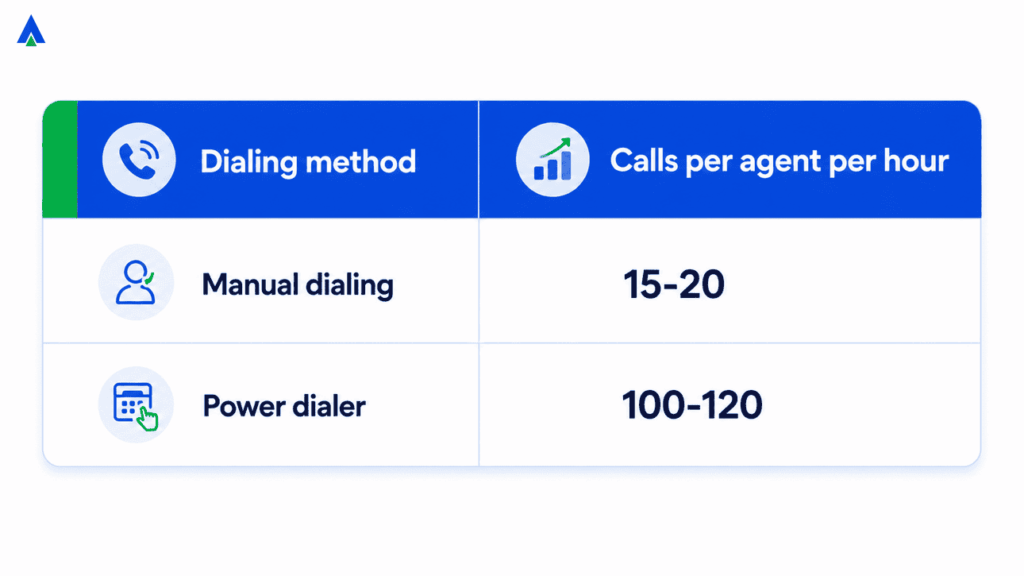
That is a 3 to 4 times increase in outbound activity with the same headcount.
This is why the power dialer suits quality-focused outbound. There are no abandoned calls, which matters for TRAI compliance.
What Is the Difference Between a Power Dialer and Predictive Dialer for Pricing?
Before comparing prices, understand which tool fits your team. The two are priced differently and serve different operation types.
A power dialer dials one line per agent. It is best suited to teams of 3 to 8 agents or campaigns where lead quality and conversation quality matter more than raw volume. This fits B2B sales, high-value lead segments, and compliance-sensitive verticals.
A predictive dialer dials multiple lines simultaneously per agent using an algorithm. It requires 8 or more agents to run safely and targets maximum volume. Predictive dialers typically carry higher base licensing costs and stricter minimum seat requirements.
The pricing implication: a predictive dialer may look cheaper per seat in a large BPO context. For a 5 to 25 seat sales floor running B2B outbound, the power dialer delivers better ROI at lower compliance risk.
How Does Power Dialer Pricing Work?
Power dialer pricing follows three models. Understanding which model a vendor uses is the first step before comparing quotes.
Per-seat monthly subscription
The most common structure. You pay a fixed monthly fee per agent license. Tiering usually follows channel coverage: voice-only plans sit at the lower end, all-channel plans (voice, WhatsApp, SMS) cost more per seat. Seat count and contract length (monthly versus annual) also move the number, with annual commits typically pricing lower per seat. Enterprise-scale deployments move to custom, quote-based pricing.
To learn about Acefone’s seat based power dialer pricing, head over to our pricing and plans page.
Per-minute or usage-based billing
Some vendors charge per outbound minute rather than per seat. This suits low-volume campaigns, but cost climbs fast once call volume scales up, since every minute adds to the bill on top of the base fee.
Bundled platform pricing
Power dialers are often sold inside a broader cloud contact center or CRM suite. The dialer function is included, but the base plan price is higher.
What Does Power Dialer Pricing Actually Include?
This is where most sales floors get caught. The per-seat price on a vendor’s website rarely reflects the actual monthly outlay. Here is what drives the real number.
Base licensing
The per-seat subscription covers the dialler engine and basic call logs. It does not automatically include everything else on this list.
Outbound call minutes
Many plans bundle a call minute allowance. Overages are billed separately at carrier rates. Confirm the included minute allowance before signing.
CRM integration
Native CRM sync with Salesforce, HubSpot, Zoho, or LeadSquared is often a higher-tier feature. Cost ranges from a quick native sync at no extra charge to a custom one-time implementation project, depending on the CRM and the complexity of the setup.
Call recording and analytics
Call recording storage and analytics dashboards are frequently gated to mid or enterprise plans. For a QA-focused sales floor, confirm these are included before comparing headline prices.
Supervisor monitoring
Live call monitoring, whisper coaching, and barge-in features typically require a supervisor license tier above the agent seat price.
Compliance tools (DLT and TRAI DND scrubbing)
Non-compliance carries fines of Rs. 25,000 per upheld complaint under TRAI’s TCCCPR framework. DND scrubbing usually adds a small per-number cost on top of the base plan. Platforms built outside India frequently do not include this compliance layer at all.
Onboarding and support
Onboarding timelines vary by vendor and setup complexity. On Acefone’s Contact Center Studio, go-live runs 4 hours for standard setups, 4 to 6 hours for migrations, and 24 to 48 hours for complex enterprise requirements. Confirm whether premium support tiers cost extra before signing.
Buyers who evaluate only the per-seat price often underestimate their real year spend once these add-ons are priced in.
A unified contact center plan that bundles these costs into a single platform fee is usually easier to budget against than stacking point solutions
How Do You Calculate ROI on Power Dialer Pricing Before You Buy?
ROI on a power dialer is calculable before you sign. Three numbers drive the model.
Step 1:
Baseline calls per agent per hour (manual). Manual dialing produces 15 to 20 connected attempts per agent per hour. Use 17 as a conservative baseline.
Step 2:
Power dialer output. A power dialer raises this to up to 100 to 120 calls per hour per agent. Use 120 as a conservative estimate.
Step 3:
Calculate incremental connections for a 10-agent team working 6 productive hours per day.
- Manual: 10 multiplied by 17 multiplied by 6 equals 1,020 daily connections.
- Power dialler: 10 multiplied by 60 multiplied by 6 equals 3,600 daily connections.
- Incremental lift: 2,580 additional daily connections.
Step 4:
Apply your conversion rate. If your team converts 3% of connected calls to qualified meetings: 2,580 multiplied by 3% equals 77 additional meetings per day. Monthly: approximately 1,540 additional meetings.
Step 5:
Payback period. At a 3% conversion rate with standard pipeline values, payback periods in India typically run under 30 days for active sales floors.
The input variables to adjust: connect rate (answer rate on your list), conversion rate (meetings per connected call), and average deal value.
How Acefone Contact Center Studio Handles Power Dialer Pricing
Acefone’s power dialer software in Contact Center Studio includes the power dialer within a unified outbound stack. There is no separate dialer license to buy or integrate.
Contact Center Studio supports six dialing modes: ratio, preview, progressive, predictive, power, and manual/inbound. TRAI DND scrubbing is built in and runs before every campaign. DLT-compliant 140-series and 1600-series number routing is configured at the platform level. Call recording, live supervisor monitoring, and post-call analytics are included, not gated behind a higher tier.
For Indian sales floors, this removes the add-on stacking problem entirely. The headline per-seat price reflects the actual operating cost. There are no compliance surprises.
Frequently Asked Questions
Per-seat models are commonly used for power dialer pricing in India. On Acefone’s Contact Center Studio, dialer plans start from Rs. 1,599, going up to Rs. 1,999 per agent per month.
A power dialer dials one line per agent sequentially after each call ends. A predictive dialer dials multiple lines simultaneously per agent using an algorithm. Power dialers suit teams of 3 to 8 agents running quality-focused outbound. Predictive dialers require 8 or more agents and are designed for high-volume BPO operations. Pricing structures differ accordingly.
Yes, for most outbound use cases. Manual dialling produces 15 to 20 calls per agent per hour. A power dialer raises that to up to 60 to 80 calls per hour. For small teams running 3 to 10 agents, the power dialler is the appropriate starting point before scaling to predictive dialling.
Yes. Every Indian outbound operation must scrub contact lists against the TRAI DND registry. Use DLT-registered number series: 140-series for promotional calls and 1600-series for BFSI service calls. Call timing restrictions also apply. Non-compliance carries fines of Rs. 25,000 per upheld complaint under TRAI’s TCCCPR framework. Confirm that TRAI DND scrubbing is built into any dialler platform before signing.
Ask your power dialer vendors for the following before choosing to a dialer subscription:
- Per-seat price and minimum seat commitment
- Outbound minute bundle and overage rate
- CRM integration cost and supported CRMs
- Call recording and analytics tier
- TRAI DND scrubbing support
- Onboarding timeline and support SLA
Evaluate total 3-year cost of ownership, not just the monthly per-seat rate.
It depends on the plan. On Acefone’s Contact Center Studio, voice-only plans start at the Professional tier. WhatsApp and other digital channels are included on the Ultra plan or available as add-ons on Professional. Confirm channel coverage per tier before comparing quotes across vendors.
No. For large BPO operations (50 or more seats), predictive dialers can deliver lower cost-per-connection because of higher call volume per agent hour. For smaller sales floors, the power dialer’s per-seat cost is lower and the compliance risk is significantly reduced. The cost comparison depends on team size, volume, and whether abandoned call penalties are factored into the predictive dialler’s true cost.
For an active sales floor, payback periods are typically under 30 days. The ROI is driven by additional connected calls per agent hour. A 10-agent team moving from manual to power dialling can generate over 2,500 additional daily connections. At standard conversion rates, the monthly licence cost is recovered well within the first billing cycle.