


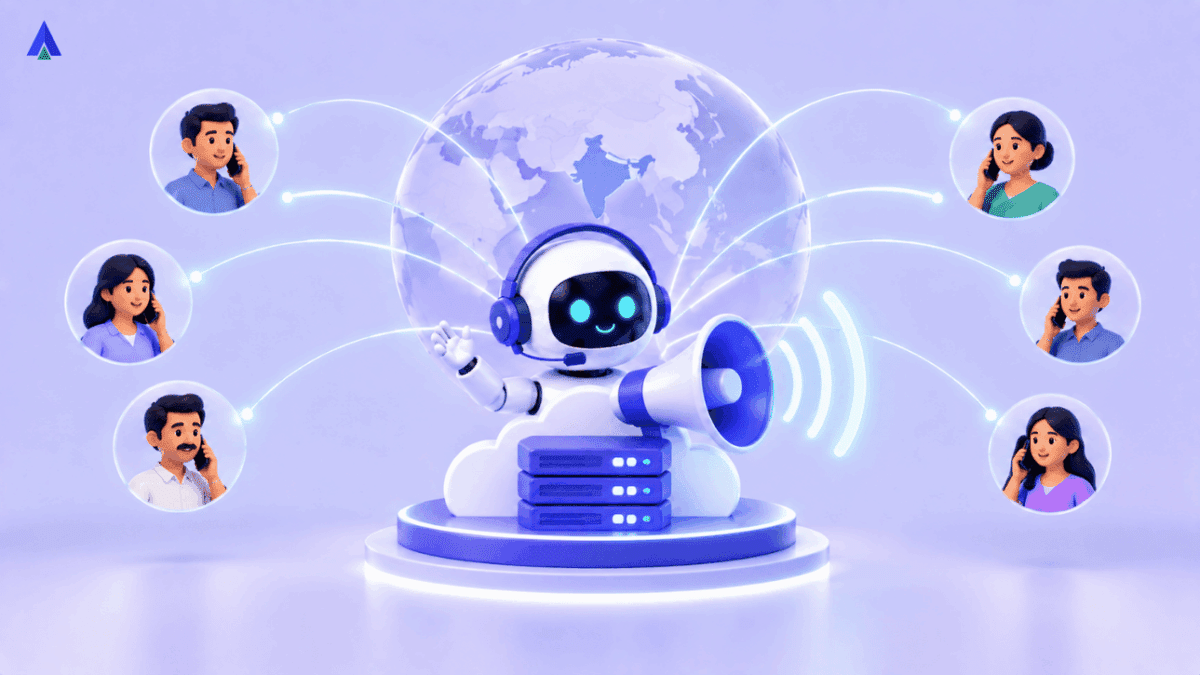


Most teams think scaling outbound means dialling faster. It doesn’t.
We’ve watched collections and alert teams hit a wall past a few lakh calls a day. Manual dialling breaks down. Basic IVR blasts annoy customers and get flagged as spam.
We run Campaigns and AceX Voice Agent at Acefone. Together, this stack handles 200 million calls a day, based on our own platform of telemetry. In this post, we walk through what voice broadcast infrastructure actually needs. We cover where AI voice agents fit, and how to judge a platform before you commit. This is what real AI outbound calling looks like at enterprise volume.
What Is Voice Broadcast and How Does It Work?
Voice broadcast sends a pre-recorded or AI-generated audio message to a large list of numbers at once.
A campaign manager uploads a contact list. They record or generate a message, then set a schedule. The system dials each number, plays the message, and logs the outcome. Outcomes include answered, busy, voicemail, or failed. No agent touches most calls.
IVR (Interactive Voice Response): an automated phone system that plays menus and collects input via keypad or voice.
Use cases span payment reminders, service alerts, appointment confirmations, and promotions. The core job is simple: reach many people with one message, fast.
See how this works on our Campaigns and Voice Broadcast platform.
How Does Voice Broadcast Scale to Millions Daily?
Scale comes from parallel call handling, not a longer dialling list.
A platform built for volume runs thousands of call legs at once. It doesn’t queue calls one after another. It fires them in parallel, tracks each leg’s state, and retries failures on its own schedule.
This matters more each year. Gartner forecasts that conversational AI will cut contact center labour costs. The forecast is $80 billion in savings by 2026. One in ten agent interactions will be automated by then. That’s up from an estimated 1.6% in 2022, per the same report.
Automated voice campaigns only hit this scale if the infrastructure underneath can absorb it. It needs to do this without dropping calls or breaching carrier rate limits.
What Role Does an Outbound Voicebot Play in Voice Broadcasting?
An outbound voice bot turns a one-way broadcast into a two-way conversation.
Instead of playing a flat message and hanging up, a voice bot listens. It understands intent and responds in real time. A customer can confirm a payment date or ask a question. They can also opt out, all without an agent.
This is where personalization happens at scale. The bot pulls account data mid-call and adjusts its script. It can detect a “stop calling me” request, too. That request routes straight to a compliance queue.
For teams already using AI to cut inbound load, this is familiar with ground. It’s the outbound mirror of that same shift. See AceX Agent Studio to learn how the bot layer works.
Voice Broadcast vs Traditional IVR Blasts : Whats the difference?
The difference is intelligence, not volume.

A basic IVR blast plays the same message to everyone. It can’t tell if a customer just asked to stop calling. A voicebroadcast paired with an AI bot listens and adapts. It logs to consent in real time too. That gap is exactly why compliance risk rises with basic IVR at scale.
How Does Acefone Handle 200 Million Calls a Day?
We built Campaigns and AceX Voice Agent to run as one system, not two bolted-together tools.
Campaigns manages the broadcast layer. This includes list segmentation, scheduling, retry logic, and carrier-grade call routing. AceX Voice Agent sits on top, handling the conversation layer. It manages intent detection, dynamic responses, and live compliance checks.
For a collections team, this looks like a payment reminder that adapts live. For an alerts team, it’s a service outage notice. It logs every “already resolved” reply without needing an agent.
At 200 million calls a day, small inefficiencies compound fast. A 1% failure rate means two million dropped calls. Our own load tests simulate this exact volume before any release ships. We monitor every call leg in real time, and any spike gets treated as an incident, not explained later.
What Compliance Challenges Come With High-Volume Voice Broadcasting?
More calls means more regulatory exposure, and rules keep tightening.
TCPA (Telephone Consumer Protection Act) — the 1991 US law governing robocalls, telemarketing, and automated voice messages.
In February 2024, the FCC ruled that AI-generated voices count as “artificial” under the TCPA. Callers using AI-generated or cloned voices need the recipient’s prior express consent now. That’s the same standard already applied to prerecorded messages.
TCCCPR (Telecom Commercial Communications Customer Preference Regulations) — TRAI’s 2018 framework governing commercial calls and SMS in India.
India runs its own parallel framework. TRAI’s TCCCPR requires telemarketers to register on a DLT platform and honour the National Do Not Call registry. Promotional voice calls are restricted to 9 AM–9 PM IST. On top of this, the Digital Personal Data Protection Act, 2023 adds its own consent layer.
It covers any personal data used in a call. The DPDP Rules were notified in November 2025, with phased implementation over 18 months. The consent principle already applies, even before every provision is fully enforced.
At high volume, none of this is a legal footnote. It’s an operational requirement. A compliant platform needs built-in consent tracking and do-not-call list scrubbing. Call-time restrictions should sit inside the routing logic, not get bolted after a complaint.
How Should You Choose a Voice Broadcasting Solution?
Judge a platform on architecture and compliance, not sticker price per call.
A Forrester Consulting study, commissioned by PolyAI, found enterprises using voice AI saw a 391% three-year ROI. The same composite organization saved $10.3 million in agent labour costs over three years. It also cut call abandonment by 50%, with payback in under six months.
Before you sign, check for:
- Proven call volume at your scale, not just a marketing claim
- Native AI bot integration, not a third-party bolt-on
- Built-in TCCCPR/TCPA-style consent and do-not-call handling
- Real-time reporting on call outcomes and intent
- Transparent per-minute or per-call pricing you can model against ROI
- For India deployments, valid DoT OSP or VNO registration on the vendor’s side
If you’re also comparing dialer costs, our predictive dialer pricing breakdown is a useful reference point.
Conclusion: What Matters When Scaling Outbound Calling?
Scaling outbound calling isn’t about dialling faster. It’s about infrastructure.
Three things matter most. First, voice broadcast needs parallel call architecture to hit real volume. Second, AI voice bots add personalization and compliance handling that basic IVR can’t. Third, regulatory scrutiny on AI-generated voice calls keeps rising, in the US and in India.
Our Campaigns and AceX Voice Agent stack proves this architecture works at 200 million calls a day. That scale isn’t a lab number. It’s live traffic, running today.
Voice Broadcasting FAQs
Voice broadcasting sends automated calls for payment reminders, service alerts, appointment confirmations, and promotions. It reaches large contact lists at once, without agents dialling each number manually.
Yes, with consent. In the US, the TCPA requires prior express consent for artificial or prerecorded voice calls, AI-generated voices included. In India, TCCCPR and the DPDP Act set their own consent and registration rules.
It depends on the platform’s architecture. Acefone’s Campaigns and AceX Voice Bot stack runs at 200 million calls a day. It uses parallel call handling across distributed telephony infrastructure.
“Robocalling” often refers to unsolicited spam calls. Voice broadcasting is the underlying technology used legitimately by businesses with proper consent, opt-out handling, and compliance controls in place.
It can be, if the platform supports DLT registration, NDNC/DND scrubbing, and calling-hour limits. Ask any India-facing vendor how they handle TCCCPR requirements before you sign a contract.
Modern voice bots use natural-sounding speech synthesis and handle real conversation, not fixed scripts. Quality varies by vendor, so listen to a live demo before deciding.
Pricing is usually per-minute or per-call, with volume discounts at scale. Costs vary by region, call duration, and whether an AI voice bot layer is included. Ask vendors for a model based on your actual volume.
No. Low-volume businesses with under a few hundred calls a month rarely need to broadcast infrastructure. It pays off once volume, compliance risk, and personalization need to outgrow manual dialling or basic IVR.
Voice Broadcasting Glossary
- IVR (Interactive Voice Response): Automated phone system playing menus, collecting keypad or voice input.
- TCPA (Telephone Consumer Protection Act): 1991 US law regulating robocalls, telemarketing, and automated voice messages.
- TCCCPR (Telecom Commercial Communications Customer Preference Regulations): TRAI’s 2018 India framework for commercial calls and SMS.
- DPDPA (Digital Personal Data Protection Act, 2023): India’s consent-based personal data protection law.
- ROI (Return on Investment): Financial return measured against the cost of an investment.
- FCC (Federal Communications Commission): US regulator overseeing telecom and call compliance.


