


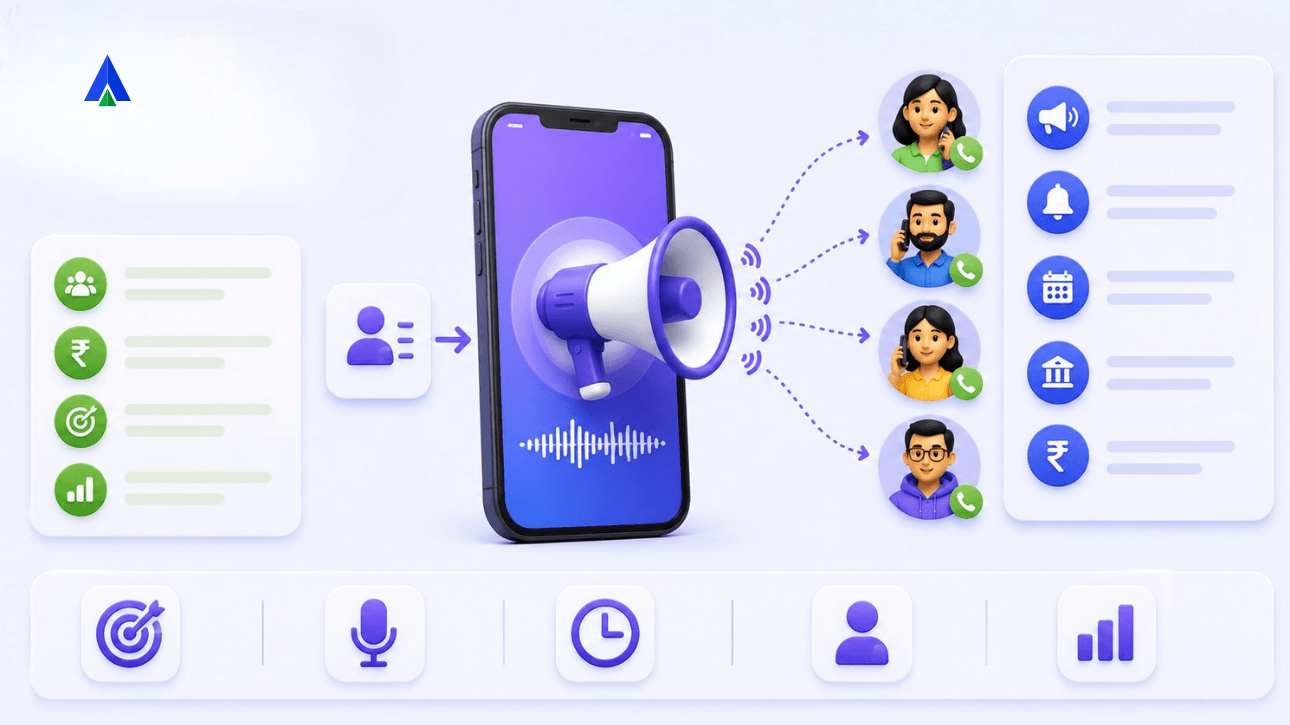


When a marketing team needs to reach thousands of customers in a short span, voice broadcasting offers a fast, scalable way to deliver recorded voice messages through phone calls. A voice broadcasting solution helps businesses send bulk voice calls for promotions, lead generation, surveys, reminders, payment alerts, customer updates, and community announcements without investing in hardware-heavy calling infrastructure.
Unlike one-to-one manual calling, voice broadcasting software automates outbound communication. It lets teams upload a contact list, record or generate a message, schedule the campaign, filter restricted contacts, and track responses from a web-based dashboard.
What Is Voice Broadcasting?
Voice broadcasting is a mass communication technique that broadcasts pre-recorded or text-to-speech voice messages to hundreds or thousands of call recipients at once. Businesses use it to automate customer outreach, promote offers, send reminders, conduct surveys, collect responses, and connect interested callers to agents through IVR inputs.
In simple terms, a voice broadcast is an automated outbound call campaign. The recipient answers the phone, listens to the message, and can either take action, press a key, request a callback, or simply receive the information.
Why Voice Broadcasting Matters for Modern Business Communication
Customers receive messages across many channels: SMS, email, WhatsApp, mobile apps, social media, and phone calls. But when a message is urgent, time-sensitive, or needs a human tone, voice broadcasting can cut through the clutter. A spoken message often feels more direct than text and can be understood by audiences who may not read long messages or check email frequently.
Voice broadcasting is useful for both commercial and community communication. Businesses use it for marketing campaigns, payment reminders, appointment confirmations, lead generation, product updates, renewal alerts, and customer feedback. Non-profit organizations, educational institutions, healthcare providers, political groups, and local communities use it to share alerts, event updates, awareness messages, and donor communication.
How Does a Voice Broadcasting Campaign Work?
A voice broadcasting campaign usually follows a simple workflow:
- Upload or import a contact list into the voice broadcasting platform.
- Create the campaign message by recording audio, uploading a voice file, or using text-to-speech.
- Personalize the message with dynamic fields such as customer name, amount, date, location, or appointment time.
- Apply campaign rules, including DND/DNC filtering, retry logic, calling hours, and target segments.
- Launch or schedule the campaign and monitor answer rates, keypress responses, call duration, and conversions.
Advanced voice broadcasting services also support press-1 campaigns, IVR menus, live agent transfer, CRM integrations, multilingual messages, and real-time reporting. This makes them useful not only for one-way alerts but also for interactive campaigns that collect intent and qualify leads.
Voice Broadcasting vs SMS, Email, and Manual Calling
| Channel | Best For | Limitation | Where Voice Broadcasting Helps |
| SMS | Short alerts, OTPs, links, quick reminders | Can feel impersonal and may be ignored in crowded inboxes | Adds a human voice and can explain the message clearly |
| Detailed updates, documents, newsletters | Lower urgency and depends on inbox visibility | Reaches customers immediately through a phone call | |
| Manual calling | High-value conversations and complex selling | Slow and agent-heavy for large lists | Automates first-touch outreach and transfers only interested callers |
| Voice broadcasting | Bulk voice campaigns, reminders, surveys, announcements | Must be used responsibly with compliance controls | Combines scale, personalization, scheduling, and response tracking |
10 Benefits of Voice Broadcasting for Businesses
1. Voice Messages are more effective than Text Messages
While many organizations use SMS because it is quick, voice messages can create a stronger sense of attention and urgency. A spoken message carries tone, emotion, and clarity that a short text message may not deliver. This is especially useful for campaigns where trust, reminders, or instructions matter.
For example, a healthcare clinic can send appointment reminders in a friendly voice. A school can announce a schedule change clearly. A business can explain an offer in a way that feels more human than a plain promotional SMS.
For BPO call center teams seeking faster outreach and better response rates, explore how Acefone’s voice broadcasting solution delivers impact at scale.
2. Maximize Your Audience Reach
Voice broadcasting enables an organization to send voice messages to thousands of call recipients at once. Instead of assigning agents to dial every number manually, the system can run the campaign in bulk and connect with a large audience quickly.
The retry option further improves outreach by calling recipients again if they did not answer the broadcast in the first attempt. This helps businesses improve contact rates without adding more agents.
3. Create and Personalize Campaign Messages
Campaign managers can create voice messages and personalize them in several ways. They can use predefined message scripts, upload a voice recording, or type a personalized message with variables such as customer name, policy number, order ID, appointment time, due amount, or city.
With text-to-speech, teams can generate dynamic voice samples without recording every variation manually. This makes the message feel relevant while keeping campaign creation fast.
4. Keep Campaign Messages Consistent
Earlier, call center agents used to manually call and talk to customers to communicate an important message or offer. But the challenge was to maintain the consistency of the information being communicated. Often, messages were altered during the communication which affected the consistency of the message.
On the contrary, voice broadcasting allows a business to send the same voice message to thousands of customers with zero chances of consistency failure. Hence, it helps marketers to maintain uniformity and consistency of the campaign message.
5. Collect Response and Conduct Surveys
Interactive voice broadcasting allows recipients to respond after listening to the message. Customers can press numeric keys on their phone keypad to confirm interest, answer a survey, request a callback, or opt out.
For customer feedback campaigns, this is highly useful. Businesses can ask a simple question, collect responses through IVR, and view campaign data in real time. To create more structured journeys, teams can connect broadcast campaigns with an IVR system for menus, routing, and self-service options.
6. Support DND and DNC Compliance
Many customers register preferences to avoid unwanted commercial communication. While running voice or telemarketing campaigns, businesses must ensure that restricted contacts are handled correctly and that campaign rules align with applicable regulations.
In India, TRAI’s TCCCPR 2018 framework protects customers from unsolicited commercial communication and provides a structure for sending commercial communication based on preference and consent. A good voice broadcasting service should support DND/DNC filtering, opt-out handling, approved templates where required, and responsible calling practices.
7. Option to Schedule Voice Campaigns
Timing plays a major role in campaign performance. Voice broadcasting software allows businesses to schedule campaigns based on time, day, region, audience segment, and campaign priority.
For example, a retail business may schedule sale reminders during evening hours, while a financial services company may schedule renewal alerts during business hours. Scheduled campaigns help teams reach customers when they are more likely to answer.
8. Run Multiple Voice Campaigns Simultaneously
Cloud-hosted voice broadcasting platforms can run multiple campaigns at the same time. A business can run one campaign for payment reminders, another for customer feedback, and another for promotional announcements without setting up separate infrastructure.
Managers can monitor every campaign from a dashboard, compare results, and share reports with stakeholders. When voice broadcasting connects with cloud contact center software, interested callers can be routed to agents for follow-up conversations.
9. Curtail Marketing Campaign Cost
Outbound campaigns often require additional agents, longer working hours, and manual follow-ups. Voice broadcasting reduces this dependency by automating the first layer of communication. The same promotional or informational message can reach thousands of customers without requiring one agent per call.
This does not remove the need for agents. Instead, it helps agents focus on customers who show interest, press a key, request a callback, or need human support. For high-volume teams, combining broadcasts with auto dialer software can improve outbound productivity across different campaign types.
10. Track Campaign Performance with Real-Time Reports
Voice broadcasting gives managers visibility into campaign performance. They can monitor total calls, answered calls, failed attempts, call duration, keypress responses, opt-outs, retry status, and lead interest.
These insights help teams improve future campaigns. If a message has low response, managers can change the script. If a time slot performs better, they can adjust scheduling. If many customers press a key for support, the campaign can be connected to live agents through Voice API integrations.
Top Voice Broadcasting Use Cases
| Use Case | How Voice Broadcasting Helps | Example Message |
| Marketing promotions | Announces offers to large customer lists quickly | “Our festive sale starts today. Press 1 to know more.” |
| Lead generation | Identifies interested prospects through keypress responses | “Press 1 to speak with our advisor.” |
| Payment reminders | Sends due-date alerts at scale | “Your payment is due tomorrow. Press 1 for assistance.” |
| Customer surveys | Collects feedback through DTMF inputs | “Rate your experience from 1 to 5.” |
| Appointment reminders | Reduces no-shows with timely phone reminders | “Your appointment is scheduled for 11 AM tomorrow.” |
| Emergency alerts | Delivers urgent information quickly | “The office will remain closed today due to heavy rain.” |
| Community updates | Helps non-profits, schools, and local groups share information | “Join our event this Saturday at 5 PM.” |
Key Features to Look for in Voice Broadcasting Software
The benefits of voice broadcasting depend heavily on the platform you choose. Before selecting a provider, check whether the solution includes:
- Bulk contact upload with easy segmentation
- Text-to-speech and uploaded audio support
- Dynamic personalization fields
- DND/DNC filtering and opt-out management
- Campaign scheduling by time, day, and location
- Retry logic for unanswered calls
- Interactive IVR and press-key response capture
- Live agent transfer for high-intent leads
- Real-time campaign dashboard and downloadable reports
- CRM, helpdesk, and API integrations
- Call recording, role-based access, and secure data handling
- Multilingual support for regional campaigns
Best Practices to Improve Voice Broadcasting Campaign Results
1. Keep the Message Short and Actionable
A voice broadcast should be clear from the first few seconds. Avoid long introductions. State who is calling, why the recipient is receiving the call, and what action they can take next.
2. Segment Your Audience
Do not send the same message to every contact if the audience has different needs. Segment by customer type, location, purchase history, language, renewal stage, or campaign intent. Better segmentation usually leads to better response rates.
3. Use a Clear Call-to-Action
Tell the listener exactly what to do: press 1, wait for an agent, visit a page, confirm an appointment, or listen to the full message. A campaign without a clear CTA is harder to measure.
4. Test Before You Launch
Run a test campaign with a small internal list. Check audio quality, pronunciation, timing, IVR keypresses, live transfer, and reporting before sending the message to thousands of customers.
5. Respect Customer Preferences
Use consent-based lists, follow applicable calling windows, keep opt-out options easy, and avoid repeated calls that may annoy customers. Compliance and customer experience should be part of campaign planning from the start.
Common Voice Broadcasting Mistakes to Avoid
- Sending campaigns without checking DND/DNC preferences
- Using long scripts that lose listener attention
- Running campaigns without audience segmentation
- Ignoring multilingual needs for regional audiences
- Not testing IVR keypresses or live transfer before launch
- Measuring only call volume instead of response quality
- Not training agents for follow-up when customers press a key
- Choosing a provider without reliable reporting or integration options
How to Choose the Right Voice Broadcasting Service Provider
The right provider should do more than send bulk calls. It should help your team run campaigns responsibly, track outcomes clearly, and connect interested customers to the next step. Before finalizing a voice broadcasting service, ask these questions:
- Can the platform handle your expected call volume?
- Does it support DND/DNC filtering and opt-out workflows?
- Can you personalize messages with customer-specific fields?
- Can campaigns be scheduled by region, time, and audience segment?
- Does the platform support IVR, press-key inputs, and live transfer?
- Are reports available in real time?
- Can it integrate with your CRM, helpdesk, or internal system?
- Is the platform cloud-based and easy for managers to use?
- Does the provider offer support during setup and campaign execution?
A strong provider helps businesses move from basic broadcast announcements to measurable, compliant, and conversion-focused communication campaigns.
Conclusion: Why Voice Broadcasting Still Matters
Voice broadcasting is one of the most effective mass communication techniques for businesses that need speed, scale, and message consistency. It helps organizations reach a large audience, personalize messages, collect responses, schedule campaigns, reduce manual calling effort, and improve campaign tracking.
For for-profit businesses, it supports promotions, lead generation, surveys, payment reminders, and customer engagement. For non-profit and community organizations, it helps deliver important updates quickly to members, subscribers, donors, and citizens.
However, every voice broadcasting solution is not the same. The best results come from choosing a provider that combines automation, personalization, compliance controls, real-time analytics, integrations, and reliable support.
Frequently Asked Questions About Voice Broadcasting
Voice broadcasting is a mass communication method that sends pre-recorded or text-to-speech voice messages to many recipients at once. It is commonly used for promotions, reminders, surveys, alerts, and customer communication.
A business uploads contacts, creates or records a voice message, schedules the campaign, applies compliance filters, and launches the broadcast. The system places outbound calls and tracks answers, failures, duration, and keypress responses.
Yes. Businesses can use press-1 campaigns to identify interested prospects. Recipients who press a key can be routed to an agent, added to a callback list, or marked as qualified leads.
Yes. Interactive voice broadcasting can collect responses through keypad inputs. Customers can rate service, confirm details, answer survey questions, or request a callback.
It depends on the campaign. SMS is useful for short written updates, while voice broadcasting is better when the message needs tone, urgency, explanation, or spoken instructions. Many businesses use both together.
Yes. Modern voice broadcasting software can use text-to-speech and dynamic fields to personalize messages with names, dates, amounts, locations, and other customer-specific details.
A reliable voice broadcasting service should support DND/DNC filtering and opt-out handling. Businesses must also follow applicable telemarketing and commercial communication regulations.
Industries such as BFSI, healthcare, education, retail, real estate, travel, BPO, insurance, logistics, and non-profit organizations use voice broadcasting for campaigns, reminders, surveys, and alerts.
No. Cloud-based voice broadcasting solutions allow teams to create, schedule, and monitor campaigns from a web portal without investing in dedicated hardware-based calling infrastructure.
Useful reports include total calls, answered calls, failed calls, retry status, call duration, keypress responses, opt-outs, campaign status, agent transfer data, and downloadable performance summaries.


