


 7 mins read


TL;DR
- MyOperator pricing starts at Rs. 5,000 per month with dialers only unlocking on SUV plans.
- Exotel’s contact center pricing starts at $70 per month for XPrime and $100 for XPro.
- Acefone’s Contact Center Studio starts at Rs. 1,599 per user per month, with dialer capability included from the entry tier.
- MyOperator Acefone wins for structured outbound operations and native AI voice automation.
- Exotel wins for developer teams building custom CPaaS integrations.
- MyOperator leads on IVR ease of use but carries a documented support gap.
- Exotel leads on API quality and developer access.
- Acefone leads on transparent pricing and India compliance.
Most teams researching Acefone vs MyOperator vs Exotel shortlist these platforms by name recognition alone. They compare headline numbers, pick the cheaper plan, and then discover the dialer they needed was an add-on.
Or the AI bot they were promised turns out to be a separate enterprise line. None of that is hard to avoid. It just takes asking the right questions before you sign.
Once you know which questions to ask, making the right choice becomes clearer.
Acefone vs MyOperator vs Exotel: Contact Center Comparison
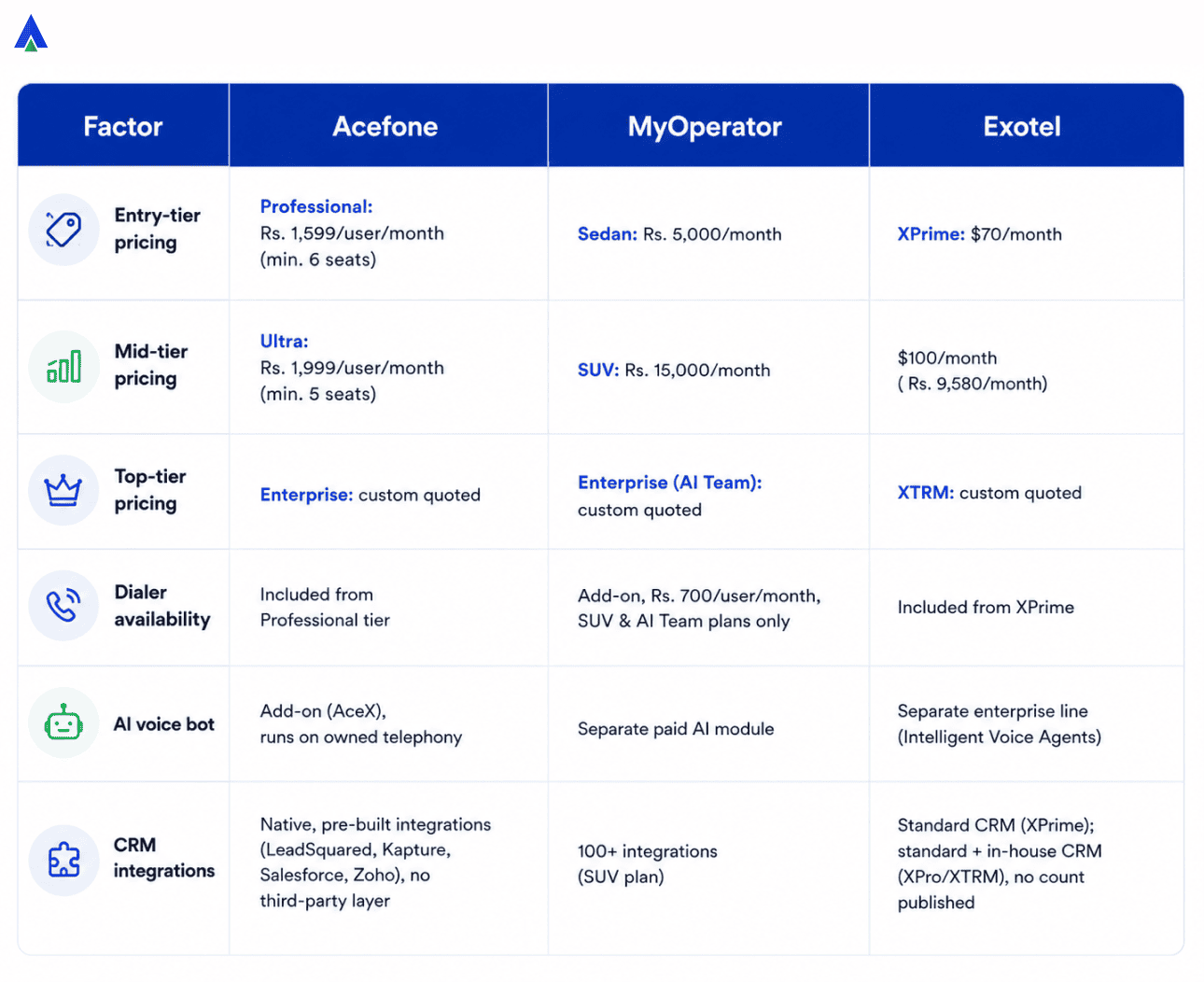
Here is how the three platforms stack up on contact center pricing and capability, side by side.
MyOperator Pricing in 2026: What Does the Plan Actually Include?
MyOperator runs three tiers. Sedan starts at Rs. 5,000 per month. SUV runs Rs. 15,000 per month. Enterprise is custom quoted. All plans are billed annually upfront, and there is no month-to-month option across any tier.
Cloud telephony platform – a SaaS solution that routes, records, and manages business calls over the internet without on-premises hardware.
The sticker price gets misleading at two points, and both catch outbound-heavy teams off guard.
First, the MyOperator dialer only comes with SUV and above. If you are on Sedan and need outbound dialer capability, you have to move up to the Rs. 15,000 SUV tier first.
Second, the auto-dialer itself is a separate add-on on top of that. It costs Rs. 700 per user per month. For a 10-agent team on SUV, that adds another Rs. 7,000 per month before you have made a single outbound call.
To be fair, Sedan does a lot for the price. It includes WhatsApp chat, unlimited calling, IVR, sticky agents, and call recording, all through a no-code call flow builder. Multi-level IVR and CRM integrations only open up from SUV. For a small team that just needs inbound routing and WhatsApp campaigns, Sedan is genuinely competitive.
Where it stops being competitive is once you start stacking add-ons. A 10-agent setup on SUV, with the dialer add-on and Truecaller Business layered in, runs close to Rs. 52,000 per month before GST. That is more than three times the Rs. 15,000 headline price.
This is usually where the Acefone vs MyOperator comparison turns. Acefone builds the dialer into its entry tier, so outbound teams are not paying an extra per-user fee just to switch it on
Exotel Pricing in 2026: What Does Enterprise Contact Center Cost?
Exotel’s contact center product is the Enterprise Contact Center line, sold as three tiers: XPrime, XPro, and XTRM.
XPrime starts at $70 per month. It comes with dialers, call routing, voice blaster, standard CRM integration, quality management, and a universal agent desktop.
XPro starts at $100 per month. It builds on XPrime with smart universal routing, in-house CRM integration, automated quality management, virtual agents, WFM integration, and agent assist.
XTRM is custom quoted. It is built for AI-first, omnichannel operations that need granular control and heavier security, adding social media DM, email, video, and agent copilot on top of XPro.
Two things are worth flagging before you model costs here. Exotel publishes these prices in USD, unlike MyOperator and Acefone, which quote in INR. And whether $70 or $100 is a flat rate or a per-agent charge is not stated anywhere on the pricing page, so that needs direct confirmation from Exotel’s sales team.
Where Exotel does earn its reputation is developer access. Customers consistently praise the API documentation, and teams that need custom IVR flows or programmable call routing get a mature CPaaS layer here. Exotel also holds ISO 27001 and PCI-DSS certifications, which matters for regulated industries.
Enterprise deployments get slab-based pricing that scales with license count, and Exotel supports private cloud, public cloud, hybrid, customer cloud, or on-premise deployment.
Acefone Pricing in 2026: Where Does it Fit?
Acefone’s Contact Center Studio starts at Rs. 1,599 per user per month on the Professional tier, with a minimum of six seats. The Ultra tier runs Rs. 1,999 per user per month with a five-seat minimum, and Enterprise is custom quoted for high-volume deployments. There is no separate setup fee on either published tier.
The structural differentiator, in an Acefone vs Exotel or Acefone vs MyOperator conversation, is the AceX Voice Bot layer. All three vendors price their voice bot as a separate add-on, so this comparison sits on capability, not cost.
MyOperator’s voicebot is a separately priced AI module. Exotel’s Intelligent Voice Agents is its own enterprise line. Acefone’s AceX is also an add-on, but it runs on owned telephony infrastructure. AceLLM, AceSTT, and AceTTS all run natively on Acefone’s DoT VNO-licensed network, so there is no third-party telephony dependency sitting between the call and the AI layer.
That matters for two practical reasons. Call recordings, transcripts, and conversation data stay within Indian servers, which supports DPDPA 2023, RBI data localisation, and IRDAI call recording requirements. It also means bot-to-agent warm transfer can pass full conversation context to the live agent before pickup, so the customer never repeats themselves.
On language, AceX itself supports Hinglish. If you need broader regional language coverage, that lives in a different Acefone product: Xtract, which supports 99+ languages for post-call analytics. Standard AceX deployments go live within 48 hours using a no-code builder, and CRM-connected workflows take 5 to 7 working days.
Contact Center Studio itself includes multiple built-in dialer modes for outbound campaigns, along with multi-level IVR, supervisor tools, and real-time dashboards. CRM integrations with LeadSquared, Kapture, Salesforce, and Zoho work out of the box.
Which Platform Wins Each Buyer Type?
The right choice really depends on what you’re managing day to day. When comparing Acefone vs MyOperator vs Exotel, three scenarios cover most mid-market buyers.
SMB needing WhatsApp plus IVR, live in under a week
MyOperator’s Sedan plan is the fastest path here. The no-code IVR builder, WhatsApp chat, and unlimited calling are all included from Rs. 5,000 per month. For a team with low outbound volume and no dialer need, this tier is hard to beat, and G2 reviewers consistently cite easy setup as MyOperator’s strongest attribute.
Mid-market ops team, structured outbound, compliance-sensitive
For a 15 to 30 agent team running dialer campaigns in BFSI, logistics, or collections, Acefone is the stronger fit. The dialer starts at Rs. 1,599 per user per month with TRAI DND scrubbing built in, and DPDPA data residency is native. CRM integrations work out of the box, with no extra setup.
MyOperator’s dialer sits behind the Rs. 15,000 SUV tier plus a Rs. 700 per user per month add-on. Exotel includes dialer capability from its XPrime plan, but whether it scales flat or per-agent for a larger team needs direct confirmation from Exotel sales.
Contact center moving toward AI-first call automation
AceX is the only voice bot here running on the same owned telephony infrastructure as the contact center beneath it. MyOperator’s voicebot is a paid AI module. Exotel’s Intelligent Voice Agents is a separate enterprise line, though its Communications API layer still gives developer teams a credible path if they have the engineering capacity for it
What Do G2 and Capterra Reviews Reveal About Each Platform?
User reviews across G2 and Capterra surface fairly consistent patterns for all three platforms.
MyOperator reviewers rate setup ease and IVR configuration positively, but the recurring complaint is post-sale support. Analysis of 500-plus G2 and Capterra reviews found support resolution averaging 3 to 5 business days for non-enterprise customers. MyOperator’s Trustpilot score sits at 1.2 out of 5 across 109 reviews, against a Capterra score of 4.2 out of 5, a gap wide enough that vendor-referred reviews may be inflating the Capterra figure.
Exotel gets approximately 4.3 out of 5 on G2 across 330-plus reviews. Reviewers cite call quality and straightforward setup as the strongest positives, with a dated UI, occasional call drops, and slow after-sales support as the recurring negatives.
Acefone’s third-party review summaries highlight transparent pricing and India-specific deployment support as differentiators. Support response quality shows up as a weak point across all three vendors, so it is worth verifying SLA terms in writing before you commit to any plan.
How Should a Mid-Market Ops Team Decide?
Picture a 25-seat BFSI collections and lead qualification team. They need predictive and progressive dialer, multi-level IVR, and TRAI DND compliance, plus RBI data localisation, a Hinglish voice bot for tier-2 cities, and CRM sync with LeadSquared.
Against MyOperator
SUV at Rs. 15,000 per month covers the base. The dialer add-on adds Rs. 700 per user per month, which for 25 users is another Rs. 17,500. Software cost reaches Rs. 32,500 per month before any AI voicebot module, and DPDPA or RBI data localisation still need direct confirmation from MyOperator’s sales team.
Against Exotel
XPrime or XPro cover dialer capability from $70 or $100 per month, but neither page confirms whether that scales flat or per-agent for 25 seats. That single gap makes it hard to model a firm monthly cost without a sales conversation, and USD pricing adds a currency-conversion step MyOperator and Acefone do not require.
Against Acefone
The dialer starts at Rs. 1,599 per user per month, which for 25 seats works out to Rs. 39,975. TRAI DND scrubbing is included, and AceX handles Hinglish natively with data staying in India throughout. Bot-to-agent transfer with full context runs on the same platform, and standard deployment takes 48 hours.
For this buyer, Acefone is the operationally complete fit. No add-on stacking or extra sales calls are needed to reach the required feature set.
That said, if you are a 3-person team that just needs a professional number with basic IVR and WhatsApp, MyOperator’s Sedan at Rs. 5,000 per month is the more sensible pick. There is no reason to pay for a dialer you will not use.
For a deeper look at how IVR compares across Indian cloud telephony providers, see our guide to the best IVR service providers in India.
What Should You Check Before Choosing a Platform?
First, check whether dialer pricing is disclosed at the seat count you actually need. MyOperator’s dialer sits behind the Rs. 15,000 SUV tier plus a Rs. 700 per user per month add-on. Exotel includes dialer capability from XPrime, but published pricing does not confirm if that holds flat or scales per agent. Acefone’s dialer starts at Rs. 1,599 per user per month, included from the entry tier, with no separate add-on required.
Second, decide how much unpublished pricing you are comfortable working around. Exotel’s contact center plans list starting prices in USD, and per-seat, INR-converted costs need a sales conversation before you can budget properly. MyOperator and Acefone both publish full per-seat INR rates upfront, which makes internal budgeting considerably easier.
Third, ask whether the AI layer runs natively or sits on top as a third-party add-on. Acefone’s AceX runs on the same owned telephony stack as its contact center, with no third-party dependency for India data residency.