


 6 mins read


Every week, a CTO somewhere stares at a decision tree that looks something like this:
Do we build our own AI voice bot?
OR
Do we buy a platform?
They are asking the wrong question.
Not because the choice doesn’t matter. It absolutely does. But the “build vs. buy AI” question flattens a genuinely complex strategy decision into a false binary one. A decision that has caused enterprises to either over-invest in redundant infrastructure or under-invest in promising platforms
The better question is: Where does your competitive advantage actually live in the stack?
Until you get comfortable answering that question, you will keep having the wrong debate, making the wrong tradeoffs, and shipping the wrong outcomes.
The Build vs Buy AI Myth
When companies say they want to “build” AI voice bots, they rarely mean building from the ground up. What they mean is assembling a stack.
They combine a large language model (LLM), an Automated Speech Recognition (ASR) layer, a Text-To-Speech (TTS) engine, telephony infra, and an orchestration layer tied to their CRM.
Once they’re past this phase, they write glue code, hire someone to maintain the glue code, and then that person leaves.
That is not building voice agents. That is integration work with a maintenance contract nobody signed up for.
And here’s the real problem: none of those components are a competitive moat. LLMs are commoditizing fast. The quality gap between voice synthesis vendors is narrowing every quarter. ASR accuracy across the major providers is converging toward parity on standard English.
The build path makes sense in a narrow set of circumstances:
- when you are an AI-native company
- when you have an elite infrastructure team
- when your use case is genuinely novel enough
None of those conditions apply for the vast majority of enterprise teams deploying AI voice agent platforms for outbound calling, collections, or customer service. The real question is whether your engineering team should become a de facto voice AI infrastructure company. And whether that is genuinely the highest-leverage use of their time.
The Buy AI Misconception
On the other side, “buying” carries a legacy reputation problem. Enterprise buyers remember the rigid IVR systems of the 2010s: Locked-in, opaque, impossible to customize without a six-figure professional services engagement and completely incapable of handling anything outside the decision tree.
Modern voice AI agent platforms are not that.
The best platforms today are composable. They expose APIs. They support custom conversation flows. They integrate natively with your CRM, whether that is Salesforce, HubSpot, or any other leading CRM.
They allow your team to own the logic that matters, including the dialogue design, the decision trees, and the escalation rules. It does all that without requiring your team to own the infrastructure that doesn’t matter.
This distinction is critical. When you deploy a voice AI agent platform, you are not outsourcing your AI strategy. You are abstracting away commodity infrastructure so your team can focus on the use cases that drive revenue.
A financial services team using an AI voice agent platform for outbound calling still owns what makes their collections calling strategy effective. The conversation design, the objection handling flows, the human escalation triggers, the compliance guardrails specific to their licensing. The platform handles the plumbing, while the team owns the intelligence.
That is a completely different proposition from the locked-in IVR vendors of a decade ago. The category has changed. The buyer framework for evaluating it needs to change too.
Where the Real Decision Lives
Here is a cleaner way to think about this.
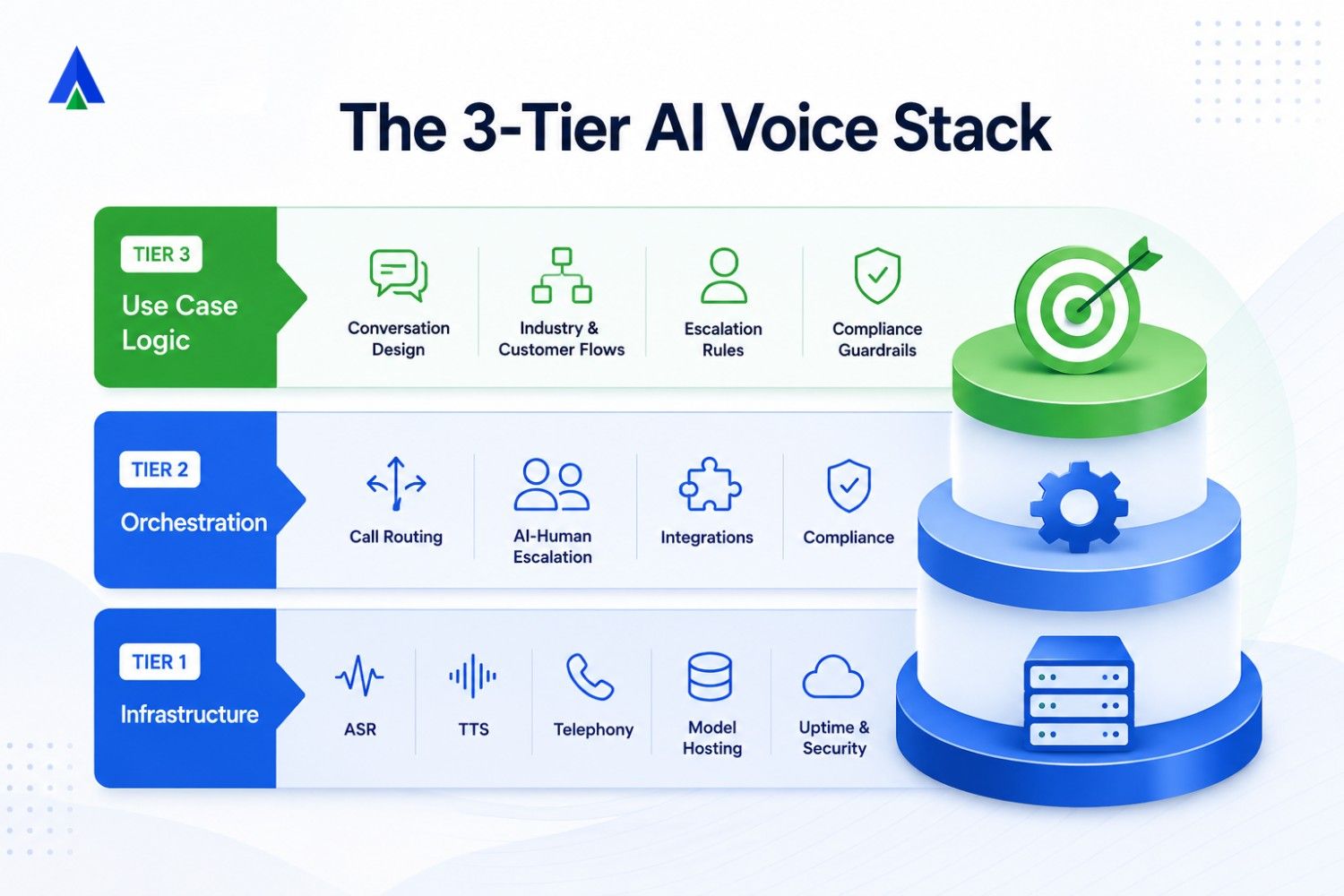
Every AI voice agent platform deployment has three distinct tiers of the stack, and the build vs. buy AI question lands differently at each one.
1. Tier 1: Infrastructure
ASR, TTS, telephony, model hosting, latency optimization, uptime, and failover. Unless you are building an AI company, this is not where your competitive advantage lives. A platform solves this tier better than most internal teams can, at lower cost and higher reliability.
2. Tier 2: Orchestration
Call routing, hybrid AI-human escalation logic, compliance guardrails, integration with downstream systems. This is where build and buy genuinely compete, and where platform choice determines how much control you actually retain. The right platform lets your ops team adjust escalation rules and routing logic without a code deploy or a vendor ticket. The wrong one locks that control behind professional services. Evaluate this tier harder than any other.
3. Tier 3: Use Case Logic
The specific conversation design for your industry and customer base. How a collections platform should handle a disputed charge. How an insurance platform should pace a policy renewal campaign. This is your moat. This is where you should build.
The build vs. buy AI debate usually gets framed at Tier 1, where the answer is almost always the same- do not build. The debate worth having is at Tier 2, where platform choice drives how much control you actually retain. And the work worth doing is at Tier 3, where your judgment about your customers, industry, and sales motion creates differentiation no vendor can replicate.
The goal is a platform that handles Tier 1 reliably, gives you genuine control at Tier 2, and stays out of your way at Tier 3.
How To Evaluate AI Voice Agent Platforms
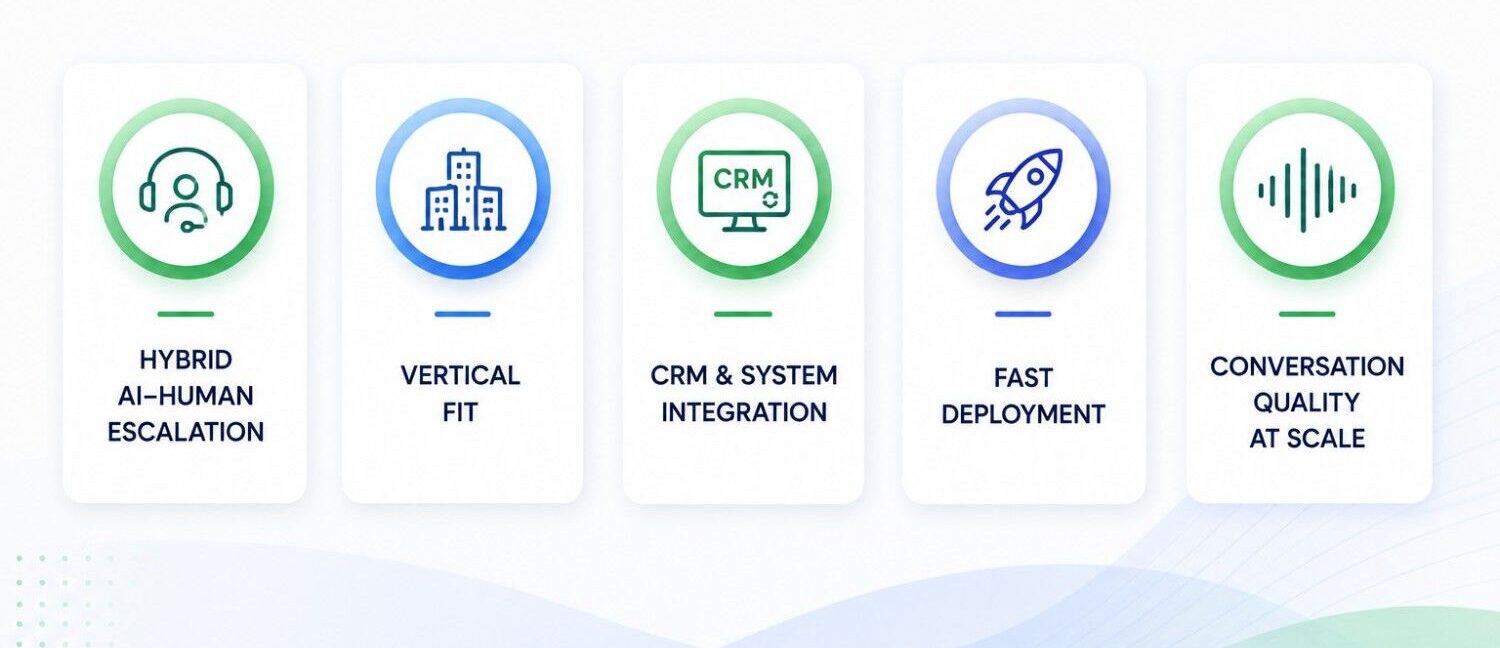
Here are the dimensions that separate great AI voice agent platforms for outbound calling, collections, insurance, or enterprise CX, from generic ones.
Hybrid AI-human escalation architecture
The most effective contact center AI automations in production today are not fully autonomous. They handle high-volume, routine interactions, and escalate to human agents when complexity, sentiment, or compliance requires it.
This is not a nice-to-have. It is the core design principle of any voice AI deployment that works at an enterprise scale. Evaluate how the platform handles the handoff: does context transfer cleanly to the human agent, does the customer have to repeat themselves, and does the escalation logic support real-time triggers based on sentiment scoring or specific utterances?
Vertical fit over generic capability
A voice AI agent platform for outbound calling in financial services has materially different requirements than one built for healthcare or SaaS. Collections calling platforms need to navigate TCPA and FDCPA compliance and handle hostile or distressed interactions with care.
A voice bot platform for insurance agents running automated campaigns needs to manage multi-step policy workflows and pass authenticated customer data to licensed agents at escalation.
Evaluate vertical depth alongside general capability. A platform with a strong generic feature set but no experience in your industry will cost more in configuration and compliance work than a platform with deeper vertical alignment.
CRM and workflow integration depth
Leading CRMs like Salesforce integration is not optional for contact center AI automation solutions. The platform should sync call outcomes, update lead records, trigger follow-ups, and pass call insights back to your system automatically, and in real time.
When evaluating vendors, go beyond enquiring about CRM connectors. Ask how many fields map natively, how custom objects are handled, whether the integration supports bidirectional sync, and what happens to call data when the CRM API is slow or down. Shallow integrations create data debt that accumulates quickly at scale.
Deployment speed and iteration cycle
Deployment speed is a competitive variable, not a configuration detail.
The first use case should go live in days, not sprints. Your ops team should update conversation flows without a code deploy. You should be able to A/B test dialogue designs against live call data without a vendor ticket.
Platforms that gate every campaign behind a professional services engagement don’t just slow you down; they kill experimentation. The best enterprise voice AI platforms make fast iterations default, not an upgrade.
Conversation quality at scale
Voice bots fail at scale when ASR accuracy degrades on accented speech, noisy call environments, or domain-specific vocabulary the underlying model has not been fine-tuned. Test with your actual call recordings, not vendor-provided demo audio. Ask for accuracy benchmarks on the specific languages and dialects relevant to your customer base.
The Deploy and Differentiate Model
The most effective enterprise AI voice deployments follow a consistent pattern. They do not look like fully custom-built systems, and they do not look like vanilla out-of-the-box deployments either.
They look like this.
Deploy a proven voice AI agent platform for infrastructure, reliability, integrations, compliance, and uptime.
Differentiate by owning the conversation design, the escalation logic, the campaign strategy, and the data layer.
This model gets teams to market in weeks rather than quarters. Platforms like AceX Voice Bot are built precisely for this.
Self-hosted LLMs trained on enterprise use cases, 500ms response latency that keeps conversations natural, and capability to go live in 48 hours for standard cases. For Indian enterprises, all customer data (call recordings, transcripts, personal information) stays within Indian servers, satisfying DoT and TRAI requirements without your legal team raising exceptions.
It also creates a better learning loop. When the infrastructure is abstracted away, teams can run more experiments, iterate on conversation designs faster, and make decisions based on live call data rather than firefighting infrastructure incidents.
What “Best” Means for Conversational Voice AI
When enterprise teams evaluate voice AI platforms, they typically shortlist three to five vendors and run structured assessments: scoring on production metrics, compliance certifications, integration depth, and scalability. The framework is right. But the criteria are often applied generically, without anchoring to a specific use case.
When evaluating how to choose a voice AI agent platform, start with your top three use cases and score vendors against those specifically. Talk to enterprise customers running those exact use cases in production. Ask about failure modes, not just wins.
“Best” is always contextual. Start with use case fit, not vendor prestige.
Read More: Voice bot evaluation checklist for operations managers
The Question Worth Asking
Build vs. buy is a procurement lens applied to a strategy problem.
The question you should be asking is: what do we need to own, and what should we delegate?
Own your use cases. Own your conversation design. Own your data strategy. Own the Tier 3 logic that creates real differentiation for your customers and your business.
Delegate the infrastructure. Let a voice agent platform handle the plumbing, so your team can focus on what actually moves the needle.
That is not a build decision or a buy decision. It is a strategy decision.
And it is the one worth having.
Ready to see what the deploy side looks like in practice? AceX Voice Bot is built for enterprise teams who want to go live fast and differentiate on conversation design. Book a demo.