


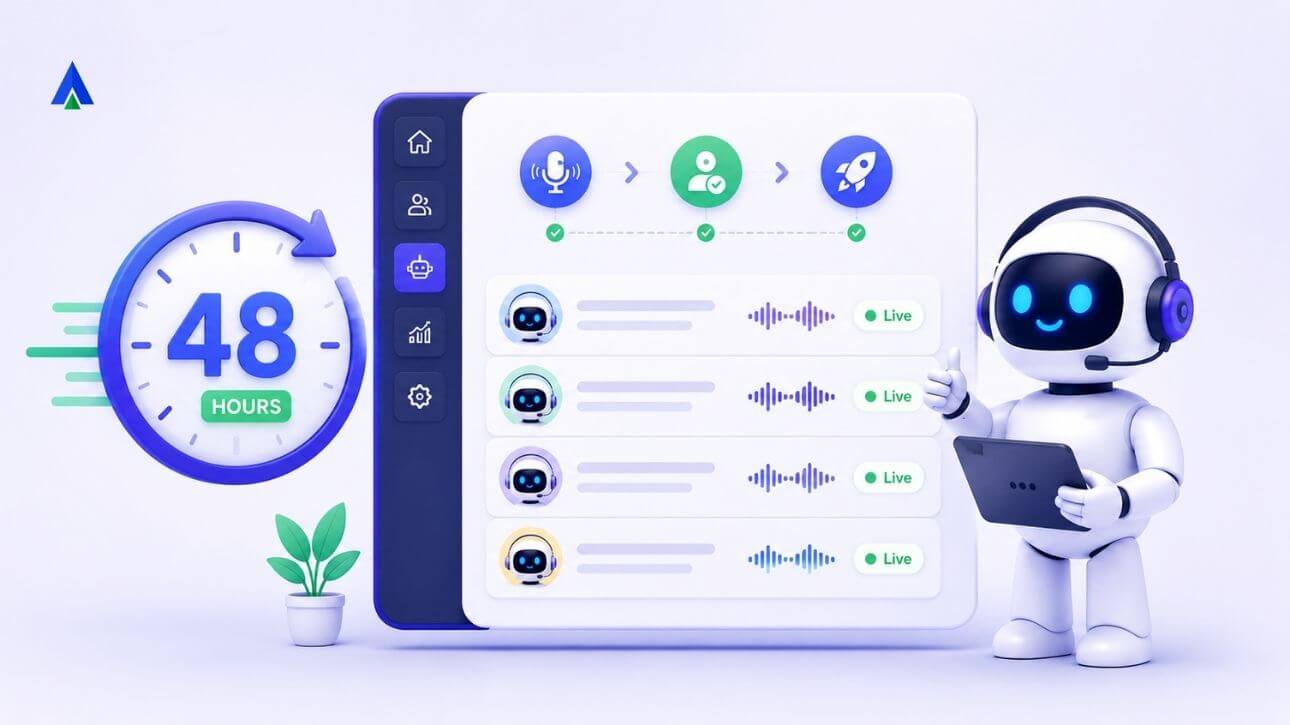


The longest gap in AI voice agents sales for BPO teams is not between demo and contract. It is between a prospect’s interest and the moment the sales team can show them something working. When a client asks “Can you show me this running against our use case?”, the standard BPO response is a slide deck describing what the technology will do once deployed. That answer ends deals faster than a pricing objection.
Enterprise buyers evaluating AI voice capabilities in 2026 expect to see a working agent, not a diagram. BPO sales teams that can produce a live, configured AI voice agent against a client’s specific call type within 48 hours will be more favorable than those who offer a roadmap.
Wondering how you can do that?
Read on!
Do BPO Teams Require Engineering for AI Voice Deployment?
The assumption that deploying AI voice bot agents is engineering-intensive dates from the previous generation of contact center AI. During this time, custom speech recognition, NLP, and telephony integration required months of specialist work at every layer. That architecture demanded API configuration for STT, LLM, TTS, and telephony separately. All this, before any working call flow could be tested against real caller variation.
That architecture is no longer the default.
Modern AI voice platforms pre-integrate the full stack: telephony infrastructure, speech recognition, language model, text-to-speech, and a visual flow builder connecting them through configuration rather than code.
The engineering overhead (infrastructure provisioning, provider selection, API wiring) exists at the platform level, not at the deployment level. A BPO pre-sales consultant can build a working inbound support agent or outbound confirmation flow using the same type of form-based interface they use to configure a CRM automation.
According to an IDC study, 96% of organizations deploying traditional set up of GenAI reported costs higher than expected. Platform-based deployment eliminates most of that cost structure. The specialist configuration layer is replaced by a no-code builder and the 12-month implementation timeline collapses to 48 hours.
What Can a BPO Team Realistically Deliver in 48 Hours?
A 48-hour deployment timeline applies to a well-scoped, single-use-case AI voice agent connected to a test data source. Understanding scope can help you prevent overselling the timeline to a client and prevents underselling the capability.
Within 48 hours:
- A configured inbound or outbound AI voice agent handling one clearly defined call type: COD confirmation, appointment reminder, WISMO inquiry, or tier-1 support FAQ
- Integration with a test CRM or OMS via webhook the agent retrieves live data fields during simulated calls
- A complete escalation path wherein the agent handles defined interactions and warm transfers to a human agent with full call context when the conversation leaves scope
- Pre-deployment testing using an AI Evaluator module
- A structured pass/fail test report by scenario category
Beyond 48 hours:
- Multi-intent agents spanning 10+ distinct call types without a prior scope definition session per flow
- Live integration with a production CRM requiring the client’s IT team to approve API access
- Custom voice persona development requiring branded TTS voice training from scratch
- Full multi-language rollout across five regional languages simultaneously
What Are the 4 Stages of a 48-Hour AI Voice Agent Deployment?
The deployment runs in four stages, each with a defined time budget. None requires engineering resources.
Stage 1 — Use Case Definition (2–4 hours, Day 1)
The most critical stage and the most commonly underestimated. Before opening the platform, define in writing: which specific call type the agent owns (inbound or outbound, single intent only); what data the agent retrieves during the call (order ID, appointment slot, account status); when it escalates to a human. This scope document is the configuration brief. A use case that is not written before the platform session begins will be defined by the platform’s defaults, which are not designed for the client’s workflows.
For BPO sales contexts, the use case definition session typically doubles as the discovery call with the client’s operations team. The questions asked during scope definition are the same questions the client’s operations lead needs answered before any deployment. The session creates alignment and urgency simultaneously.
Stage 2 — Platform Configuration (4–6 hours, Day 1–2)
An AI voice agent is created from a one-to-two line use case description. Configuration covers: LLM selection (or BYOK: Bring Your Own Key, for clients with existing LLM contracts), call flow design in the no-code builder, webhook connection to the test data source, and escalation rules. For Indian-market BPO deployments, Sarvam AI STT is configured at this stage for Hinglish and regional Indian language support without a separate language integration.
Stage 3 — AI Evaluator Testing (4–6 hours, Day 2)
Before the client sees the agent, run the configured flow through a synthetic scenario matrix.
- Primary call path
- Intent variations (the same query phrased 8–12 ways)
- Edge cases (data not found, mid-call intent shift)
- Escalation triggers.
The output is a scored pass/fail report by the scenario category.
Stage 4 — Client Demonstration (Day 3)
The agent enters the client meeting live, not as a recording or a slide. The BPO runs the prospect’s actual call type against the agent in real time. Capability objections (“Can it handle a mid-call escalation?”) are answered by triggering the escalation during the demo.
The AI Evaluator test report answers QA questions before the client’s technical team asks them.
How 48-Hour AI Voice Agent Deployment Applies to BPOs?
The commercial application applies across three specific BPO sales scenarios.
- Competitive RFP response: When an RFP includes an AI capability requirement with a submission deadline in days rather than weeks, the BPO that attaches a live AI Evaluator test report to its response is not competing on the same terms as vendors who attach capability slides.
- Prospect qualification acceleration: For BPO sales cycles where meeting one is exploratory and meeting two is a technical evaluation, inserting a configured voice agent demo between the two meetings compresses the sales cycle. The prospect evaluates capability in meeting two rather than scheduling a separate technical proof-of-concept that typically extends the cycle by four to six weeks.
- Existing client expansion: BPOs with established account relationships can introduce AI voice services by demonstrating a working agent against the client’s existing highest-volume call type before the conversation about scope and pricing begins. The demo creates demand rather than responding to it.
Conclusion
Three things determine whether a BPO team can convert a prospect’s AI requirement into a signed contract rather than a scheduled follow-up: the platform must compress engineering overhead to zero, the deployment path must be executable by non-technical team members, and the output must be demonstrable evidence, not a capability claim.
Configure a client-ready AI voice agent on Acefone AceX before your next BPO presentation and walk into the meeting with a live, tested agent and an AI Evaluator report your client’s technical team can evaluate on the spot.
FAQ
A: There is no additional cost for deploying a demo agent beyond the standard Acefone AceX platform subscription. The same configuration, testing, and observability infrastructure used for production deployments is available for pre-sales demonstrations.
A: A 48-hour deployment can produce a demo-ready agent that is architecturally identical to a production deployment. The same call flow configuration, webhook integration, and AI Evaluator testing that validates the demo validates the production agent.
A: When the client’s use case involves multi-intent flows across 10 or more call types, requires real-time integration with a production system pending IT approval, or demands a custom branded TTS voice.
The demo agent remains fully configured, and AI Evaluator validated in the client’s account. If the client proceeds, the demo agent is the starting point for production configuration, no rebuild required.


