


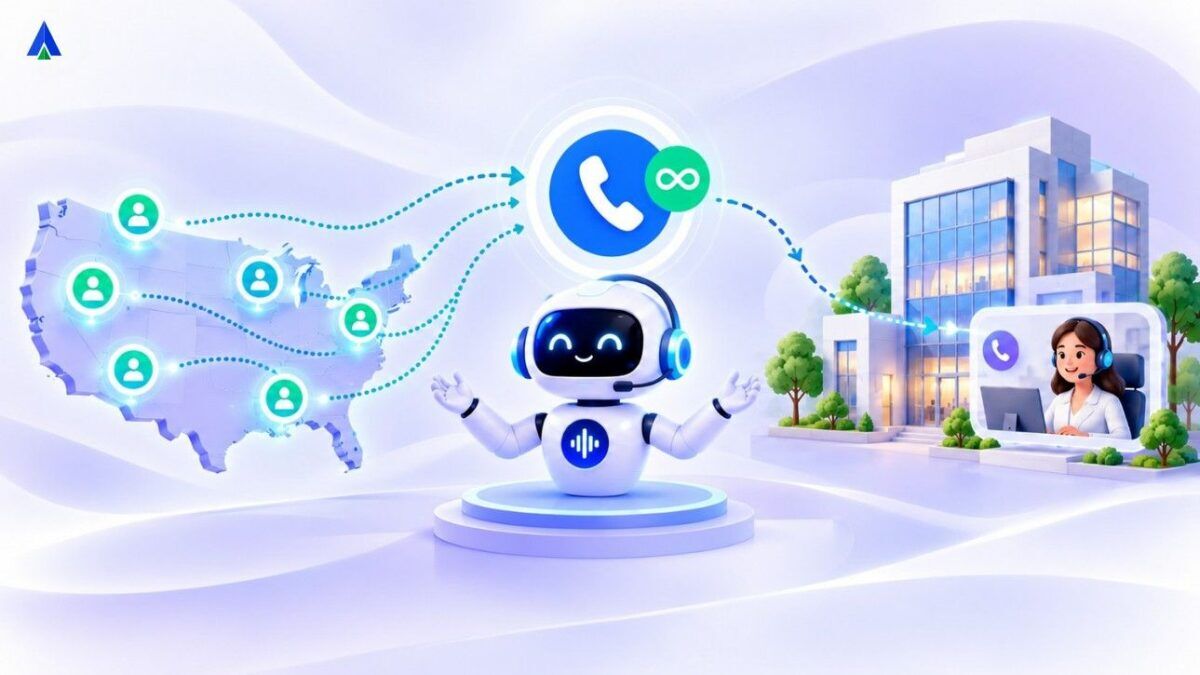


A US toll free number looks simple from the outside a customer dials, you answer, nobody pays for the call. But underneath that simplicity is a routing system that’s evolved a lot since the days of physical phone lines. If you’re trying to understand how toll free number work before setting one up for your business, it helps to know both the mechanics and the modern, cloud-based layer that sits on top of them today.
How Does a Toll-Free Call Get Routed? The Basic Mechanics
When a customer dials a US toll free phone number, the call doesn’t go directly to a single, fixed line the way a home phone call might have decades ago. Instead, it passes through what’s called the toll-free network, managed through a system of databases that determine where the call should be sent.
Here’s the simplified version of what happens:
- The customer dials the toll-free number.
- The call is picked up by the customer’s local carrier and routed to the SMS/800 database (the industry system that tracks which carrier “owns” or manages a given toll-free number).
- That database identifies which telecom provider is responsible for handling calls to that number.
- The call is then routed to the business’s chosen destination which could be a desk phone, a mobile number, a call center queue, or a cloud phone system.
- The business, not the caller, is billed for the airtime.
This entire process happens in a fraction of a second, which is why toll-free calling feels instantaneous and identical to dialing any other number. (For the regulator’s overview, see the FCC’s guide to toll-free numbers.)
Is a USA Toll-Free Number Tied to One Fixed Location?
A common misconception is that a toll-free number is tied to a physical office, the way a local number is tied to an area code. It isn’t. A USA toll free number can ring anywhere a home office, a call center in another state, or a cloud system that distributes calls across multiple remote agents. This is part of what makes toll-free numbers so useful for businesses that operate across state lines or don’t want their phone number to reveal exactly where they’re headquartered.
What Role Does Cloud Telephony Play in Modern Toll Free Numbers?
Traditional toll-free service used to require dedicated hardware and a direct relationship with a telecom carrier. Today, most businesses run their toll-free numbers through cloud telephony platforms, which changes what’s possible considerably.
With a cloud-hosted toll-free number, businesses can typically:
- Set up Interactive Voice Response (IVR) menus so callers can route themselves to sales, billing, or support without waiting for a live transfer
- Forward calls dynamically based on time zone, business hours, or agent availability
- Record and store calls for training, compliance, or dispute resolution
- Integrate with CRM software so incoming calls automatically pull up customer history
- View real-time analytics on call volume, wait times, and missed calls
None of this requires the customer to notice anything different. From their side, it’s still just a free call to a memorable number. The complexity is entirely on the business’s end, and it’s largely invisible once it’s set up.
How Do Toll-Free Numbers Handle High Call Volumes?
One reason toll free number work well for growing businesses is that the underlying infrastructure is built to scale. A single toll-free number can handle a large number of simultaneous calls because the “number” itself isn’t tied to one physical line it’s a routing address that can distribute calls across many agents or queues at once.
This matters for business toll free number setups where call spikes are common: a marketing campaign goes out, a product launches, or a support issue affects many customers at the same time. Cloud-based systems are generally built to absorb these spikes without dropped calls, as long as the business has configured enough agent capacity or overflow routing on the back end.
Virtual Toll-Free Number vs. Traditional Setup: What’s the Difference?
Increasingly, businesses opt for what’s sometimes called a virtual toll free number a toll-free number that lives entirely in the cloud rather than being tied to a specific physical phone line or piece of hardware. The advantage here is flexibility: you can activate a number in minutes, change its routing rules from a dashboard, and connect it to mobile phones, softphones, or desk phones interchangeably.
This is largely how providers like Acefone deliver toll-free services today the number itself becomes a flexible entry point into your business’s communication system, rather than a fixed piece of physical infrastructure you have to plan around. (Not sure which type fits you? Read our comparison of toll-free number vs virtual phone number.)
How Do You Set Up a Toll-Free Number? What to Expect
For most businesses, getting a toll-free number running involves:
- Choosing an available number from the toll-free codes currently in use (800, 888, 877, 866, 855, 844, 833)
- Selecting a provider that offers the call routing and features your business needs
- Configuring call flows deciding what happens when someone calls: an IVR menu, a direct ring to a team, or a queue
- Connecting it to your existing systems, such as a CRM or helpdesk, if you want calls logged automatically
- Testing the setup before promoting the number publicly
Because most of this runs through software rather than physical wiring, the entire process usually takes hours or days, not weeks. Planning your budget? See how much a US toll-free number costs.
Key Takeaway: How US Toll Free Numbers Work Today
A toll-free number might look like a simple courtesy to customers, but it’s backed by a well-established routing system and, increasingly, a flexible cloud layer that gives businesses far more control than the technology allowed a decade ago. Understanding how it works isn’t necessary to use one effectively but it does make it easier to choose a provider and a setup that actually fits how your business operates.
Frequently Asked Questions
The call routes through the SMS/800 database, which identifies the responsible carrier and sends it to the business’s chosen destination.
No, it can ring a desk phone, mobile number, call center queue, or cloud system anywhere.
The business is billed for the airtime, not the caller.
IVR menus, dynamic call forwarding, call recording, CRM integration, and real-time analytics.
No, which is useful for companies that operate across states or don’t want geography tied to their brand.


