


 8 mins read


Many enterprises still assume that building an AI agent requires a developer. In practice, no-code platforms now allow business teams to configure defined workflows without writing code.
Your operations manager understands the workflow. Your CX lead knows which calls repeat 500 times a day. Your branch head can draw the process on a whiteboard in two minutes. The people who understand the problem are already in your organisation. What they are missing is not the skill. It is the platform.
Learning how to build AI agents used to mean hiring data scientists and writing API connections. It meant waiting months for an IT project queue. No-code AI agent platforms have changed that entirely. For a clearly defined workflow, non-technical teams can configure, test, and deploy an agent on Acefone AceX in as little as 48 hours.
This post explains what agentic AI is and how it differs from the chatbots your team already uses. It covers what executives at BFSI, BPO, e-commerce, healthcare, and automotive organisations need to know. And it walks through the exact steps to build your first agent without writing a single line of code.
What is agentic AI? The executive definition
Agentic AI is software that perceives information, reasons over it, and takes action to complete a defined goal. It differs from a chatbot because it acts rather than just responds. It differs from workflow automation because it decides which step to take next based on what it observes. An AI agent owns the outcome of an interaction, not just the answer to a single query.
Think about the gap between two scenarios. In the first, a customer asks a chat window how to reset their password. The chatbot returns a scripted answer. The customer reads it and completes the reset themselves. The chatbot’s job ends with the response.
In the second scenario, an AI agent detects three failed login attempts. It triggers a password reset proactively. It sends an SMS confirmation. It logs the security event and flags it for audit. No human touched any of those steps. That second scenario is agentic AI in operation.
IBM defines an AI agent as “a software-based system that is able to perceive information, reason over that information, and take actions to achieve a defined goal.” The word that matters is “actions,” not “responses.”
Agentic AI operates on a continuous decision loop: observe current state, decide the next action, execute it, evaluate the result, and repeat. That loop runs without waiting for a new human instruction at each step.
Earlier AI systems mainly reduced simple ticket volume or improved self-service. Agentic AI goes further by completing tasks across connected systems. Conversational AI improved containment rates by 50–60%. Generative AI accelerated content creation 3–5x. Agentic AI does not just generate content or deflect queries. It completes tasks.
One misconception worth correcting: if the steps are fixed and pre-programmed, the system is automation, even when an AI model is involved. Agency is a product of system design, not simply a result of using a large language model. A system that follows a rigid script is an automation tool. A system that decides its next step based on what it observes is an agent.
Key takeaway: Agentic AI perceives, decides, and acts in a loop to complete an outcome. A chatbot responds. Automation follows a fixed script. An agent owns the result.
How are no-code AI agents different from chatbots?
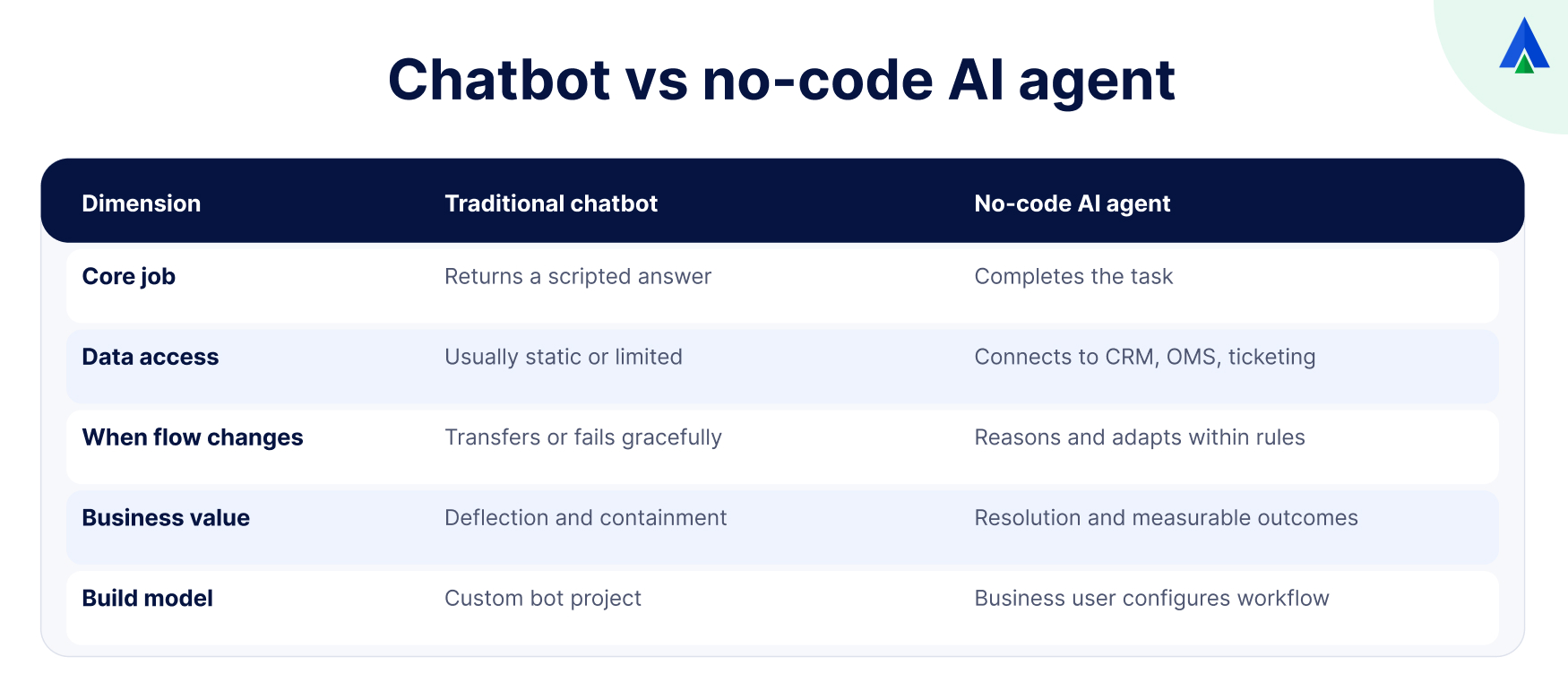
A chatbot matches your query to a pre-written script and returns a text response. A no-code AI agent connects to your live systems, interprets what is happening in real time, and takes a real action: updating a record, triggering a payment, scheduling a callback, or routing an escalation. The difference between them is the difference between an answer and a resolution.
Most organisations have chatbots. Most of them underdeliver. The failure pattern is consistent: the conversation moves one step outside the expected script, and the bot asks the customer to call the support line. That is deflection with extra steps, not automation.
No-code AI agents behave differently because they are architected differently. The core architectural distinction lies in how the system handles the unexpected — a chatbot fails gracefully by transferring, while an agent adapts by reasoning.
Research by Moveworks found that 91% of IT executives say non-technical employees are driving agentic AI initiatives at their organisations. The reason is that the people who know where conversations break are running the contact centre, not building the code.
No-code AI agents connect to your CRM, OMS, and ticketing system via pre-built connectors. During every interaction, the agent pulls live data and acts on what it finds. A customer asking about their order does not receive a scripted holding message. The agent retrieves the real-time tracking status, reads it back, and updates the record if the delivery status has changed.
The cost comparison makes the gap concrete. Building a non-agentic chatbot from scratch costs between ₹4–12 lakh. An advanced agentic AI system built from scratch costs ₹40 lakh or more. No-code platforms collapse that difference by handling the infrastructure layer. The business user configures the workflow. The platform handles execution.
Key takeaway: No-code AI agents resolve queries by acting on live data. Chatbots respond with pre-written answers. That gap shows up in actual resolution rates, not just deflection metrics.
How do you build AI agent without code?
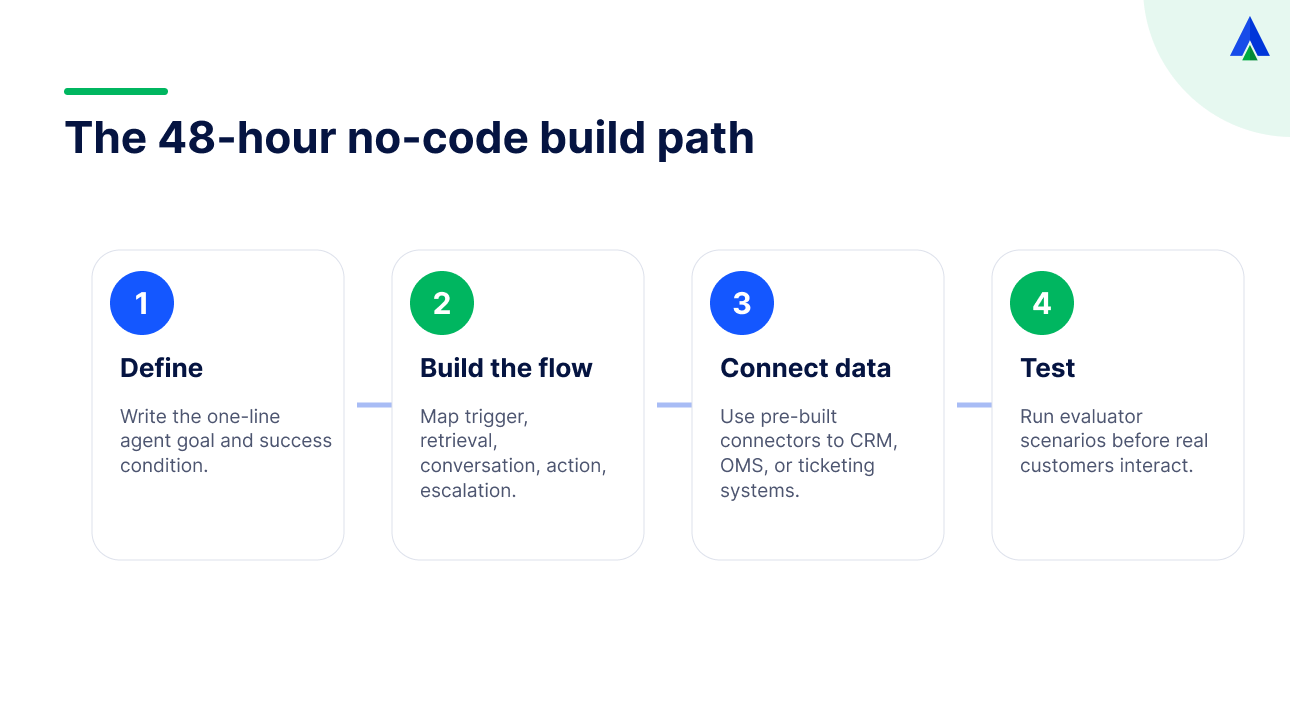
No-code AI agent creation uses a visual builder: define the goal, map the conversation flow, connect your live data systems via pre-built integrations, and test before going live. You describe what the agent does. The platform builds the underlying logic. No APIs to write, no models to configure from scratch.
The architectural shift that makes no-code possible is real. Modern AI agent platforms have pre-integrated the full technical stack: the telephony layer, the language model, speech recognition, text-to-speech, and the visual flow builder. What previously required specialist engineers at every layer now requires a business user who knows the workflow.
On Acefone AceX, the build path runs in four stages. None requires an engineering team.
1. Stage 1 — Define
Write in one or two lines what the agent does. “Calls every COD order customer within 30 minutes of purchase. Confirms delivery details. Offers a UPI payment alternative.” That description is your configuration brief. This is the most underestimated stage. Every session that skips a written use case definition adds days to the build.
2. Stage 2 — Build the flow
In the visual builder, connect the steps: trigger, data retrieval, conversation design, action execution, escalation rules. No programming syntax. The builder generates the underlying logic from your configuration choices.
3. Stage 3 — Connect your data
Pre-built connectors link the agent to your CRM or OMS via webhook. The agent pulls and updates live data during every interaction. No developer writes the integration.
4. Stage 4 — Test before going live
The built-in AI Evaluator module runs the configured agent through simulated scenarios covering the primary flow, edge cases, and escalation triggers. You receive a pass/fail report by scenario category before any real customer interacts with the agent.
Non-technical CX managers, operations leads, and pre-sales consultants complete this path in 48 hours on Acefone AceX. No engineering headcount. The person who understands the workflow builds the agent.
Moveworks research aligns with what we see in practice: 78% of executives say their most successful AI projects started with support staff solving persistent operational challenges, not IT-led transformation programmes.
Key takeaway: Define the goal, build the flow visually, connect live data via pre-built integrations, and test before launching. A business user completes the entire path. No code required.
Which industries are deploying AI agents fastest?
BFSI, BPO, e-commerce, healthcare, and automotive are the fastest-adopting verticals. All five share one structural driver: high volumes of repetitive, rules-defined transactions that agents complete faster and more consistently than human teams.
McKinsey’s State of AI 2025 report, based on a survey of 1,993 respondents across 105 countries, found that 62% of organizations are already experimenting with or actively scaling AI agents — 23% are scaling in at least one business function today.
IBM’s 2025 CEO study, surveying 2,000 CEOs across 33 countries, found that 61% are actively adopting AI agents and preparing to implement them at scale. That figure puts adoption well past the pilot stage for most large organizations.
BFSI
AI agents in financial services handle KYC document collection, loan eligibility checks, claim status updates, and policy renewal reminders. Compliance is the consistent driver. A configured agent follows the same regulatory path on every interaction. Every step is logged for audit.
BPO
BPO teams on Acefone AceX configure no-code voice agents for a single client call type before a prospect meeting. That gives them a live, tested demonstration ready in 48 hours — a working agent in the meeting room closes AI-mandated contracts faster than a slide deck describing what the technology will eventually do.
E-commerce
WISMO queries (“Where is my order?”) account for 30–40% of inbound support volume at most D2C brands. At ₹150 per call and 50,000 monthly contacts, that is ₹75 lakh per month on a question an agent answers in under 30 seconds.
Healthcare
Appointment reminders, prescription refill confirmations, and discharge follow-up calls are high-volume, low-complexity workflows where agents reduce staff workload without affecting patient experience quality.
Automotive
Service appointment scheduling, post-service follow-up, and extended warranty renewal are the primary agent use cases. The workflow is consistent across thousands of service centres. An agent handles outreach at scale without adding headcount.
Key takeaway: BFSI, BPO, e-commerce, healthcare, and automotive share the same adoption driver: high-volume transactional workflows where agents are faster, more consistent, and measurably cheaper than human teams.
How executives apply no-code agent creation
The organisations scaling AI agents fastest in 2026 share one trait: the person who owns the workflow also builds the agent. In BFSI, it is the branch operations manager who configures the KYC follow-up agent. In BPO, it is the pre-sales consultant who builds the demo agent before the client meeting. In e-commerce, it is the CX head who sets up the COD confirmation workflow.
This is not a skill gap issue. The no-code builder does not require programming knowledge. It requires workflow knowledge. The person who can explain the call flow on a whiteboard can configure it on the platform.
On Acefone AceX, the configuration interface takes a one-to-two line use case description and generates the starting agent structure from it. From there, the user refines the flow, connects the data source, and runs the AI Evaluator test sequence. The full path from written brief to a tested, production-ready agent takes 48 hours.
The step that most teams underestimate is use case definition — and it is not technical. It requires answering three questions before the platform is opened: What does the agent do? What data does it need during the interaction? When does it hand off to a human? Sessions that skip those three answers consistently take three to five times longer.
How to create a no-code voice agent with AceX
Most platforms that claim “no-code” still require a developer to handle telephony setup, API connections, or model configuration. AceX is built differently — the entire stack is owned by Acefone, which means the configuration interface is the only thing standing between you and a live voice agent.
Define
Write one or two lines describing what the agent does. “Calls every overdue borrower in the DPD-1 bucket. Reads outstanding amount. Captures promise-to-pay date.” That sentence becomes the agent’s brief.
Configure
Select your LLM, STT, and TTS from the dropdown. Add your knowledge base or connect your CRM via webhook. No API credentials to manage unless you bring your own keys.
Test
Run the built-in AI Evaluator. It simulates real caller scenarios — including edge cases and escalations — and returns a pass/fail report before a single customer hears the agent.
Deploy
Assign a DID for inbound or set an outbound CLI. Go live.
The person who owns the workflow builds the agent. No engineering ticket. No sprint cycle. The first deployment typically takes under 48 hours, not because the platform cuts corners, but because every layer underneath is already handled.
For senior executives deciding where to start: find the workflow where your team delivers the same answer more than 500 times a month. That is your first agent. Build it, measure the resolution rate, and then build the next one. The organisations winning on AI capability in 2026 did not start with a comprehensive roadmap. They started with one workflow.
Into Your Workflow
Start small, then scale
Building AI agents is no longer an IT project. It is an operational decision. And the people best equipped to make it are the ones who own the workflow.
Three things to take away. Agentic AI is defined by its ability to act autonomously through a decision loop. No-code platforms have removed the technical barrier that kept agent creation inside engineering departments. And the industries scaling fastest gave workflow ownership to the people who understand the problem.
Pick one high-volume, repetitive workflow. Build one agent. Measure what changes. The same path is open to your team today.