


 4 mins read


Most cost comparisons between human agents and AI voice bots start and end with salary. That is the wrong starting point. Salary is one component of a much larger cost structure. And it is usually not the largest driver of the gap.
Let’s break down what a human support call truly costs in 2026, what an AI voice agents call costs across the same components, and where the real savings come from in an e-commerce operation.
Why Cost-Per-Call Is Harder to Calculate Than It Looks
Cost-per-call is a ratio. Total support cost divided by total calls handled. Simple to state, difficult to calculate accurately.
Most operations teams undercount total support cost. They include agent salaries and sometimes telephony. They leave out supervision, training, attrition, idle time, repeat contacts, quality management, and infrastructure. Each of these is real. Each of them belongs in the denominator.
According to a study published in 2025 in US Contact Center Decision-Makers’ Guide, the average cost of an inbound call is $7.16. Voice calls cost 18% more than email and 42% more than web chat. These are Western market benchmarks. For Indian in-house e-commerce operations, the absolute numbers are lower. But the cost structure, the components and their proportions is the same.
The True Cost of a Human Support Call
Let’s build the cost model from the ground up.
Agent compensation. For a mid-level support agent in an Indian e-commerce operation, base salary runs ₹20,000 to ₹30,000 per month. Add employer PF, ESI, and variable pay and the monthly cost per agent reaches ₹24,000 to ₹36,000.
A full-time agent working an 8-hour shift handles 40 to 60 calls per day depending on average handle time. At 50 calls per day and 22 working days, that is 1,100 calls per month. Agent compensation alone works out to ₹22 to ₹33 per call.
- Training and attrition. E-commerce support attrition in India runs 30 to 50% annually. Every replacement carries onboarding cost — typically 2 to 4 weeks of reduced productivity and trainer time. When spread across total call volume, training and attrition adds ₹8 to ₹15 per call to the model.
- Supervision and quality. One team lead or supervisor for every 10 to 15 agents is standard. Quality analysts, coaches, and floor managers add further overhead. This layer typically contributes ₹10 to ₹18 per call when fully allocated.
- Infrastructure. Seat cost, telephony, CRM licensing, internet, and workstation depreciation. For an in-house operation, this runs ₹8,000 to ₹15,000 per agent per month — adding ₹7 to ₹14 per call.
- Idle time. Agents are paid for shifts, not calls. During low-volume windows, between-call wrap-up, team meetings, and breaks, the cost clock keeps running. Idle time typically represents 20 to 30% of total agent hours. At a 25% idle rate, every 75 productive minutes carries 25 minutes of idle cost — inflating effective cost-per-call by 30 to 40%.
- Repeat contacts. A query not resolved on the first call generates a second contact. In e-commerce, WISMO and delivery queries have a meaningful repeat contact rate when resolution quality is inconsistent. Each repeat contact doubles the cost of that interaction.
The True Cost of an AI Voice Bot Call
The cost model for an AI voice bot is structurally different. Most components that drive human agent cost simply do not exist.
- Per-minute calling cost. At AceX pricing of approximately ₹1 per minute, a 2 to 3 minute bot-handled call costs ₹2 to ₹3. This is the primary variable cost for an automated interaction.
- Platform and integration cost. Monthly platform access, OMS integration, and CRM connectivity carry a fixed cost. At 10,000 calls per month, platform cost spreads to ₹1 to ₹2 per call. At higher volumes, it falls further.
- No training cost. The bot does not onboard. It does not need refresher training when a policy changes. A script update takes minutes and applies instantly to every subsequent call.
- No attrition cost. The bot does not resign. There is no replacement cycle, no knowledge transfer period, no productivity dip between agents.
- No idle time cost. The bot is billed only for connected call time. There is no shift to staff, no overnight coverage premium, no between-call cost. It handles 3 calls at 2 AM at the same cost as 3 calls at 2 PM.
- No supervision overhead. There is no team lead layer. Performance monitoring happens through dashboards, not floor managers.
- Escalation cost. Calls that exceed the bot’s scope transfer to a human agent. Those calls carry the full human cost for that interaction. The escalation rate determines how much of the human model remains in the blended figure.
Where the Savings Actually Come From
The cost reduction is not primarily from cheaper per-minute rates. It comes from eliminating entire cost categories.
Training and attrition costs disappear. Idle time disappears. Supervision overhead disappears. Night shift premiums disappear. Repeat contact costs fall because bot-handled calls are consistent — they retrieve the same data, follow the same logic, and deliver the same answer every time.
The remaining human cost concentrates on the calls that genuinely need a human. Complex complaints, payment disputes, emotionally escalated interactions. These calls benefit from full agent attention. And because agents are not burning through 60% of their day on WISMO and COD confirmation, they handle escalations better.
This is the compounding effect that a simple per-minute comparison misses. It is not just that bot calls are cheaper. It is that the human calls that remain become higher quality and lower volume at the same time.
The Automation Rate Is the Critical Variable
A 75% automation rate was used in the model above. That number is achievable for e-commerce operations where the majority of calls are WISMO queries, COD confirmation, and delivery updates.
An operation where 60% of calls are complex complaints will see a lower automation rate and a higher blended cost. The savings model still applies — it just applies to a smaller proportion of total volume.
Before building your cost comparison, audit your call mix. Identify what percentage of your monthly call volume falls into repetitive, scriptable categories. That percentage is your automation ceiling. The actual automation rate you achieve will depend on bot configuration quality, integration depth, and escalation threshold design.
Conclusion
The cost difference between a human support call and an AI voice bot call in 2025 is not a marginal improvement. It is a structural shift in how support cost is built.
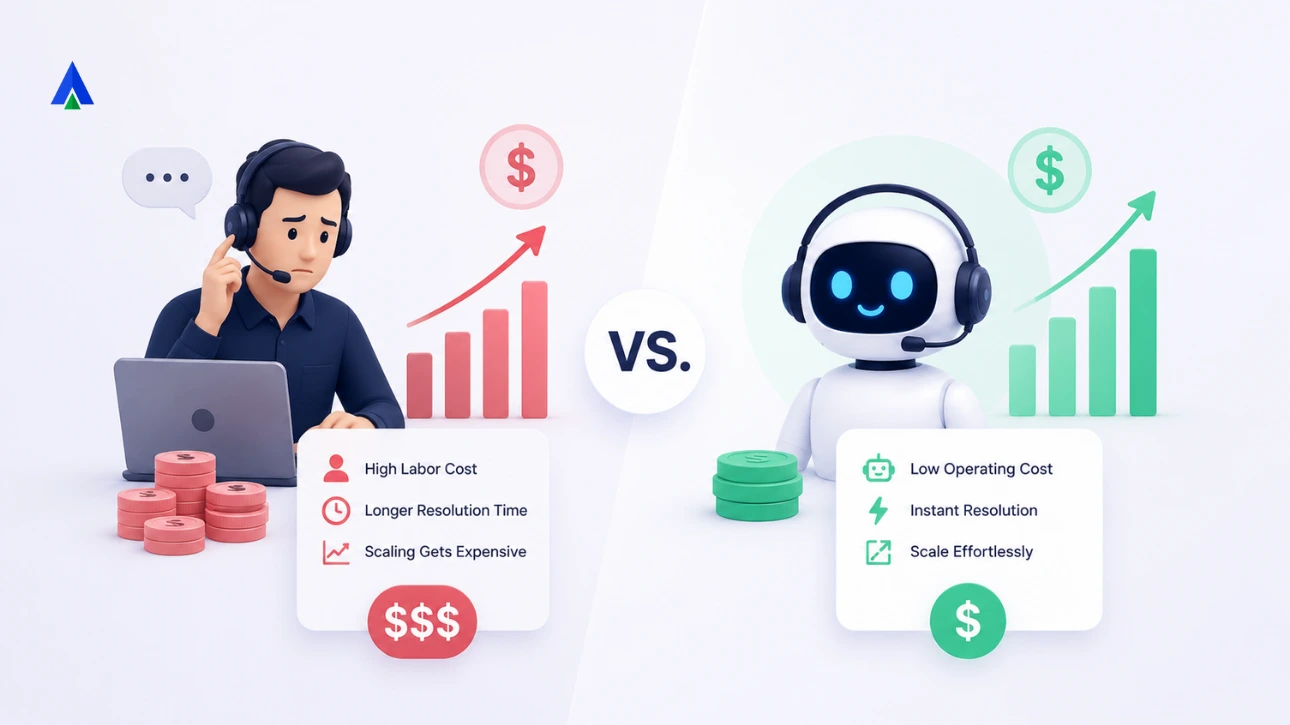
Human agents carry fixed cost regardless of call volume. They require training, supervision, and shift coverage. They produce inconsistent quality across agents and hours. They cost the same whether the call takes 2 minutes or 8.
An AI voice bot carries variable cost tied directly to usage. It scales instantly. It delivers consistent quality at 3 AM on a Sunday during Diwali week. And for e-commerce operations where the majority of calls are predictable and scriptable, that structural difference translates to savings that compound with every call handled.
FAQs
[av_toggle_container initial=’1′ mode=’accordion’ sort=” styling=” colors=” font_color=” background_color=” border_color=” hover_colors=” hover_background_color=” hover_font_color=” colors_current=” font_color_current=” background_current=” background_color_current=” background_gradient_current_color1=” background_gradient_current_color2=” background_gradient_current_direction=’vertical’ av_uid=’av-2y3zlan’ custom_class=”]
For an in-house Indian e-commerce operation, a fully loaded cost-per-call (including agent compensation, training, attrition, supervision, infrastructure, idle time, and repeat contacts) typically ranges from ₹85 to ₹150 per call.
Automation rate is the percentage of calls the bot handles without escalating to a human agent. A higher automation rate means more calls stay with the bot and the blended cost stays low.
Not immediately. The more practical outcome is redeployment. Agents shift from repetitive queries to complex escalations where their judgment and empathy add value.
The economics become compelling at around 5,000 calls per month. At 10,000 calls per month, the monthly saving in a fully loaded cost model typically runs into several lakh rupees. At 25,000 or more, the case is difficult to argue against on pure cost grounds alone.
[/av_toggle_container]