


 5 mins read


Eighteen months ago, AI was a differentiator in an outsourcing RFP. Today it is a gate. Contemporary enterprise procurement frameworks now allocate most of their total RFP scoring criteria to AI-specific evaluation factors. This category was effectively absent from most outsourcing evaluations 18 months prior. BPOs that cannot show production-ready capabilities in a vendor presentation no longer make the shortlist.
The immediate reaction from most BPO leadership teams is to build. Build an in-house AI capability, acquire a tooling vendor, staff a data science team. The economics of that reaction rarely survive a CFO review. For most BPOs with revenues below $50 million, developing proprietary AI voice infrastructure costs more than the first contract it is designed to win.
Let’s understand what enterprise buyers now require in AI BPO evaluations, why the build path is a value trap for most outsourcers, and how a structured partnership model enables BPOs to meet RFP requirements.
What Are Enterprise Buyers Now Requiring in AI BPO Contracts?
Enterprise procurement teams have restructured outsourcing RFPs to treat AI capability as a contractual obligation, not a vendor differentiator. The shift is embedded in evaluation criteria, SLA schedules, and financial penalties.
Three AI-specific requirements now appear consistently in enterprise-level BPO RFPs:
- Mandatory automation minimums: Enterprise contracts specify a floor percentage of interactions that must be handled or assisted by AI with performance against this floor subject to SLA penalties. A BPO that presents AI as a future roadmap item no longer clears this requirement.
- Interaction classification and audit trails: New contract clauses require every interaction to be tagged in real time as AI-handled, AI-assisted, or human-only. This audit trail must be exportable and available to the enterprise client on demand. BPOs without an integrated AI platform cannot produce this output.
- Hallucination risk protocols: In healthcare, financial services, and insurance, RFPs now explicitly require AI hallucination detection, prevention methodology, and incident response procedures. This is a non-negotiable requirement in regulated industry procurement.
The Deloitte 2024 Global Business Services Survey confirmed that 83% of executives are already leveraging AI as part of their outsourced services. This confirms that AI adoption is a mainstream expectation in enterprise procurement, not an experimental preference.
Why Building Proprietary AI Is a Value Trap for Most BPOs?
For most BPOs operating below $50–100M revenue, the economics of proprietary AI development do not produce a return within any contractual cycle. The upfront investment, maintenance cost, and time to production-readiness consistently exceed the contract value the AI capability is built to unlock.
Proprietary AI: A voice or contact AI system owned and operated by the BPO itself, built on custom-trained models, maintained by an internal engineering team, and deployed exclusively for that BPO’s clients.
The cost structure includes: model fine-tuning on domain-specific data (typically $100,000–$500,000+ for a production-ready contact center voice model), infrastructure for real-time speech-to-text, language model inference, and text-to-speech at sub-1,500ms latency, and ongoing maintenance as foundation models evolve typically requiring quarterly re-evaluation.
Three additional build-path risks BPO leadership teams consistently underestimate:
- Time-to-deployment mismatch: Enterprise RFPs close in 60–90 days. A proprietary AI voice bot builds for production readiness runs 12–18 months. The contract is decided before the in-house solution is ready.
- Talent scarcity: AI engineering talent required to build and maintain a voice AI system commands compensation packages that most BPOs cannot competitively offer. Teams built at cost face high attrition, particularly when the work involves maintaining a niche enterprise tool rather than building at-frontier systems.
- Technology lock-in: The AI model landscape evolves on a 6–12 month cycle. BPOs that build against a specific model architecture in 2025 risk owning a system requiring substantial re-engineering within 18 months.
Read this blog : BPO Call Center
What Does the AI BPO Partnerships Model Deliver in a Client Pitch?
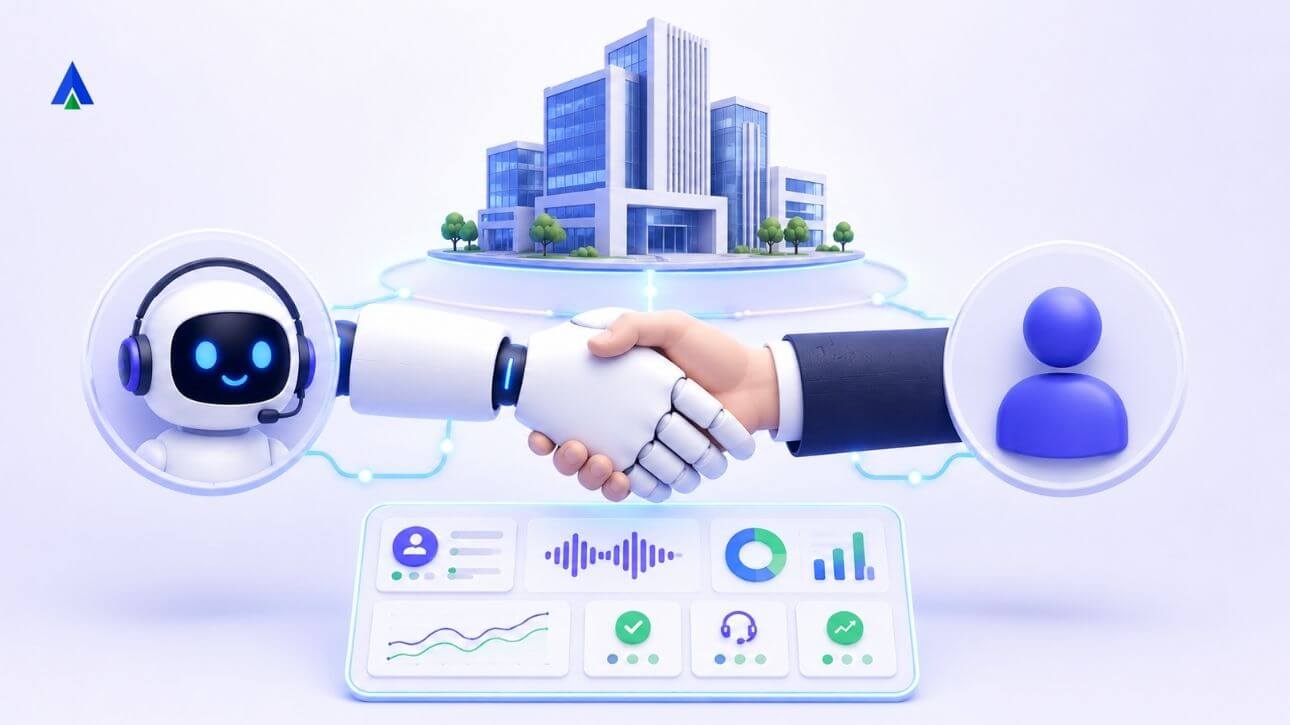
The partnership model pairs the BPO’s core competency (process expertise, workforce management, multilingual capability, compliance track record) with an AI voice platform provider’s technology stack. The BPO does not need to own the model or the infrastructure. It needs to demonstrate it, deploy it, and report on it.
A strong AI voice platform partnership gives the BPO:
- Pre-built AI voice agents: Configured for common outsourcing use cases (inbound support, outbound collections, appointment scheduling, COD confirmation, compliance callbacks) demonstrable to an enterprise prospect within days of engaging the partnership.
- Usage-based commercial model: A model that aligns AI cost to actual interaction volume no large upfront infrastructure investment, no headcount overhead. BPOs can price AI-enabled service lines on a per-interaction model transparent to the enterprise client.
- Compliance and audit infrastructure: A complete solution built into the platform interaction classification, call recording, audit trails, and reporting dashboards that satisfy the contractual requirements enterprise buyers now embed in SLA schedules.
- Rapid integration: With enterprise CRM , OMS, and telephony stacks, shortening time from contract signature to live deployment to days rather than months.
For enterprise buyers, the partnership model also delivers optionality. A BPO that partners with a specialist AI vendor and maintains transparent integration architecture is a lower-risk enterprise supplier.
How Do AI-Capable BPOs Win at the RFP Evaluation Stage?
The competitive advantage of a partnership model is not just deployment speed post-contract, it is demonstrability pre-contract. BPOs with an integrated AI voice platform can show enterprise buyers a live demo during the evaluation cycle. BPOs without one cannot.
At the RFP stage, a partnership-enabled BPO demonstrates three outputs that close the AI scoring criteria:
- Live AI voice agent demonstration: Rather than describing AI capabilities on a slide, the BPO runs a live scenario (a COD confirmation call, an inbound order tracking query, a compliance callback) against a sandbox environment representing the prospect’s workflow. This converts AI from a vendor claim to a verifiable capability within the evaluation.
- Documented audit trail output: The platform produces the interaction-level classification logs that enterprise procurement now requires in SLA schedules. The BPO shares a sample output during the RFP process, demonstrating the contractual deliverable before the contract is signed.
- Deployment timeline commitment: Platform partnerships with pre-built use case templates and CRM integrations enable a BPO to commit to a 2–4 week go-live timeline.
How AI BPO Contracts Apply to Enterprise CX Outsourcing?
For BPOs actively in enterprise evaluation cycles, the AI partnership model addresses the most common scoring gap in current RFP evaluations. It also opens a second commercial opportunity in existing client accounts.
Here’s how:
- Winning new enterprise contracts: AI voice capabilities via partnership immediately close the AI scoring gap in enterprise RFPs. BPOs can walk into an evaluation with a live demo against the prospect’s use case, a sample audit trail export, and a documented go-live timeline. These are the three elements enterprise AI evaluation criteria now require.
- Expanding existing client contracts: Enterprise clients in established BPO relationships are actively seeking AI-powered customer support as part of their current engagement. A BPO that introduces AI voice automation for high-volume repetitive call types converts a cost-center engagement into a technology-enabled service relationship.
Acefone AceX provides the AI voice infrastructure needed for this deployment model. It includes pre-configured voice agents for BPO use cases, CRM and ticketing integrations, real-time call observability, and warm transfers to human agents with complete call context. AceX operates at 500–600ms voice-to-voice latency, ensuring the call experience meets enterprise SLA expectations.
Recommended Read: BPO Cost for 50 Seat Call Center
FAQ
A: Enterprise procurement teams evaluate AI capabilities across three dimensions: demonstrated containment rate (percentage of interactions handled without human escalation), interaction classification with exportable audit trails, and a documented deployment methodology with a specific go-live commitment. A: Yes, this happens via platform partnership. The model does not require proprietary AI infrastructure. It requires integration with a specialist platform that provides pre-trained voice agents, compliance infrastructure, and usage-based commercial terms. A: Building proprietary AI is defensible when the BPO owns a unique dataset at scale, a specialized vertical with 5+ years of annotated call recordings in a domain not served by existing platforms and a client base that explicitly values proprietary technology ownership over deployment speed. A: BPOs should require at partnership initiation: multi-year pricing commitments with defined escalation caps, data portability clauses ensuring access to call logs and interaction data, and platform architecture that supports multi-vendor integration.