


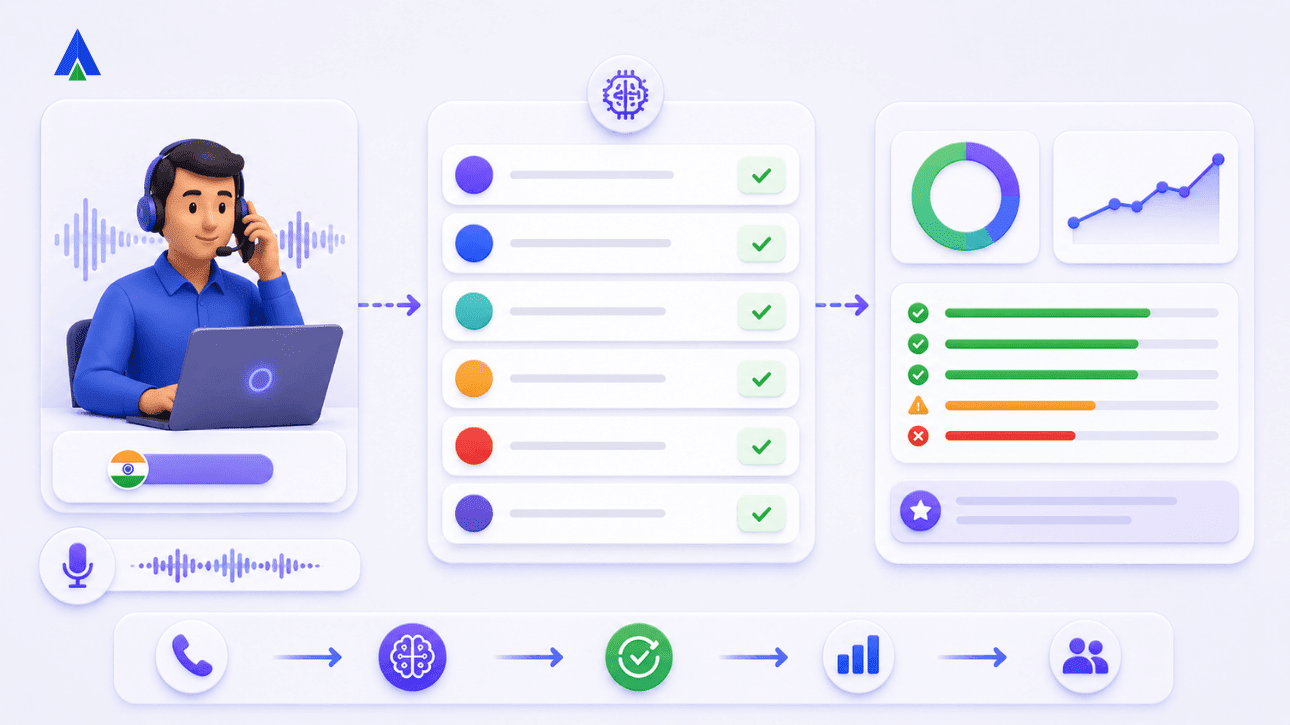


Your QA dashboard says the call was clean. The transcript says otherwise.
For most Indian contact centers running BFSI, e-commerce, or BPO operations, this gap is common. Mainstream speech to text software works well on American and British English. It stumbles the moment a customer switches to Hindi mid-sentence, speaks Tamil, or carries a strong regional accent.
Every downstream process, from sentiment scoring to compliance flagging, sits on top of that transcript. If the words are wrong, every insight built on them is wrong too. This is not a minor accuracy gap. It is the single biggest blind spot in Indian contact center QA today.
Let’s understand which solutions can help you overcome this gap.
What is Speech to Text?
Speech to text is an AI-powered technology that automatically converts spoken conversations into written text in real time or after a call ends. It helps you create accurate call transcripts, making it easier to search conversations, monitor quality, analyze customer sentiment, ensure compliance, and uncover actionable insights.
Speech-to-text software eliminates manual notetaking. This in turn improves agent productivity, and enables faster, data-driven decision-making across customer service, sales, and support teams.
Why Does Generic Speech-to-Text Software Struggle with Indian Speech?
Most mainstream speech to text software is trained mainly on American and British English datasets. Indian accents, Hinglish, and regional languages are underrepresented in that training data. The result is a measurable accuracy drop the moment a call moves away from standard English. Transcripts can look clean while misrepresenting what the customer actually said.
This is not a fringe concern. A benchmark study on Indian-accented English, Svarah, tested this directly. It found that even strong models show real accuracy drops on Indian accents (Javed et al., 2023, Svarah study). A leading global model already struggles with Indian English alone. Add Hindi, Hinglish, and regional languages, and the gap widens further.
Generic STT models are trained on Western English audio. Indian accents, Hinglish, and regional languages sit outside that training data. Accuracy drops before a single QA rule even runs.
Why Is Code-Switching a Challenge for Speech-to-Text Software?
Code-switching, a customer mixing Hindi and English mid-sentence, is one of the hardest problems for generic STT models. It is extremely common in Indian contact center audio.
Code-switching: when a speaker mixes two languages within one sentence, such as “mera EMI late ho gaya hai, sir.”
Generic models are usually trained to expect one language per utterance. When a customer switches languages mid-thought, these models default to the language they know best, usually English. They then drop or garble the other half of the sentence. In a country where Hinglish is the default register for phone support, this is not an edge case. It is the everyday call.
Mid-sentence language switching breaks the core assumption most STT models are built on: one language per utterance. Hinglish calls need models trained specifically for code-mixed speech.
Why Does Regional Language Coverage Matter for QA?
Language coverage decides which customers your QA process can actually see. A platform that only transcribes Hindi and English misses large parts of the customer base.
Tamil, Telugu, Bengali, Marathi, Kannada, Malayalam, and Punjabi speakers are common in BFSI, insurance, and e-commerce calls. If your STT engine cannot handle these languages, those calls are effectively invisible to QA. Supervisors cannot score what they cannot transcribe. Compliance teams cannot audit disclosures they cannot read. The blind spot is not evenly distributed either.
It typically falls hardest on Tier 2 and Tier 3 city customers. These customers are also the fastest-growing segment for many Indian brands.
Regional language gaps are QA coverage gaps. If the engine cannot transcribe a language, that customer segment sits outside your quality and compliance process entirely.
Recommended Blog: Call Center Speech Analytics Software
How Do Speech-to-Text Errors Impact QA and Compliance?
Every downstream QA process including call scoring, sentiment analysis, compliance flagging, is built on top of the transcript. A wrong transcript produces wrong scores at every layer above it.
This compounding effect is well documented in contact center analytics. A single error can look invisible in an aggregate accuracy report. But that same error carries real reputational and compliance weight the moment that call gets escalated or audited. A single mis transcribed word can flip a compliance flag or sentiment score entirely. Picture a borrower saying, “will pay,” mis transcribed as “won’t pay.” The transcript is not a side detail in QA. It is the input every other layer trusts.
Sentiment models, compliance checks, and coaching scores all read the transcript, not the audio. If the transcript is wrong, every layer built on it inherits that error.
Why Do Small STT Errors Compound at Scale?
A 90% accurate STT engine sounds acceptable on a single call. Applied across thousands of daily calls, that 10% error rate stops being a rounding error and starts distorting aggregate reporting.
QA teams relying on inaccurate transcripts usually end up in one of two places. Either they over-trust flawed automated scores and miss real compliance risk. Or they revert to manual call listening to double-check the AI. That defeats the purpose of automating QA in the first place. Neither outcome is acceptable at scale. STT accuracy also directly affects fairness in agent scoring.
Agents should not be penalized, or missed, for compliance issues that exist only in a mistranscription. That issue lives in the transcript, not the actual call.
Errors that look small per call become large in aggregate. At thousands of calls a day, a 10% error rate is not a rounding error. It is an unreliable QA process.
How Can One Transcription Error Change a Compliance Score?
Picture a BFSI collections call. A borrower tells the agent, “I will pay by Friday.” A generic STT engine, unfamiliar with the accent and the phrasing, transcribes it as “I won’t pay by Friday.” Downstream, the compliance model reads that transcript and flags a broken promise-to-pay. The agent gets penalized for handling the call badly. Nothing about the actual conversation was mishandled. The error was manufactured entirely by the transcription layer.
This is exactly the failure an India-first STT stack avoids. It is trained on Hindi, Hinglish, and regional audio from the start, not adapted later from an English-first model.
A single mis transcribed word can flip a compliance flag and unfairly penalise an agent. The fix sits upstream, in the STT layer, not in the scoring rules.
How Indian-Language-First Engines Perform Differently?
The fix isn’t a marginally better version of the same generalist model. It’s a fundamentally different approach. You need to look for STT engines that get trained specifically on Hindi, Hinglish, and Indian regional language audio, rather than adapted fact from an English-first model.
Providers like Acefone provide such engines that can handle code-switching more naturally. That’s because they were trained in actual multilingual audios. So, a regional dialect is not an edge case bolted on afterward. Tools like Post Call Analytics support 99+ languages, both regional and international. It can transcribe across English, Hindi, Hinglish, Marathi, Bengali, Punjabi, Kannada, Malayalam, Tamil, Telugu, and other Indian regional languages.
The same language depth carries through to Acefone’s AI Voice Agent. It handles multilingual conversations natively, not as an add-on feature.
Choosing the Right Speech-to-Text Software for Indian Contact Centers
Three things matter more than anything else when picking speech to text software for an Indian contact center. First, generic STT models are trained on Western English and consistently underperform on Indian accents. Second, code-switching between Hindi and English is the norm in Indian calls, not the exception. It needs a model built for exactly that. Third, every QA and compliance process downstream is only as reliable as the transcript feeding it.
Indian-language-first STT engines are trained specifically on Hindi, Hinglish, and regional language audio. They consistently outperform global generalist models on Indian contact center audio. When you evaluate an STT provider, put language coverage and code-switching accuracy first. Latency and cost are secondary if the transcript itself cannot be trusted.
Your QA team may be scoring calls off transcripts that mishandle Hindi, Hinglish, or regional languages. If so, those scores were never reliable to begin with. Acefone’s Post Call Analytics runs multilingual transcription and scoring built for exactly this problem. Request a demo and run it against your own BFSI, e-commerce, or BPO call recordings.
FAQs
Contact centres use speech to text software to convert call audio into text. Teams then use that text for QA scoring, sentiment analysis, compliance auditing, and CRM logging. Accuracy directly affects how reliable every one of these processes is.
Indian calls routinely mix Hindi, English, and regional languages within a single conversation. Generic STT models are trained mostly on Western English. They show higher error rates on this kind of audio than on standard English speech.
Most generic tools struggle with Hinglish because they expect one language per utterance. Mid-sentence switches between Hindi and English often get dropped, garbled, or mistranslated. That is why code-mixed audio needs a model trained specifically for it.
Yes, for narrow, low-risk use cases. A team handling only English-speaking customers with minimal compliance exposure may find a generic engine adequate. Once Hindi, Hinglish, regional languages, or regulatory compliance enter the picture, generic accuracy gaps become a real business risk.
The cost shows up as unreliable scores, unfair agent penalties, and missed compliance risks. Teams often respond by reverting to manual call listening, which adds headcount and defeats the purpose of automated QA.
Evaluate language coverage and code-switching accuracy first, since these determine whether the transcript is trustworthy at all. Latency, pricing, and integrations matter, but only after the transcription itself is reliable.


