


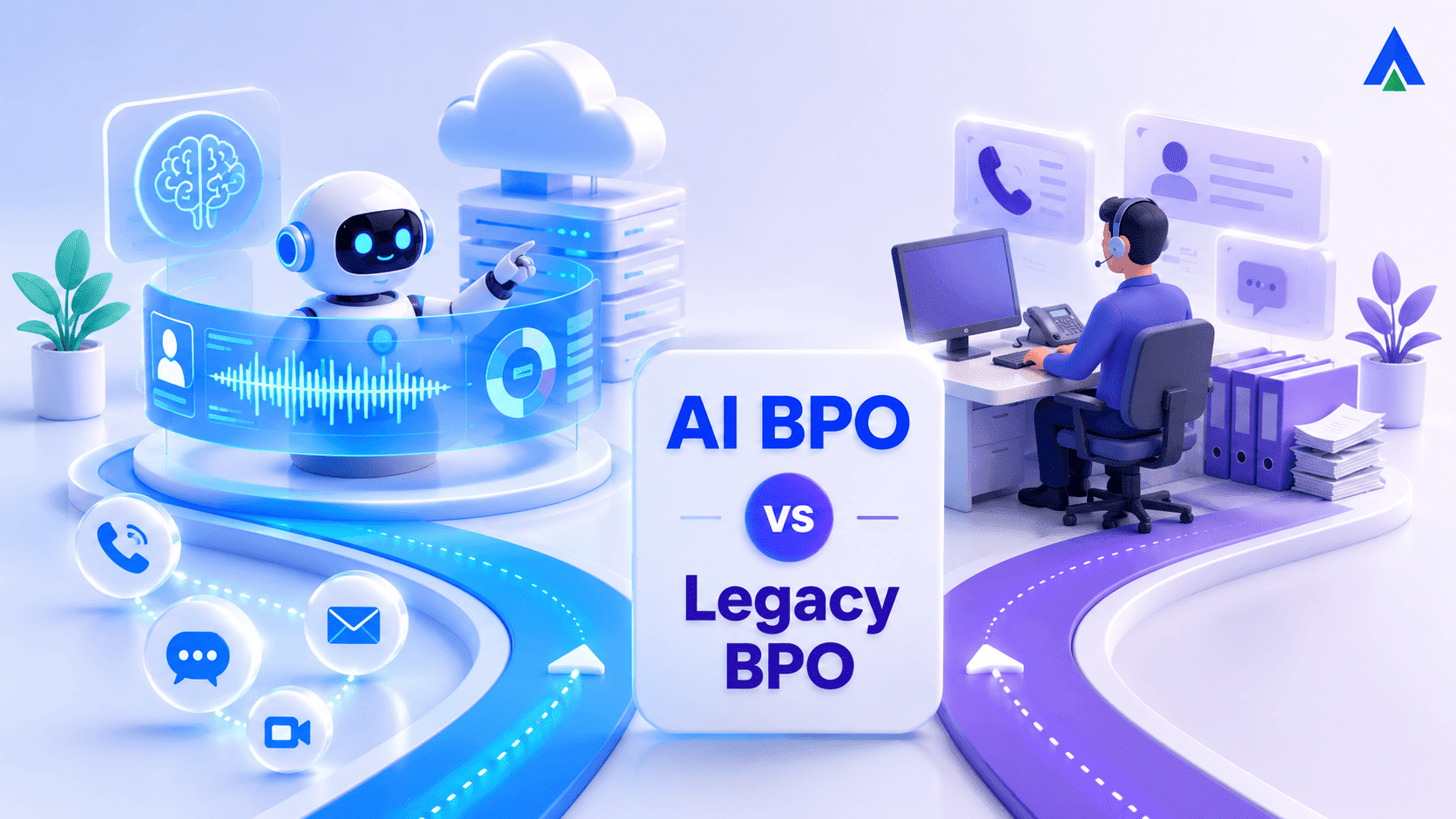


Is the BPO industry disappearing because of AI? No, that’s the wrong question. The real shift is that the AI BPO market is splitting into two camps. One side treats AI as the way it delivers work, from day one. The other side still sells seats and shifts, hoping the old playbook holds a little longer.
The gap between these two camps widens every quarter. It shows up in contracts, in pricing, and even in stock prices. This isn’t a story of BPO versus AI. It’s BPO with AI versus BPO without it, and knowing which side you’re on decides who wins the next RFP.
How Is AI Splitting the BPO Market?
Vinod Khosla put it plainly ahead of the India AI Impact Summit 2026. “IT and BPO services will disappear, almost certainly within the next five years,” he said (Khosla, via BusinessToday).
For three decades, outsourcing followed one playbook. Win the deal on cost per seat. Staff up. Hit the SLA (service-level agreement). Renew. That playbook is breaking down in 2026.
Two markets now sit inside one industry. First: AI-ready BPO. It treats AI as a core delivery layer, not a bolt-on. It bids on outcomes, not headcount. Second: the legacy labour-arbitrage model. Still priced by FTE (full-time equivalent staff). Still scales by hiring more agents in more cities.
The BPO industry isn’t shrinking. It’s splitting into AI-native operators and labour-arbitrage legacy players.
AI BPO vs Legacy BPO
| Factor | AI-ready BPO | Legacy labour-arbitrage BPO |
|---|---|---|
| Pricing model | Outcome-based, per resolution or deflection | Per seat, per FTE hour |
| SLA focus | Deflection rate, resolution time, CX quality | Average handle time, headcount fill rate |
| Tech stack | Agentic AI, conversational AI, real-time analytics | Static scripts, manual QA, legacy dialers |
| Contract structure | Shared-outcome, gainsharing | Fixed-term staffing contract |
| Capital view | Valued on AI readiness | Valued on headcount, seat count |
Read More: How AI BPO Partnerships Win Enterprise Contracts?
What Does Concentrix’s Earnings Call Prove?

Two 2025 deals kicked off this consolidation wave. Capgemini paid $3.3 billion to acquire WNS, closing the deal in October 2025 (WNS, SEC filing). TELUS took its digital arm fully private the same month, in a $539 million buyout (Investing.com).
Neither deal is the real story anymore. The real story is what’s happening inside legacy BPOs right now.
Take Concentrix. Its Q2 2026 earnings call told the story in one set of numbers. CEO Chris Caldwell reported record contract signings for its iX Suite, up 400% year over year (Concentrix Q2 2026 transcript, Investing.com). Deals combining AI, technology, and services climbed 80% year over year. That layer now touches roughly 11% of total company revenue.
Yet overall revenue grew just 0.6% in constant currency that quarter, and the stock fell sharply after results.
The same earnings deck showed what this looks like on the ground. In one energy-sector deployment, AI lifted first-contact resolution by 16.5% and cut average handle time by 6%. In retail, an agentic AI tool transcribed 175,000 calls at 85% accuracy and lifted sales close rates by 4% (Concentrix Q2 2026 slides, Investing.com).
One company, two BPOs: the AI-native sliver growing fast, the legacy base stalling. That’s the split, happening live.
TL;DR: Concentrix’s own Q2 2026 results show two BPOs inside one company. The AI layer is growing fast while the base slows.
What Separates AI BPO From Legacy BPO?
Simple test. Ask any vendor: where does AI sit in your delivery model?
Legacy BPO answer: it’s a tool agents use sometimes. It sits on top of the existing process. It doesn’t touch pricing or SLA structure.
AI-ready BPO answer: it sits inside the delivery layer itself. It shows up in three places:
- Outcome-based delivery. Pricing tied to resolution, deflection, or CX outcome, not hours logged.
- Agentic AI in contact centres. Systems handle multi-step workflows end to end, not just scripted single-turn replies.
- Tier-1 call deflection with AI voice agents. Routine queries get resolved before they reach a human.
BPOs that treat AI as a core delivery layer are pulling ahead of those treating it as a bolt-on. That’s the line separating the two camps.
TL;DR: The real split isn’t whether a BPO uses AI. It’s whether AI sits inside pricing and delivery, or just on top of it.
Why Are BPOs Losing AI-Ready Contracts?
Buyers changed first. Vendors are catching up late.
By mid-2026, enterprise procurement teams stopped treating AI as optional. Automation minimums, audit trail requirements, and financial penalties for missed targets now sit in core contract language, not aspirational add-ons.
A BPO that signs a 40% automation minimum needs production-grade capability on day one. Not a pilot, not a roadmap slide. Vendors without it lose at the RFP stage, before pricing even comes up. Some BPOs now partner rather than build in-house, just to clear this bar fast.
Clients list AI voice capability as an RFP line item now, not an add-on. Legacy BPO models built on FTE pricing and static SLAs are breaking down in 2026.
TL;DR: Automation minimums and audit trails are now standard contract terms. Vendors without production-grade AI lose before pricing is even discussed.
What Is Business Transformation Outsourcing (BTO)?
Industry has a name for where legacy players need to go: Business Transformation Outsourcing, or BTO.
BTO (Business Transformation Outsourcing): the provider owns the outcome of transforming a process, not just running it as-is.
Traditional BPO manages a process as it stands. BTO uses AI, analytics, and automation to change the outcome itself. It isn’t a new term; IT outsourcers floated it decades ago. But 2026 gives it real teeth, since agentic AI, voice automation, and real-time outcome tracking finally exist at scale.
Private equity now values BPOs on AI readiness, not headcount. India’s BPM industry hit nearly $49 billion in FY24, per NASSCOM (NASSCOM). Players like WNS, Genpact, and Firstsource, all India-origin, are repositioning around outcome-based delivery rather than pure cost arbitrage.
TL;DR: BTO means owning the transformation outcome, not just running the process. It’s an old term with new teeth in 2026.
Read More: Call Center Software Cost: Pricing Guide 2026
How Can Legacy BPOs Move to BTO?
Four moves separate operators making real progress from those just relabelling slide decks.
- Pick one workflow. Move it from FTE pricing to outcome-based pricing first, not the whole book of business.
- Deploy a working AI voice agent against one high-volume call type before pitching capability to clients.
- Build an audit trail. Tag every interaction as handled, assisted, or human-only, and make it exportable on demand.
- Renegotiate SLAs around deflection and resolution, not average handle time alone.
TL;DR: Four moves matter: one workflow, one working AI agent, one audit trail, one SLA renegotiation.
How Do You Choose an AI BPO Partner?
Every vendor claims capability. Not all have it. Five questions cut through the noise.
- Show me a working demo, against your call type, on a live system. Not a slide deck.
- What’s your deflection rate, by call category? Vague answers signal a bolt-on, not a core layer.
- How is automation priced in your model? An add-on line item means the vendor is still in the legacy model.
- What does your audit trail look like? Regulated sectors need interaction-level logs (BFSI: banking, financial services, and insurance).
- How do you handle errors and escalations? No clear human-oversight model means compliance risk, not efficiency.
TL;DR: Ask for a live demo, a deflection rate, a pricing model, an audit trail, and an escalation process.
Where Could the AI BPO Story Go Wrong?
Worth a pause. Not every claim in this space holds up.
Job displacement is real, not theoretical. Tier-1 roles shrink first as deflection rises. Legacy employers in India and the Philippines will feel this earliest, given the scale of entry-level hiring involved.
Accuracy risk is real too. Hallucination-related complaints affect roughly 0.34% of AI-handled tickets industry-wide. That drops to about 0.11% once responses are grounded in a verified knowledge base (Digital Applied). That gap matters most in BFSI and healthcare, where a wrong answer carries real compliance cost.
Watch also for “agent washing,” vendors rebranding old chatbots and rule-based automation as agentic AI. Gartner estimates only about 130 of the thousands of vendors marketing agentic AI are genuinely agentic (Gartner, via Digital Applied). Ask for the live demo. Don’t take a homepage claim at face value.
TL;DR: Job losses and hallucination risk are real, and agent washing is common. Ask for grounded numbers, not a slide deck.
What Is the Future of BPO?
Will AI replace BPO companies? No. It’s replacing the ones that refuse to change.
The future of BPO in 2026 looks like consolidation around capability, not geography. More contracts write automation in as a gate. Labour-arbitrage pricing keeps eroding quarter by quarter.
The Philippines’ IT-BPM sector is targeting nearly $42 billion in revenue and 1.97 million employees by end of 2026 (IBPAP, via Newsbytes.ph). That outpaces global BPO growth. That growth increasingly favours operators moving up the value chain: oversight, complex case management, CX transformation, not pure voice volume.
India-led BPO transformation is part of this story too. Indian delivery scale, combined with AI-native platforms, gives operators here a real shot at leading the AI-ready camp. Not just the cost camp.
TL;DR: BPO isn’t dying. It’s consolidating around AI capability, and India and the Philippines are both racing to lead the AI-ready camp.
Conclusion
The AI BPO story isn’t about disappearance. It’s about which side of the split you’re on. One camp bids on outcomes, builds AI into delivery, and wins RFPs with automation minimums attached. The other still sells seats, watching labour-arbitrage pricing erode a little more each quarter.
Three things matter most. First, the split is already visible inside single companies, not just across the industry, as Concentrix’s own numbers show. Second, BTO gives legacy players a real path forward. That only works if they start with one workflow, not the whole book of business. Third, the risks (job displacement, hallucination rates, agent washing) are real. They demand proof, not slide decks, from every vendor claiming AI readiness.
Pick a side before the market forces you to pick one.
FAQs
AI BPO is business process outsourcing where artificial intelligence sits inside core delivery, not on top of it. Providers price on outcomes like resolution or deflection instead of per-seat hours. This differs from BPO AI used only as an add-on tool for existing agents.
Artificial intelligence in BPO industry delivery is shifting contracts from FTE pricing to outcome-based models. Buyers now write automation minimums and audit trail requirements into RFPs. Vendors without production-grade AI capability are losing deals before pricing is even discussed.
No. Total BPO revenue keeps growing, including in India and the Philippines. What’s declining is the labour-arbitrage pricing model. Operators building AI into delivery are winning share from those still selling seats and shifts.
Tier-1, routine call-handling roles shrink first as AI voice agents deflect simple queries. Complex case management, oversight, and CX transformation roles are growing instead. Entry-level hiring in India and the Philippines will likely feel this shift earliest.
There’s no single industry-wide figure yet, since outcome pricing varies by call type, deflection rate, and contract structure. Most operators start with one workflow, not their whole book of business, to build a defensible comparison before scaling further.
Not automatically. Regulated sectors like BFSI and healthcare need a proven human-oversight model before scaling AI deflection. Even a low hallucination rate carries real compliance cost. Businesses with low call volume or highly variable queries may see less value from outcome pricing today.


