




Your voice bot answered 40,000 calls this month. Did it do a good job?
Most contact center teams cannot answer that with confidence. They know call volume. They know average handling time. They do not know how many bot conversations ended in frustration, confusion, or a customer quietly deciding to leave.
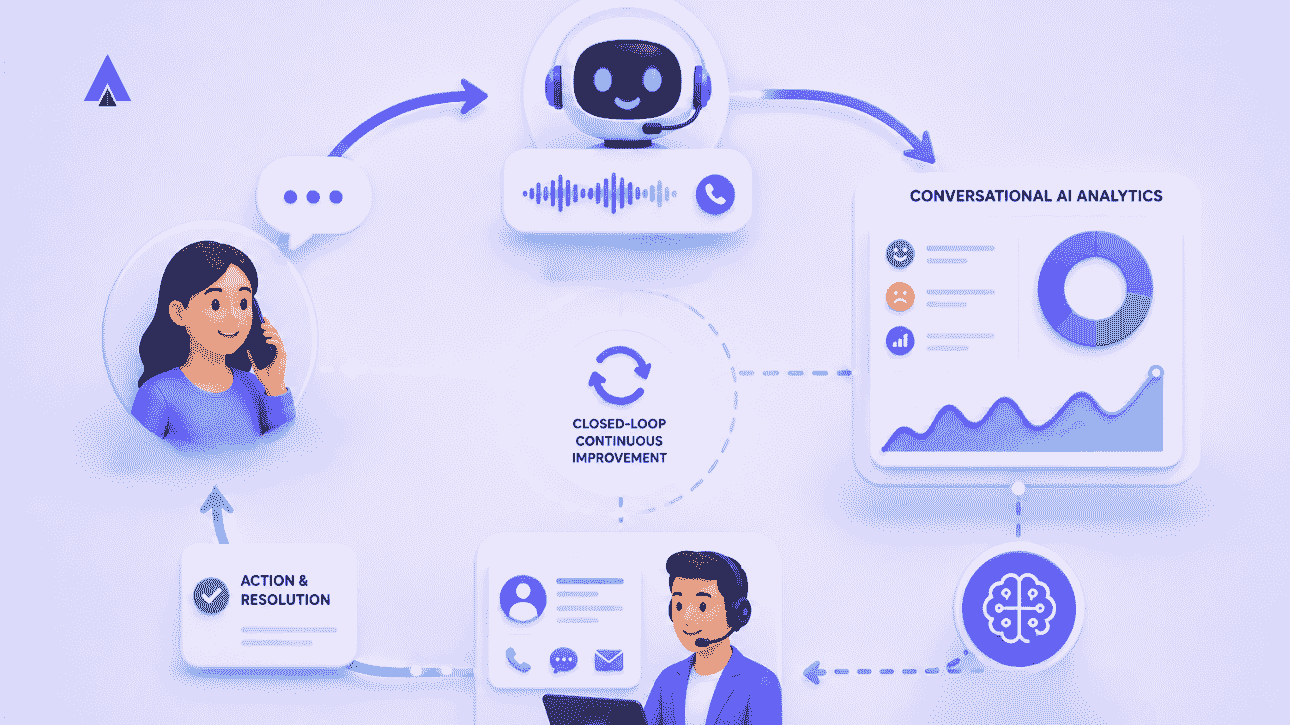
This is the black box problem. A voice bot without conversational AI analytics is a system you can measure but cannot manage. This is why you need post call analytics to close that gap. This piece explains how scoring every bot call, flagging risk in real time, and feeding insights back into the Acefone AI Voice Bot keeps performance improving instead of quietly drifting.
Why Is Your Voice Bot a Black Box?
A voice bot becomes a black box when teams track call volume but not conversation quality. You see how many calls the bot handled. You do not see how many callers got a wrong answer, repeated themselves in frustration, or hung up mid-sentence.
This gap grows as call volume grows. A bot handling 5,000 calls a month can hide hundreds of bad conversations inside a single “calls handled” number. Nobody catches it until a customer complains, or worse, until they simply stop calling.
For BPO operations leads managing bots across client accounts, this is not a minor blind spot. It is the difference between a bot you can defend to a client and one you are hoping performs.
How Does Post Call Analytics Replace Manual QA Sampling?
Post Call Analytics (PCA) scores every bot-handled call against configurable parameters, not a sample. Traditional QA reviews a small slice of calls and assumes it represents the rest. PCA scores 100 percent of conversations, so nothing about bot performance is left to guesswork.
Post Call Analytics (PCA): a system that automatically scores every recorded call against a defined quality rubric right after the call ends.
Manual QA was built for human teams, not bot scale. According to RingCentral, most contact centres review only 1 to 2 percent of conversations manually, leaving more than 98 percent untouched.
That math gets worse with bots. A human agent has judgement to fall back on mid-call. A bot follows scripted logic, so a bad pattern repeats across thousands of calls before a small sample would ever catch it.
How Does Automatic Flagging Surface Voice Bot Problems Fast?
PCA automatically flags calls with low quality scores, negative sentiment, or churn risk language the moment scoring finishes. Teams see problem calls within hours, not at the next monthly review. QA turns into a live signal, not a lagging report.
Monthly QA reviews catch problems weeks after they started. By the time a pattern shows up in a report, it may have already run through thousands of calls.
Flagging changes that. If the bot mishandles a billing question badly enough to trigger a low score, the team owning that flow finds out the same day.
What Do Call Transcripts Reveal at Scale?
PCA generates a transcript and summary for every bot call. One transcript tells you about one conversation. Hundreds of transcripts, reviewed together, reveal the same failure repeating: a question type the bot keeps misreading, a fallback that triggers too early, a flow customers keep abandoning.
This is where analytics moves from reporting to diagnosis. A single low score tells you something went wrong. A hundred low-scoring transcripts tagged to the same intent tell you exactly what to fix.
For teams managing bots across multiple business lines, this pattern detection matters. It turns improvement into something planned, not accidental.
How Does Closed Loop QA Improve Your Voice Bot?
A closed loop means analytics insights feed directly back into the bot: its prompts, its conversation flows, its escalation logic. Analytics that only sit in a dashboard are not a closed loop. They are a report nobody actioned.
Closed loop: a cycle where call analytics directly inform bot configuration changes, which then get measured again by the same analytics.
Without this loop, bot performance plateaus. Real conversations drift from what the bot was designed to handle, as customers phrase requests differently or ask new questions. A bot tuned once and left alone degrades quietly as that drift widens.
Closing the loop means the PCA team and the bot-prompt team work off the same data, on a set cadence. Fixes come from evidence, not guesswork.
How Can Sentiment Flags Help Stop Customer Churn Early?
PCA flags negative sentiment and churn-risk language on bot calls as they happen. Retention teams get a chance to intervene before a customer disengages, instead of finding out after they have already left.
According to PwC research, 32 percent of customers stop doing business with a brand after just one bad experience. A frustrated customer stuck in a bot loop is exactly that kind of experience.
Sentiment flagging changes the outcome. Instead of a silent exit, the retention team gets an alert while the customer is still reachable.
Is Your Voice Bot Fast, Cheap, and Good?
Bot side data gives you per-turn latency and cost. PCA gives you quality scores. Neither number alone is complete. A voicebot can be fast and cheap while still failing customers, or slow and expensive while scoring well on quality.
Operations leads reporting to leadership need all three numbers together. A bot that resolves calls in 45 seconds but scores poorly on accuracy is not saving money. It is creating rework and complaints downstream.
Combining latency, cost, and PCA quality scores turns a bot review from a vague impression into a defensible number. For AI teams that need real-time audio movement, Acefone Voice Streaming can support the voice AI layer behind bot analytics and improvement.
How Can BPOs Run Closed Loop QA at Scale?
Picture a BPO running voice bots for five client accounts. Every bot handled call gets scored by PCA overnight. Each morning, the ops lead reviews flagged calls: low scores, negative sentiment, churn language.
Patterns get tagged to a specific intent or flow. Once a week, that list goes to whoever owns bot prompts and conversation design. They ship a fix, and the next batch of PCA scores shows whether it worked.
Over a few cycles, this is what actually moves containment rate.
Containment rate: the percentage of bot-handled calls resolved without escalation to a human agent.
This is the operational difference between a bot that sort of works and one that measurably improves month over month. The QA team stops auditing and starts engineering bot performance. When escalation is needed, teams can route calls into Acefone Contact Center Studio or Acefone Interactions Hub with human agents ready to continue the conversation.
Conclusion: Why Conversational AI Analytics Matters for Voice Bot Performance
Three things matter here. First, a voice bot without analytics is a black box: you know volume, not quality. Second, Post Call Analytics scores every call and flags risk immediately, replacing sampling and monthly reviews with real-time signal. Third, none of this matters unless insights feed back into the bot itself.
That closed loop, not the dashboard, is what compounds bot performance over time. For BPOs and enterprises running bots at scale, this is what separates a bot that sort of works from one that keeps getting better.
See how Post Call Analytics and AceX Voice Bot work together on a real call.
FAQs:
Conversational AI analytics is the practice of scoring, tagging, and reviewing bot-handled conversations to measure quality, not just volume. It covers call scoring, sentiment detection, transcript analysis, and flagging of risk signals like churn language.
Manual QA reviews a small sample, often under 5 percent of calls, and assumes it represents the rest. PCA scores 100 percent of bot handled calls automatically, against the same configurable parameters every time.
Yes. Post Call Analytics scores both bot-handled and human agent calls against configurable parameters. Running both through one system lets teams compare containment, quality, and escalation patterns across the full contact center.
Flagged calls surface as soon as scoring finishes, typically within hours of the call ending, not at a monthly review. Teams set their own thresholds for what triggers a flag, so review speed depends on internal workflow.
If your bot handles only a handful of calls a day, manual review may still be manageable. Closed loop analytics earns its cost once volume is high enough that sampling starts missing real patterns.
BPOs can score every bot handled call, review flagged conversations each morning, tag repeated failures to specific intents or flows, and send those findings to the bot-prompt team on a weekly cadence.
Teams should review quality scores, negative sentiment, churn risk language, transcript patterns, containment rate, latency, and cost together so speed and savings are judged alongside customer experience.
Manual QA sampling leaves most conversations untouched. A bot follows scripted logic, so a bad pattern can repeat across thousands of calls before a small sample would catch it.
Sentiment analysis flags negative sentiment and churn-risk language while the customer is still reachable. That gives retention teams a chance to act before the customer quietly disengages.
Yes. Running bot-handled and human agent calls through the same scoring framework lets teams compare containment, quality, escalation patterns, and performance across the full contact center.


