


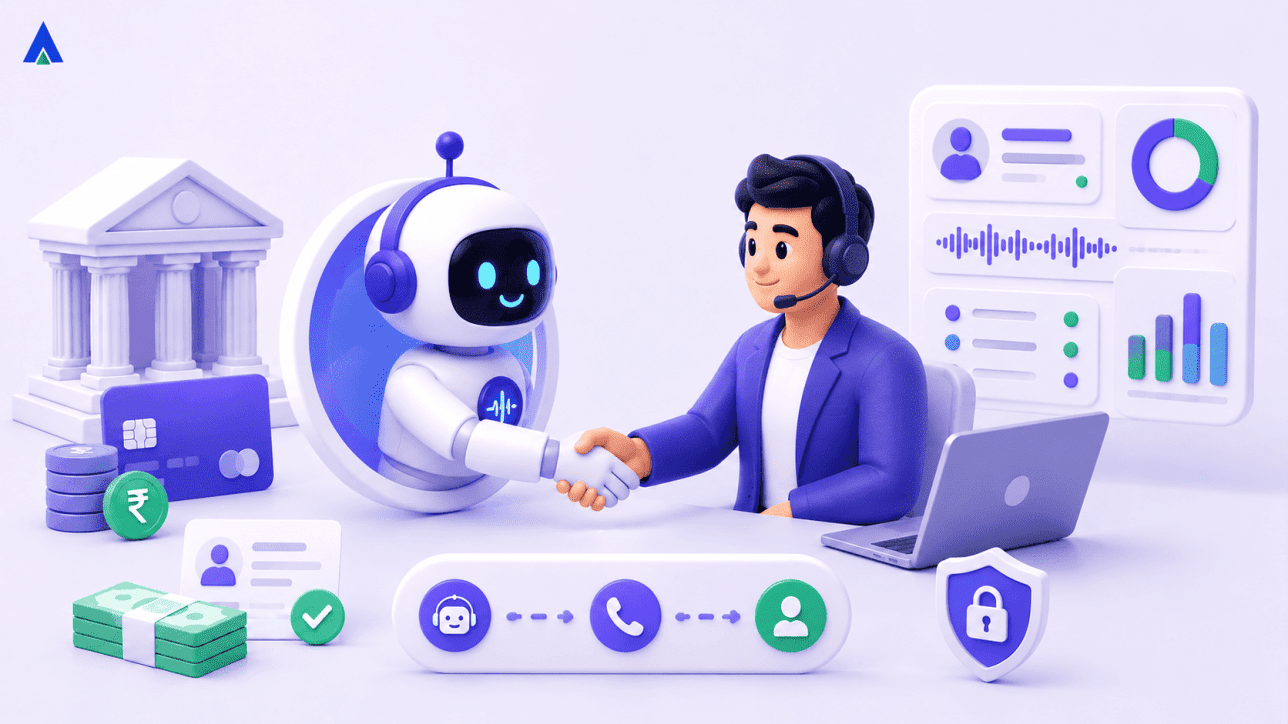


Most collections teams assume more automation means more money recovered. That is not always true. Push AI in debt collection too far, and you lose a borrower’s trust. That trust is what gets a promise kept. We built AceX Contact Center Studio on a different premise. Let AceX AgentStudio run the routine calls, then get a human on the line the moment a call stops being routine. Here is exactly how AI in debt collection works inside AceX’s own collections call center.
How Does AceX AgentStudio Open a Call?
AceX agentstudio, our AI voice agent for collections, opens every pre-due and early-overdue account the same way. It addresses the payment reminder calls in the borrower’s own language. It asks directly whether the borrower can pay anytime soon and logs the answer as a structured record, not a note.
Our voice agent can run this stage in 12 or more Indian languages, including Hindi and regional dialects. That way, the reminder never feels like a script read in the wrong tone. This is what an intelligent voice AI in debt collection looks like at the first touchpoint.
India’s Reserve Bank restricts recovery calls to daytime hours under its Fair Practices Code for lenders (CredSettle). AceX’s dialer enforces that window automatically, so AceX AgentStudio never places a call outside it. If the borrower confirms a PTP (Promise-to-pay) with no hesitation, the voice agent closes the call there. Nothing about this stage needs a human yet. That is the first stage of AI in debt collection done right.
TL;DR: AceX AgentStudio runs reminders and PTP capture on its own, in-language and inside RBI’s approved calling window.
When Does AceX AgentStudio Escalate?
The AceX AgentStudio hands off the moment it hears a hardship signal, a dispute, or a broken promise. It never waits until the voice agent has already tried to push past it. This human escalation trigger fires automatically, mid-call, with no agent needing to request it.
AceX AgentStudio checks for four triggers on every call. Any single one of them fires the handoff on its own.
- Hardship language, like a mention of a lost job or a medical emergency
- An outright dispute over the debt
- The account crossing a set days-past-due threshold
- A PTP that fails to land after a second attempt
DPD (days past due): days an EMI or installment has gone unpaid, used to bucket accounts by risk.
We built it this way on purpose. A voice agent that keeps negotiating past a hardship claim risks more than a bad outcome. It risks the relationship the human agent needs to recover the debt later. That is the human oversight piece that responsible AI in debt collection cannot skip.
TL;DR: AceX AgentStudio escalates on hardship, dispute, DPD threshold, or a failed PTP, never pushing through them first.
What Does AceX AgentStudio Handle Alone?
AceX AgentStudio owns reminders, payment links, and PTP capture for low-risk, early-stage accounts. That is the automatable core of AI in debt collection. Everything involving a dispute, hardship, or legal step goes to a human agent, by design, not by default.

Some Indian NBFC deployments report automating 60 to 70% of early stage contact this way. That is per Caller Digital’s 2026 industry analysis. It is still a fair benchmark for what the automatable side of AI in debt collection looks like today.
TL;DR: AceX AgentStudio owns early, low-risk contact. Every dispute or hardship call goes straight to a person.
What Does an AceX Agent See First?
An AceX agent opens an escalated call already holding the full transcript and the DPD bucket. That includes the outstanding amount, every prior PTP, and the exact reason the voice agent escalated. That AI to agent handoff carries full context every single time.
It includes the borrower’s sentiment signals and every past contact attempt. Any promise already made is loaded in before the agent says a word. Sticky Agent then tries to reconnect a repeat borrower with the same agent from their last call. That way, the relationship carries forward instead of resetting. For the broader logic behind voice agents and human handoff read- Voice bot to human handoff
TL;DR: AceX’s handoff carries the full transcript, DPD, prior PTPs, and escalation reason, not just a summary.
Why Does Native Beat Bolted-On AI?
Most collections call center platforms sell AI in debt collection as a voice agent alone. Then they expect you to wire it into whatever dialer you already run. AceX skips that step because AceX AgentStudio, the dialer, and the agent desk are one system already.
That matters the moment a call escalates. A bolted-on voice agent must pass context across two separate systems, and something usually gets lost in that handoff. AceX’s AI to Agent Handoff moves the full call state inside one platform. Nothing gets dropped between the voice agent’s last word and the human agent’s first one. Native architecture is what makes AI in debt collection reliable at scale, not just fast.
TL;DR: AceX runs contact center, bot, and agent desk as one system, so handoff context never gets lost between tools.
The Bottom Line on AI in Debt Collection
Getting AI in debt collection right is not about how much you automate. It is about knowing exactly which calls the voice agent should never finish alone. AceX AgentStudio runs the routine reminders and PTP capture. The moment a call gets complicated, an agent picks it up with full context, not a cold transfer. That is the whole workflow, running as one platform instead of three stitched-together tools. This is what AI in debt collection should look like at any lender running EMI recovery.
See how AceX splits your collections calls between voice agent and agent from day one. Book a demo and watch your DPD buckets get handled on a call.
Frequently Asked Questions
No. A Yale School of Management study covered over 22 million debt collection cases. It found AI-only callers got 21% fewer promises to pay than human callers did. Borrowers who did promise an AI broke that promise more often too. That is the exact risk AceX’s escalation logic is built to avoid.
AceX AgentStudio escalates on four triggers: hardship language, dispute, DPD threshold, or a failed promise to pay. Each fires automatically, mid-call, without an agent asking for it.
The agent gets the full call transcript, contact details, the entire conversation flow, and history. That includes every prior promise to pay, sentiment signals, and the exact escalation reason.
AceX AgentStudio independently runs pre-due reminders, payment link delivery, callback scheduling, and routine PTP capture. It does this in multiple Indian languages, for early-stage, low-risk accounts. This is the automatable side of AI in debt collection.
The short answer is, No. The more justifiable answer is that calls involving a known dispute, hardship case, or settlement discussion should route directly to a human agent. Starting these with a voice agent risks the outcome and the relationship.


