




TL;DR
- A multilingual call center lets customers use their own language instead of forcing everyone into English.
- Language-fluent agents, interpreters, and routing tech work together to connect callers with someone who understands them.
- India’s language diversity means English-only support leaves out most of your addressable customer base.
- Language match drives better resolution, deeper trust, and reach into markets English-only support can’t touch.
- Most businesses start with inbound support, then extend multilingual coverage to outbound and technical queues.
- Pick languages based on where your customers call from, not a generic national list.
- Check language coverage, routing tech, scalability, and reporting before committing to a setup.
Picture calling customer support with a genuine complaint, only to struggle explaining it in English. For millions of Indian customers, this happens daily. A business might operate in English, but its customers often think and speak in Hindi, Tamil, or Bengali. That gap costs sales and trust.
A multilingual call center closes it by letting people ask, complain, and buy in the language they’re most comfortable using. This guide covers what that setup looks like, how it works, and what to check before choosing one.
What Is a Multilingual Call Center?
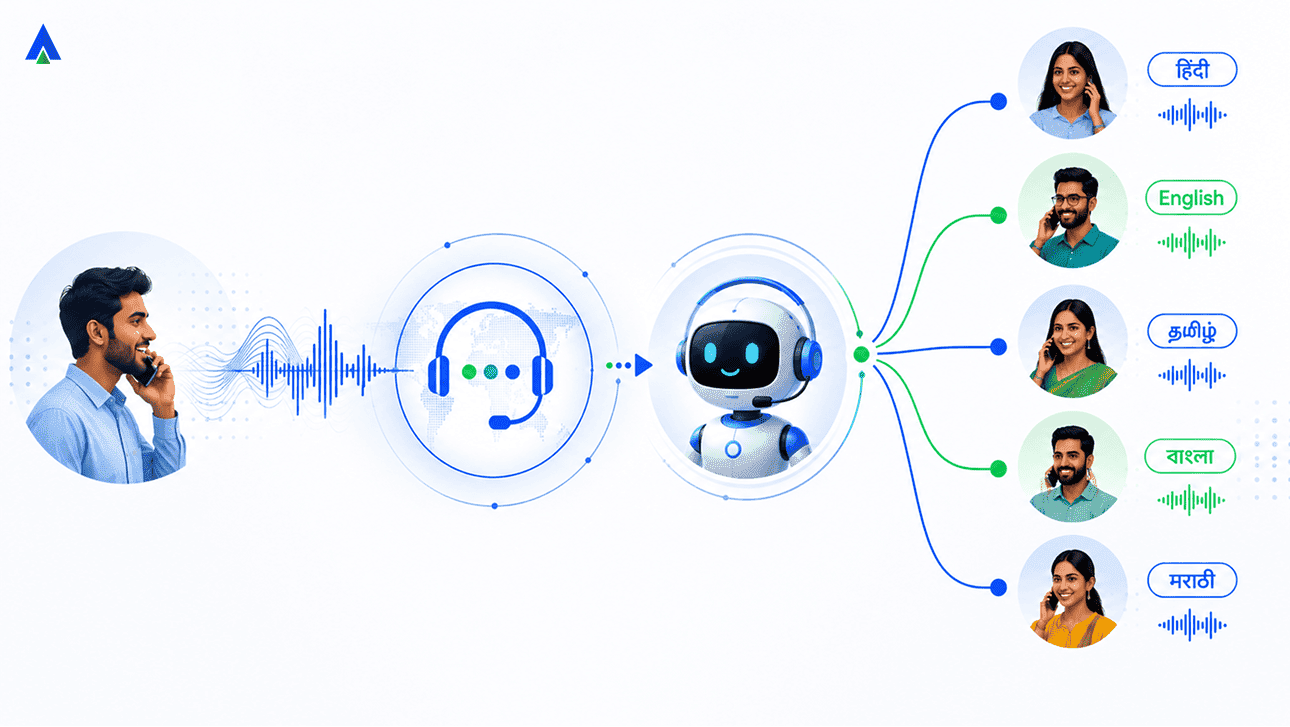
A multilingual call center is a customer support setup & provides customer support and communication across multiple languages via phone, chat, email, and social media. Instead of forcing every customer through an English-only line, it routes each contact to a fluent agent or AI system. The goal is simple: let people communicate the way they naturally do, not the way a business defaults to.
This differs sharply from a single-language setup, where every caller adapts to the business instead of the other way round. A single-language center might redirect a Tamil-speaking caller to a translator, or worse, ask them to manage in broken English. A multilingual setup builds language options into the system itself, through staffing, technology, or both.

How Does a Multilingual Call center Setup Work?
Multilingual call centers work through three components: language-fluent agents, interpretation support, and technology-based call routing. Larger centers hire agents across major languages directly. Smaller teams often pair English-speaking agents with interpretation services. Most setups also rely on routing technology that identifies a caller’s language and directs them automatically.
IVR (Interactive Voice Response) – an automated phone system. It lets callers make menu selections using their voice or keypad before reaching an agent.
The routing layer matters most at scale. A well-built system asks callers to pick a language early, often through an IVR menu. It then sends the call to a matching ai voice agents or bot. Without it, businesses either overstaff every language around the clock, or leave callers waiting for an agent to free up.
Why Do Indian Businesses Need Multilingual Call Centers?
India has 22 scheduled languages and hundreds more spoken across states. Most customers are more comfortable in a regional language than in English. Businesses that support only English exclude a large share of their market, especially outside metro cities.
Census 2011 data puts this in perspective. Hindi accounts for 43.63% of India’s population as a first language. Bengali, Marathi, Telugu, and Tamil each have tens of millions of speakers (Census 2011 language data). Just over a quarter of Indians, 314.9 million people, are bilingual, but most stay most comfortable in one primary language.
IAMAI and Kantar’s 2024 Internet in India Report adds another point. 98% of India’s internet users engage with Indic-language content, and 57% of urban users actively prefer it (IBEF, 2025).
Quick stats:
- 22 scheduled languages recognized in India
- 43.63% of Indians speak Hindi as a first language
- 314.9 million Indians (just over a quarter) are bilingual
- 98% of India’s internet users engage with Indic-language content
What Are the Benefits of a Multilingual Call Center?
Multilingual call centers improve customer experience and raise resolution rates. They also widen market reach into regions an English-only team can’t serve well. Customers trust businesses that meet them in their own language.
- Better customer experience: callers explain issues clearly the first time, without translation guesswork
- Higher first-contact resolution: agents understand context and nuance, not just words
- Wider market reach: businesses can serve tier-2 and tier-3 customers who default to regional languages
- Stronger customer trust: language match signals a business built for its audience
What Services Can a Multilingual Call Center Handle?
These multilingual contact center services typically span inbound support, outbound calls, technical support, and telemarketing. Most Indian deployments start with inbound support, since that’s where language mismatches cause the most friction. They then expand into outbound and technical queues.
Inbound support covers order status, complaints, and general queries; it’s usually the first queue businesses localize. Outbound calling, including collections and renewal reminders, benefits just as much. A caller who understands the message is more likely to act on it. Technical support needs the deepest fluency, since customers describing a problem in their own words help agents diagnose it faster. Reporting on how each language queue performs, through call center analytics, shows where language gaps still cost calls.
Which Languages Should an Indian Call Center Support?
Language choice should follow your customer base, not a generic list. Hindi, Tamil, Telugu, Marathi, Bengali, Gujarati, and Kannada cover most of India’s population. These align with the country’s largest scheduled language groups. Beyond that, look at where your actual customers call from.
A Chennai-based business gets more value from Tamil support than Bengali. A pan-India BFSI or ecommerce brand usually needs coverage across most major regional languages, plus Hinglish. Customers often mix Hindi and English mid-call. Start with the two or three languages your call logs already show the most demand for, then expand.
How Do You Choose the Right Multilingual Call Center Setup?
Choosing a multilingual call center setup comes down to four checks: language coverage, routing technology, scalability, and reporting. Most multilingual call center software handles the routing piece through configurable IVR flows, so this shouldn’t need custom development.
- Language coverage: Does the vendor support your top 3-5 languages natively?
- Routing technology: Can the system route calls by language without manual transfers?
- Scalability: Can you add languages or agents as you grow into new regions?
- Reporting: Can you see language-wise call volume through tools like post-call analytics?
At Acefone, our cloud contact center platform handles this through language-based routing and IVR. Calls reach the right agent without extra transfers.
How Does a Multilingual Call Center Apply to Indian Businesses?
Take a BFSI collections team calling customers about overdue payments. A customer who understands the call in Hindi or Tamil is more likely to engage instead of hanging up. The same logic applies to ecommerce order support, where a confused customer often abandons the call. It also applies to healthcare reminders, where clarity genuinely matters. In our work with contact center teams across these sectors, language mismatch consistently drives abandoned calls.
In each case, the setup looks similar. Route by detected or selected language, connect to a fluent agent or bot, and log the interaction. This lets teams measure which languages need more coverage. A good multilingual contact center solution keeps this process consistent. Only the language layer changes.
Key Takeaways
Three things matter most here. First, a multilingual call center is closer to table stakes in India than a nice-to-have. Too many customers think in a regional language for it to be optional.
Second, routing and IVR matter as much as hiring multilingual agents. Third, choosing a setup means matching languages to your actual customer base. Then check that routing, scalability, and reporting hold up as you grow.
Curious how routing and IVR come together in practice? Take a look at Acefone’s cloud contact center solution to see how multilingual call routing actually works.
Frequently Asked Questions
A multilingual call center is a support setup that handles calls, chats, or emails in more than one language. It routes each customer to a fluent agent or system, instead of forcing everyone through a single-language line.
Hindi, Tamil, Telugu, Marathi, Bengali, Gujarati, and Kannada cover most of India’s population. These are the largest scheduled language groups from Census 2011. The right mix depends on where your specific customers call from, not a generic national list.
Yes. A bilingual setup supports exactly two languages, usually English plus one regional language. A multilingual call center supports three or more, with routing technology that directs each caller to the right one automatically.
Cost depends on approach. Hiring agents across every language is expensive; pairing a smaller team with interpretation services or routing technology keeps costs lower. Most businesses start with their top 2-3 languages by call volume and expand from there.
Yes. Routing technology uses IVR menus, caller data, or language detection to identify a caller’s preferred language. It then sends them straight to a matching agent, without manual transfers or extra hold time.
Not always immediately. A small, geographically concentrated, English-comfortable customer base may not need one yet. But most businesses serving customers across Indian states benefit from basic language coverage, especially in BFSI, ecommerce, or healthcare.


