


 6 mins read


If you have been researching AI voice bot platforms, Vapi has probably come up. It has strong developer adoption, wide API coverage, and a low advertised base rate. On paper, it looks like a capable option.
The question for an e-commerce operations head, CX manager, or founder is not whether Vapi is a good platform. It is whether Vapi is the right platform for your use case. And for most non-technical e-commerce teams, the answer is no.
Let’s break down the two platforms across the dimensions that actually matter for e-commerce deployment: setup, use case fit, pricing transparency, India-specific capability, and operational independence.
Who Each Platform Is Built For?
This is the most important distinction and the one that determines everything else.
Vapi is a developer-centric platform. It requires programming knowledge, lacks pre-configured voice flows and industry-specific templates, and has no UI dashboard for non-technical users. For teams without dedicated technical support, it significantly increases time to launch.
AceX is built for operations teams. It offers a no-code visual builder, pre-built e-commerce call flows, and a dashboard that CX and operations managers can use without engineering support. A COD confirmation flow or a WISMO bot can be live in hours, not weeks.
If your team includes developers who want to build from scratch and customize at the infrastructure layer, Vapi gives you that control. If your team is a CX head, an operations manager, and a product lead who need a working voice bot without a development sprint, AceX is the platform designed for you.
Setup and Time to Launch
Vapi
Building a reliable and accurate voice bot on Vapi requires a prolonged development process and continuous manual refinement. Each change requires the bot to be tested again by talking to it, with no automated testing layer for non-technical teams. You need to understand JSON, work with voice APIs, and in many cases write Python code before a functional agent is deployed. Call Center Studio
For an e-commerce team without in-house developers, Vapi is not a self-service platform. You are either hiring a developer, working with an agency, or waiting for engineering bandwidth.
AceX
AceX is built for non-technical deployment. The visual builder lets you configure call flow logic through a canvas interface. Prompt setup is done in plain language. Pre-built connectors for common OMS, CRM, and logistics platforms reduce integration time. For standard e-commerce flows, the path from setup to first live call is measured in hours, not sprints.
Teams that need to move fast — ahead of a festive season campaign, a new COD region launch, or a returns volume spike — cannot afford a four-week developer build cycle. AceX is designed around that operational reality.
Pricing Transparency
Vapi
Vapi advertises a base rate of $0.05 per minute. But this represents only a fraction of the total deployment cost. When you add speech-to-text, text-to-speech, LLM inference, and telephony costs, the real per-minute rate can be 3 to 10 times the advertised figure. Kodif
Vapi uses a bring-your-own-key (BYOK) model. You connect your own API providers for each component — transcription, language model, voice synthesis. Each of these carries a separate cost. A buyer who sees $0.05 per minute and builds a business case around that number will receive a very different invoice.
AceX
AceX pricing is all-inclusive. The per-minute rate covers the full call stack — telephony, transcription, language model, and voice output. There are no component-by-component add-ons to budget for separately. For Indian e-commerce operations, the rate applies to calls handled entirely within the platform, with no hidden carrier pass-through charges.
For procurement managers and founders building a cost model, the difference between a BYOK platform and an all-inclusive platform is the difference between a predictable invoice and a variable one that requires ongoing monitoring.
E-commerce Use Case Coverage
Vapi
Vapi supports general-purpose voice agent development. It does not ship with e-commerce-specific templates, pre-built flows for COD confirmation, WISMO, delivery updates, or returns automation. Every use case starts from a blank configuration.
This is fine if you have developers who know what they are building. It is a significant barrier if you are a CX head who needs a COD confirmation bot live before a sale event starts.
AceX
AceX is purpose-built for e-commerce voice automation. Pre-configured flows for COD confirmation, order status, delivery update calls, cart recovery, and return initiation are available out of the box. These are not demo templates, they are production-ready flows based on real Indian e-commerce support patterns.
For operations teams managing COD confirmation, WISMO, and delivery update calls at scale, this means the core work is configuration and customization, not building from zero.
India-Specific Capability
Vapi
Vapi is a US-based platform built primarily for the English-language market. Indian language support, Hinglish handling, and regional accent recognition are not core product priorities. For Indian e-commerce operations where a significant portion of customers speak Hindi, Tamil, Telugu, Marathi, or regional Hinglish, Vapi’s language model performance on these inputs is inconsistent.
Telephony for Indian numbers through Vapi requires integration with a third-party provider such as Twilio. This adds cost, configuration complexity, and an additional dependency to manage.
AceX
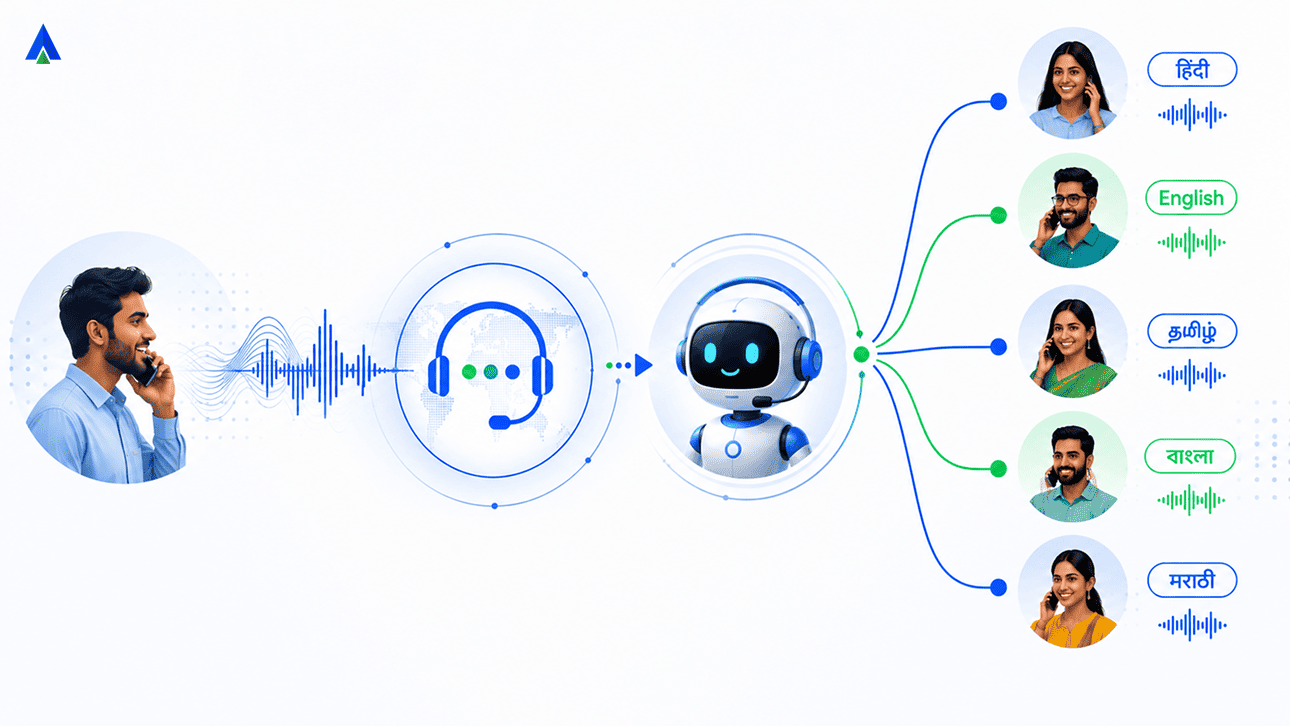
AceX is built for the Indian market. Language support covers Hindi, Hinglish, and major regional languages with models trained on real Indian customer call data — not generic multilingual models applied to Indian accents as an afterthought.
Telephony is bundled. Indian DID and outbound calling through registered CLIs is handled within the platform. There is no third-party telephony layer to configure or pay for separately.
For e-commerce operations serving customers across Tier-1, Tier-2, and Tier-3 cities, this is not a minor distinction. A bot that misunderstands a Hinglish order status query or cannot handle a Tamil-speaking caller correctly is not a working bot.
Operational Independence
Vapi
Because Vapi is developer-centric, ongoing changes to call flows, scripts, and escalation logic typically require developer involvement. A CX manager who wants to update a script ahead of a sale event cannot do it independently. A new use case requires a new build cycle.
This creates a structural dependency on engineering that most e-commerce operations teams want to avoid.
AceX
AceX is designed for operational independence. CX and operations teams can update prompts, modify call flow branches, adjust escalation triggers, and launch new campaigns without engineering support. The platform is owned by the business team, not the IT team.
This independence matters most during time-sensitive moments — pre-festive season preparation, rapid response to a logistics issue, or iteration based on early campaign performance. When your team can make changes immediately, the platform becomes a competitive advantage. When every change requires a ticket, it becomes a bottleneck.
Who Should Choose Vapi?
Vapi is a strong platform for the right buyer. If you are a technical team building a custom voice product, want full control over every component of the stack, and have developers who can own the build and maintenance, Vapi gives you that flexibility.
If you are an e-commerce operations team in India that needs a voice bot deployed fast, maintained independently, and built for Indian customers, Vapi is the wrong starting point.
Conclusion
The comparison between AceX and Vapi is not a close call for most e-commerce buyers. Vapi is a developer infrastructure platform. AceX is an e-commerce voice automation platform. They serve different buyers with different needs.
If your team does not have developers to spare, if you need to go live in days rather than weeks, if your customers speak Hindi and Hinglish, and if you want a predictable invoice, AceX is built for that. Vapi is not.
FAQs
[av_toggle_container initial=’1′ mode=’accordion’ sort=” styling=” colors=” font_color=” background_color=” border_color=” hover_colors=” hover_background_color=” hover_font_color=” colors_current=” font_color_current=” background_current=” background_color_current=” background_gradient_current_color1=” background_gradient_current_color2=” background_gradient_current_direction=’vertical’ av_uid=’av-2y3zlan’ custom_class=”]
[av_toggle title=’Is Vapi suitable for non-technical e-commerce teams?’ tags=” av_uid=’av-n109kf’]
No. Vapi requires programming knowledge to set up and maintain. Non-technical teams without developer support will face significant barriers to deployment and ongoing changes. It is designed for engineering teams building custom voice products, not for CX or operations managers running e-commerce workflows.
[/av_toggle]
[av_toggle title=’How does AceX pricing compare to Vapi?’ tags=” av_uid=’av-n109kf’]
Vapi advertises a low base rate but uses a BYOK model where transcription, language model, voice synthesis, and telephony are all additional costs. Total cost can be 3 to 10 times the headline rate. AceX uses an all-inclusive per-minute rate with no separate component charges, making cost modeling straightforward.
[/av_toggle]
[av_toggle title=’Does Vapi support Indian languages and telephony?’ tags=” av_uid=’av-n109kf’]
Vapi has limited and inconsistent support for Indian languages including Hindi and Hinglish. Telephony for Indian numbers requires a third-party integration such as Twilio. AceX is built for the Indian market with native Hindi, Hinglish, and regional language support plus bundled Indian telephony.
[/av_toggle]
[av_toggle title=’Can my operations team manage AceX without developer help?’ tags=” av_uid=’av-n109kf’]
Yes. AceX is designed for non-technical operational independence. CX and operations managers can update scripts, modify call flows, adjust escalation logic, and launch new campaigns through the visual builder without engineering support.
[/av_toggle]
[/av_toggle_container]