


 5 mins read


AI agent coaching is not one product. Most people use the phrase for two completely different things. One is live, in-call whispers. The other is scoring calls after they end. Vendors pick whichever they already sell and call it the whole thing. That mix-up costs contact centers in real time when they buy the wrong tool for the wrong job.
This piece is about the latter: agent coaching built from scores on every single call, not a sample. We built that half at Acefone and named it Xtract. Our conversational AI analytics software that you can run across contact centers every day.
Here is how the coaching side of it actually works, and where it stops.
AI Agent Coaching vs Quality Assurance
AI agent coaching uses scored call data to plan what an agent should improve next. Quality assurance uses the same scores to check if an agent met a standard. QA asks, “did this call pass.” Coaching asks “what should this agent practice this week.” Xtract feeds both from one scoring pass, but they are not the same job.
As promised, here’s where the real-time assistance for AI agent coaching fits in. It is an AI copilot suggesting what to say while the customer is still on the line. Xtract can flag a sentiment shift the moment it happens. But the coaching workflow itself, the scoring, checklist, and queue, runs after the call ends.
Traditional QA teams review a small slice of calls and file a pass or fail. Acefone’s own data puts that slice at 1 to 5% of calls. That is not enough data for real coaching. It’s also why Gartner expects conversational AI to cut contact center labor costs by $80 billion by 2026
TL;DR: AI agent coaching plans what an agent should improve next, using scores from every call. QA just checks if a single call passed, and most QA programs only see about 1% of calls to check.
How Does AI Agent Coaching Work?
Xtract turns every recorded call into a transcript, a score, and a set of flags a supervisor can act on. It does not just record; it reads what it captured. Each call moves through four steps: transcription, scoring against a fixed checklist, sentiment flagging, and compliance detection. That is the mechanism. What Xtract does with the result next is where AI agent coaching actually starts.
Plain AI call recording software stops at the recording and maybe a transcript. Xtract goes leagues beyond. It scores the call against a fixed checklist and flags sentiment shifts and compliance phrases in the transcript. Then it hands over the result to a coaching workflow, not just a report.
Post-call scoring: grading a completed call transcript against a fixed quality checklist, without a human listening first.
TL;DR: Xtract scores every call and flags sentiment and compliance issues, well beyond what plain call recording software does.
From Score to Coaching Queue: Post-Call Coaching Explained
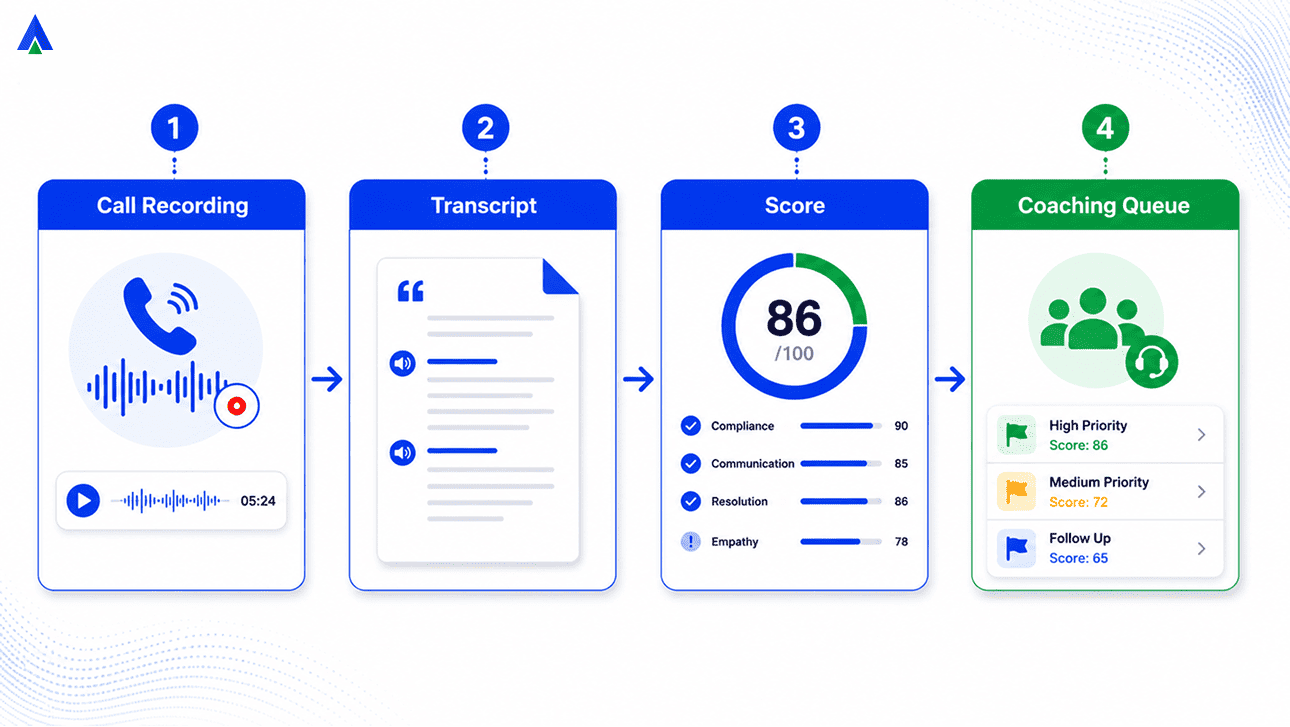
A single low score on one call is not a coaching plan. A pattern of low scores across ten calls is. This is the part most call scoring tools stop short of, and it’s the actual point of AI agent coaching. Most tools stop at the number and leave pattern-spotting to a spreadsheet. AI agent coaching turns that pattern into a real next step for the agent, not just a lower score.
Xtract auto-generates coaching queues from these patterns. If an agent scores low on objection handling across several calls, the pattern gets flagged automatically. The agent lands in a coaching queue with the calls attached as evidence. A supervisor coaches from those real moments, not a vague impression.
Acefone’s Chief Product and Technology Officer said this on Xtract’s launch: PR Newswire. “At Acefone, we don’t pursue artificial intelligence merely to follow trends. Instead, we believe in building solutions that maximize value for our users.” That focus on real value over the trend shows up directly in the coaching queue, not just the score.
This matters financially, not just operationally. McKinsey found a 500-agent center spends roughly $2 million a year on coaching. Yet it still sees a 30-to-40-point gap between top and bottom quartile agents. Coaching built on guesswork is expensive and often misses. Xtract customers see coaching cycles run 3X faster once queues replace manual sampling.
TL;DR: Xtract turns low-scoring patterns into coaching queues, so supervisors coach from evidence and cut cycle time roughly 3X.
Is AI Call Scoring Accurate Enough to Trust?
Not as a final verdict, and we say that on purpose. This is where AI agent coaching lives or dies on trust. Xtract’s own scoring guidance describes agent and customer scores as directional, not absolute judgments. A perfect-sounding accuracy number means nothing if a supervisor cannot see why a call scored the way it did. That visibility is the actual trust mechanism, not the score itself.
That sounds like a weakness until you see how it is used. A directional score tells a supervisor where to look first. Every score comes with the transcript and the exact moment that triggered it. A supervisor can check the reasoning instead of trusting a number blind.
This is a deliberate design choice, not a limitation. Competing tools that promise a single, unquestionable accuracy percentage ask you to trust a black box. Xtract asks you to verify a flagged moment in under a minute, then decide. For AI call scoring used to plan real coaching conversations, that is the safer default.
Does AI Call Scoring Work in Multiple Languages?
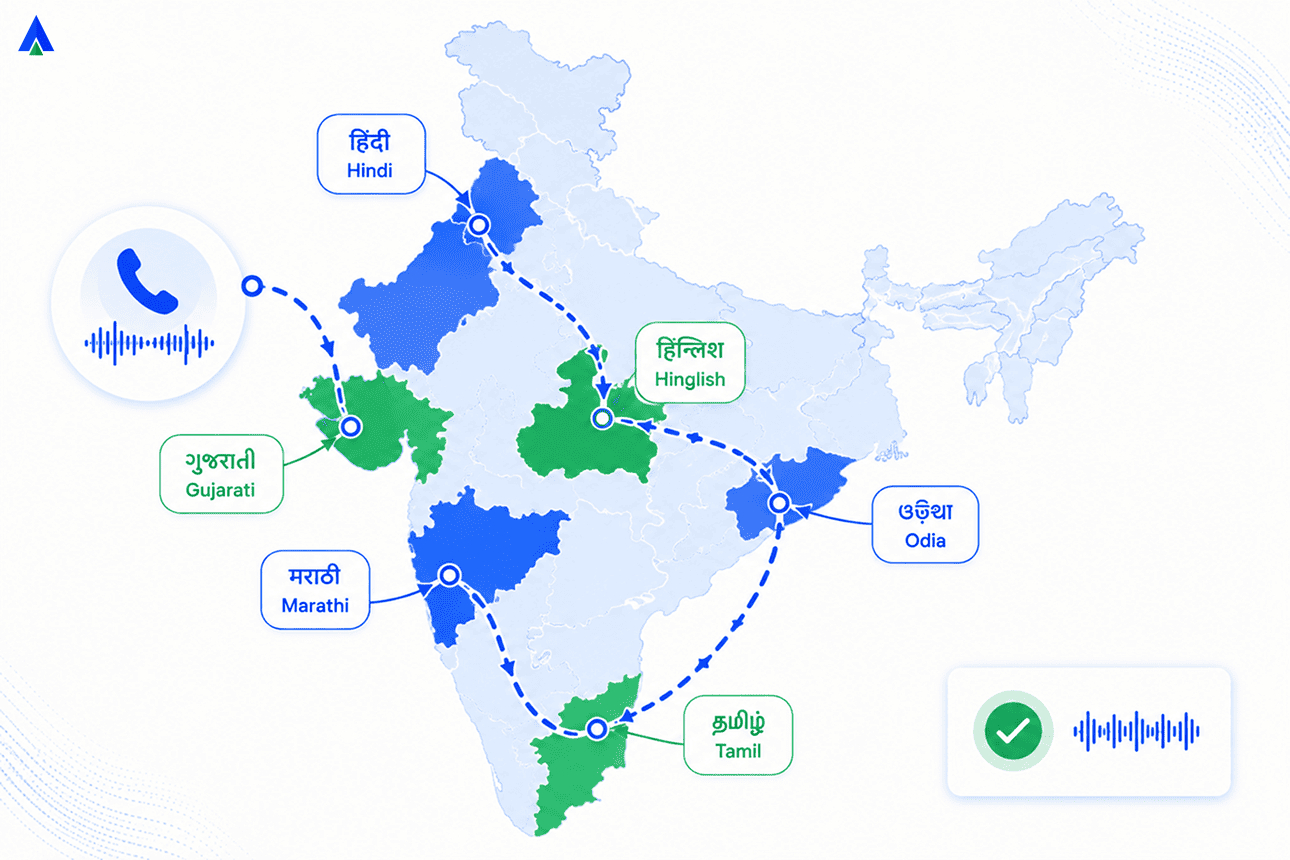
Yes, and this is where most call scoring tools we have reviewed simply stop. Xtract supports 99+ languages, including Hinglish and several regional Indian languages, inside a single scoring pass. Most vendors we reviewed score English calls well and quietly fall apart on anything else. That gap alone can invalidate a scoring program for an Indian floor before it even starts.
Indian contact centers rarely run one language. An agent can open in Hindi, shift into English, and close in Hinglish, all in one call. Xtract’s 2026 update added one-click transcript translation to English. A supervisor can read a Tamil or Hinglish call in English instantly. The original stays intact for compliance records.
For an India-based coaching program, this is not a nice-to-have feature on a checklist. AI agent coaching that ignores half your call volume over a language gap is not coaching at all. It decides whether the rest of this piece, the coaching queues and the trust model, applies to your floor.
TL;DR: Xtract scores calls in 99 languages, including Hinglish and regional Indian languages, with one-click transcript translation.
Call Reporting Automation: Every Score in One Dashboard
Picture a QA manager at a 200-seat BPO logging in on a Monday morning. Every call from the weekend is already scored. This is AI agent coaching and call reporting automation doing their actual job, not just a chart refreshing itself. No one spent Saturday sampling calls by hand. The system did that work overnight on every single call.
The dashboard shows three things together:
- A Sentiment Card summarizing customer mood
- A Quality Checklist score against the six core criteria
- A coaching queue sorted by pattern severity
QA managers can also edit scoring prompts themselves now, using Xtract’s self-serve configuration, without waiting on an engineering ticket.
This is call analysis with a specific job to do, not a prettier report. It hands you a ranked list of who to coach today, and why, before their first cup of coffee. We have seen this pattern play out on our platform before, in different workflows.
TL;DR: Xtract’s dashboard combines sentiment, quality scores, and a coaching queue, turning call reporting automation into a daily to-do list.
Takeaway
AI agent coaching, the post-call kind, is not about scoring more calls. It is about turning those scores into a coaching queue a supervisor can actually act on. Three things matter most from everything above. First, coaching and QA use the same score for different jobs. Xtract hands off cleanly between the two. Second, a directional score with a visible transcript beats a black-box accuracy claim you cannot verify. Third, for an Indian contact center, multilingual scoring is not optional. It is the difference between coaching your whole floor and coaching only half of it. Xtract runs all three together, on every call, every day.
Frequently Asked Questions
AI agent coaching uses call scores to decide what an agent should practice next. It replaces guesswork from a handful of calls. Real-time coaching whispers guidance mid-call. Post-call coaching, Xtract’s approach, scores the finished call and builds a queue. Most teams start with post-call coaching since it needs no live integration.
Most manual QA programs review a small fraction of total call volume. Acefone’s own data puts that figure at 1 to 5% of calls where on the contrary Xtract scores 100% of calls instead. Read more here- Acefone AI Speech Analytics
Xtract's AI agent coaching features run on top of Acefone's contact center plans, not as a separate line item. Exact cost depends on seat count and features enabled. Check the pricing page for current plans or talk to sales for a quote sized to your call volume.
Xtract treats scores as directional signals, not final verdicts, and links every score back to the transcript moment behind it. A supervisor can verify a flagged call in under a minute. It is accurate enough to prioritize, not accurate enough to skip a human check.
Xtract scores calls in 99+ languages, including Hinglish and several regional Indian languages, within a single scoring pass. It also offers one-click transcript translation to English for supervisor review. This matters most for Indian contact centers running mixed-language conversations in a single call.
Not always. A team making fewer than a few hundred calls a week may not need automation yet. A human QA reviewer can often check every one of those calls directly. AI agent coaching earns its cost once call volume outgrows what any reviewer could realistically cover alone.