


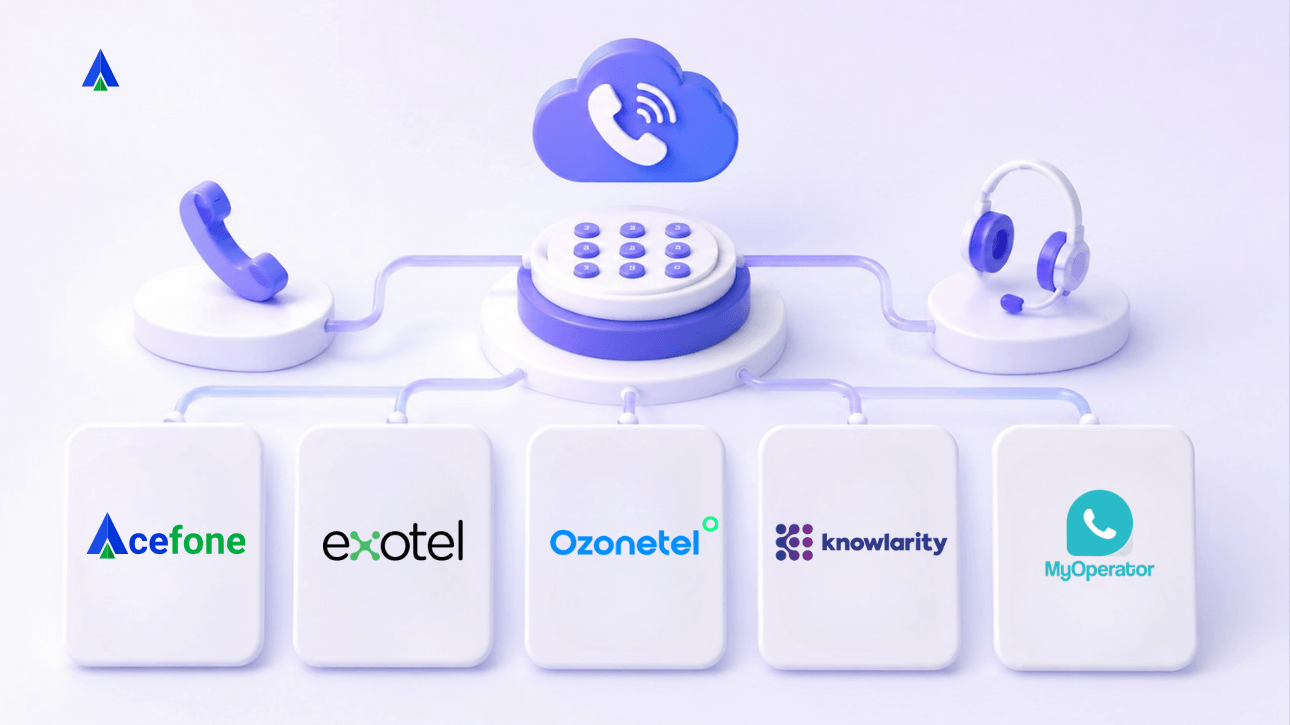


If you’ve started shortlisting IVR service providers in India, you’ve probably noticed the category doesn’t sit still anymore. Legacy on-premise vendors, cloud-native platforms, and AI-augmented systems are all competing for the same budget line, and the feature lists are starting to blur together.
That’s a problem when the decision itself isn’t really about telephony. It’s about CX infrastructure, the layer that determines whether a customer’s call gets routed correctly, resolved quickly, and logged in a way your team can actually use. Get it wrong, and you’re looking at dropped calls, compliance headaches, and agents who spend more time fighting the system than helping customers.
This guide gives you a criteria-driven framework for evaluating IVR solution providers in India, plus a practical shortlist of who’s worth considering in 2026.
How Should Contact Center Leaders Choose the Best IVR Service Provider in India?
- The best IVR service provider in India depends on uptime, DoT/TRAI compliance, Hinglish and regional language support, CRM integration depth, transparent pricing, escalation quality, and reporting depth.
- Contact center leaders should validate actual SLA documents, carrier redundancy, DLT registration support, live CRM screen pops, sample invoices, and real report exports before choosing a partner.
- For teams that need reliable, compliant, India-ready, and integrated IVR rather than only the cheapest per-minute rate, Acefone’s Contact Center Studio is worth a closer look.
What Is an IVR Service Provider and How Does It Support Cloud Contact Centers?
An IVR service provider is a company that supplies the technology and infrastructure behind Interactive Voice Response systems — the automated menus that greet callers, route them to the right department or agent, and often handle simple queries without human intervention.
In practice, a modern IVR service provider does more than play “Press 1 for Sales.” The better platforms combine IVR solutions with call routing logic, CRM integration, multilingual voice prompts, and analytics. This effectively acts as the front door to your entire cloud contact center.
Why Choosing the Right IVR Partner Matters in India in 2026
Three shifts are making this decision higher-stakes than it used to be.
- Compliance is no longer optional: TRAI’s regulatory push around telemarketing and call registration means your IVR provider’s compliance posture is now your compliance posture. A provider without proper DoT licensing or DLT registration support can put your outbound and inbound operations at risk.
- Customers expect to be understood literally: India’s contact centers serve callers who move fluidly between Hindi, English, and regional languages, often mid-sentence. An IVR system that only handles clean English prompts creates friction at the very first touchpoint.
- The IVR is now a data source, not just a switchboard: Ops leaders are expected to report on call deflection rates, IVR drop-offs, and self-service resolution. This means reporting and analytics depth has become a genuine differentiator, not a nice-to-have.
There’s also a cost dimension that’s easy to underweight. A poorly configured IVR doesn’t just frustrate callers, it quietly inflates average handle time and agent workload, because customers who can’t self-serve or get routed correctly end up escalating issues that a well-designed system would have resolved or triaged in the first thirty seconds.
When comparing providers, you’re not just comparing menu-building tools; you’re comparing how much operational drag each system will add to your team’s day-to-day work.
Procurement cycles in India increasingly involve IT and compliance stakeholders alongside contact center operations. A vendor that can’t clearly answer questions about data residency, call recording storage, or licensing will slow your evaluation down regardless of how polished their IVR flows look in a demo.
How to Evaluate IVR Service Providers in India?
Use these eight criteria to compare vendors on substance rather than sales pitch. Most vendor pitches will cover the same broad strokes: cloud-based, scalable, AI-powered. So, the real differentiation shows up in the specifics below, not in the headline features.
| Evaluation Criterion | What to Ask | Why It Matters |
| Uptime SLA and carrier reliability | Ask for the actual SLA number in writing and ask how carrier-level redundancy works. | Prevents a single-carrier setup from becoming a single point of failure. |
| DoT/TRAI compliance and DLT support | Confirm licensing and whether the provider actively supports DLT registration. | Determines whether calls and messages reach customers without compliance risk. |
| Hinglish and regional language support | Look for Indian accent, multilingual, and code-switching support. | Reduces friction for callers who move between Hindi, English, and regional languages. |
| CRM and helpdesk integration depth | Ask for a live call with real-time screen pop and call disposition sync. | Separates shallow integrations from operationally useful integrations. |
| Pricing model transparency | Request a sample invoice and confirm how IVR minutes are billed. | Prevents hidden costs in routing, storage, or add-ons. |
| Self-serve vs. managed setup | Match configuration ownership to internal team capacity. | Avoids delays for simple flow changes after go-live. |
| Escalation and warm transfer quality | Test whether context is preserved when moving from IVR to live agent. | Reduces repeat explanations and customer frustration. |
| Reporting and analytics depth | Ask for IVR path analysis, abandonment by menu level, trend reports, and exports. | Supports operational reporting beyond total call count dashboards. |
1. Uptime SLA and Carrier Reliability
Ask for the actual SLA number in writing, not a marketing claim. Also ask how the provider handles carrier-level redundancy, a single-carrier setup is a single point of failure for your entire call center. It’s worth asking specifically what happens during a carrier outage: does the system failover automatically to a backup route, or does it simply drop calls until the primary carrier recovers? The answer tells you a lot about how the provider has architected for reliability versus how they market it.
2. DoT/TRAI Compliance and DLT Registration Support
Confirm whether the provider holds a DoT Other Service Provider (OSP) or VNO license, and whether they actively support DLT registration for your templates and sender IDs. This isn’t paperwork, it determines whether your calls and messages reach customers at all.
3. Hinglish and Regional Language Support
Look for IVR systems with genuine multilingual prompt support and speech recognition tuned for Indian accents and code-switching, not just a translated menu.
4. CRM and Helpdesk Integration Depth
Check how deeply the CRM integration of the IVR works with tools like Salesforce, Zoho, and Freshdesk. Surface-level integrations that only pass a phone number are very different from ones that pull customer history and push call dispositions automatically.
During a demo, ask the vendor to show a live call where the agent’s screen pops with the caller’s account history in real time. If they can’t demonstrate this, the integration is likely shallower than the sales deck suggests.
5. Pricing Model Transparency
IVR pricing in India typically follows per-minute, per-seat, or flat-fee models. Ask providers to walk you through a real invoice example. Vague “starting from ₹X” pricing usually hides costs in call routing, storage, or add-on features. It’s also worth asking whether IVR minutes are billed separately from agent call minutes, since some providers bundle these while others itemize them in ways that make month-to-month costs harder to predict.
6. Self-Serve vs. Managed Setup
Some providers let you configure IVR flows yourself through a visual builder; others require their team for every change. Match this to your internal capacity, a self-serve model is only an advantage if you have someone who can actually use it.
7. Escalation and Warm Transfer Capabilities
Test how the system handles a caller who needs to move from self-service to a live agent. Does it preserve context, or does the customer have to repeat themselves? Warm transfer quality is one of the most common complaint sources in Indian contact centers, and it’s often the single detail that separates a genuinely well-engineered IVR from one that just looks polished in a sales demo.
8. Reporting and Analytics Depth
Look for granular reporting on IVR path analysis, call abandonment by menu level, and time-of-day trends, not just a total call count dashboard. Ask to see an actual report export rather than a dashboard screenshot, since some platforms present attractive visualizations in-app but offer limited export or API access to the underlying data your BI team would need.
9. AI–Powered Capabilities
Many providers now market “AI–powered IVR,” but the term covers a wide range of actual capability. Ask specifically whether the AI features are natural language / conversational IVR (letting callers say what they want instead of pressing numbers), AI–driven intent–based routing, or generative AI for automated summarization and agent assist. Also check whether these features work reliably in Hindi and Hinglish, not just English, since many AI voice models are trained primarily on English speech and underperform on Indian language patterns and accents.
Best IVR Service Providers in India in 2026: Quick Comparison
Here’s a quick-scan comparison, followed by a longer look at each provider what they are, what they cost, and what actual users on G2 and other review platforms say about them.
| Providers | Best For | Starting Price | G2 / Review Signal |
| Acefone | Contact centers needing IVR as part of a full cloud telephony stack | Contact Center Studio plans from ~₹1,599/month, with custom Enterprise pricing | Reviews across G2, Capterra, and GetApp are largely positive, with users frequently citing support responsiveness and ease of setup |
| Exotel | API-first teams building custom voice workflows | Business Phone System from ₹9,999 (prepaid bundles); Enterprise Contact Center on custom quote | 4.3–4.4/5 on G2 (330+ reviews); 66% five-star, with support speed as the recurring criticism |
| Ozonetel | Enterprises with complex, high-volume routing needs | Cloud Agent runs $25–$55/agent/month (NA/EU, unlimited minutes); India/APAC pricing via sales | 4.6/5 on G2 (600+ reviews); one of the highest-rated platforms in this list, though connectivity issues under high load come up in reviews |
| Knowlarity | SMBs wanting a quick-start cloud IVR | Not publicly published; custom quote via sales | 4.4/5 across aggregator sites; users flag basic dashboard reporting and cost for mid-flow IVR changes |
| MyOperator | Small businesses needing basic call management | Compact plan from ₹2,500/month (3 users, billed annually) | Ratings vary sharply by platform: Capterra/Software Advice ~4.3, G2 3.7, Trustpilot notably lower, with support consistency the common complaint |
1. Acefone

What it is: Acefone is a cloud communications and contact center platform offering hosted PBX, toll-free numbers, and its Contact Center Studio suite, which bundles IVR, auto dialer, call recording, and CRM integrations into a single dashboard. It operates under DoT VNO licensing for Indian telephony compliance.
Pricing: Acefone’s contact center and click-to-call plans start from around ₹1,599/month, with monthly and annual billing options and custom Enterprise pricing for larger deployments. Acefone’s pricing page emphasizes transparent, no-hidden-fee billing, with tailored quotes once your call volume and feature needs are confirmed.
Pros:
- Deep, native integrations with Zoho, Salesforce, Freshdesk, HubSpot, Zendesk, and Microsoft Dynamics 365
- DoT VNO licensing and TRAI-aligned compliance built into the India offering
- Hinglish and regional language support designed for Indian calling patterns
- Positioned as part of a broader contact center stack (IVR, predictive dialer, cloud contact center) rather than a standalone tool
Cons: Best suited to teams that want an integrated cloud communications stack rather than a narrow, single-purpose IVR tool. If you only need a bare-bones IVR with no CRM or dialer requirements, the fuller platform may be more than you need.
Review signal: Acefone holds generally positive marks across G2, Capterra, and GetApp, with reviewers most often calling out responsive customer support, straightforward onboarding, and competitive pricing relative to the feature set. As with any provider, a search across review sites will also surface some billing and cancellation complaints, which is worth factoring into any procurement conversation.
2. Exotel:

What it is: Exotel is a full-stack customer engagement and CPaaS platform that merged with Ameyo’s contact center technology in 2021. It offers a smart, multi-level IVR builder, programmable voice and messaging APIs, and omnichannel routing, and operates under UL-VNO licensing for Indian telephony compliance.
Pricing: Exotel’s Business Phone System is its only line with published numbers, structured as prepaid bundles starting around ₹9,999. The Enterprise Contact Center, Communication APIs, and AI Automation product lines are all quote-based. Exotel bills on a credit system (1 credit = ₹1) shared across voice, SMS, and WhatsApp usage, with a Fair Usage Policy that applies across all plans.
Pros:
- Strong developer tooling, REST APIs make it a good fit for teams that want to build custom voice workflows rather than use a pre-built interface
- Multi-level IVR builder with drag-and-drop call flow configuration
- Established India-first compliance posture (UL-VNO licensing, published status/incident history)
Cons: G2 and Capterra reviews consistently flag slow post-sale support as the platform’s biggest weakness, and the credit-based billing model can become unpredictable once voice usage scales. Several reviewers note that credits burn quickly during heavy outbound calling.
Review signal: Exotel sits around 4.3–4.4 out of 5 on G2 across 330+ reviews, with roughly two-thirds of ratings at five stars. Reviewers consistently describe it as affordable and reliable for core Indian telephony needs, with the main criticism clustering around after-sales responsiveness rather than the product itself.
3. Ozonetel:

What it is: Ozonetel is a Hyderabad-based cloud contact center platform (CloudAgent) founded in 2007, offering a low-code, drag-and-drop IVR with conversational (speech/NLP) capabilities, alongside omnichannel support for voice, SMS, WhatsApp, and chat.
Pricing: Ozonetel’s CloudAgent pricing for North America and Europe is published at $25–$55 per agent/month, which includes unlimited minutes — a meaningfully different model from per-minute billing. India and APAC pricing isn’t published and requires a direct sales conversation. Its separate KooKoo CPaaS/IVR product has metered India rates (roughly ₹0.70/minute outgoing).
Pros:
- Strong smart routing and ACD (skill-based, priority-based, fallback routing)
- Conversational IVR with no-code configuration
- Unlimited-minute agent pricing (where published) removes a common source of bill unpredictability
Cons: The interface is described as dated in some independent reviews, and a recurring complaint across G2 reviews involves voice breakage, dropped calls, or connectivity lag under high call volume or in certain geographies.
Review signal: Ozonetel is one of the highest-rated platforms in this shortlist, at roughly 4.6 out of 5 across 600+ G2 reviews, with 77% five-star ratings. Ease of use, setup, and support all score strongly in G2’s category breakdowns, though the connectivity complaints noted above are worth probing in a demo before committing to high call volumes.
4. Knowlarity:

What it is: Knowlarity is a cloud telephony provider offering SmartIVR, cloud contact center, virtual numbers, and a missed-call solution, serving businesses across a wide range of industries. It integrates with Zoho CRM, Freshdesk, and LeadSquared.
Pricing: Knowlarity doesn’t publish pricing publicly. Every plan requires a custom quote through its sales team, based on call volume, number of agents, and required features.
Pros:
- Quick, simple setup that appeals to SMBs wanting a fast-start cloud IVR
- Reviewer comparisons on Capterra note it can come out more cost-effective than some peers once caller/agent counts scale past a handful of seats
- Established integrations with common Indian SMB CRM and support tools
Cons: A recurring theme in Capterra reviews is that modifying an existing IVR flow, For example, adding a new menu option after go-live can trigger a high fee. The pricing becomes similar to the original setup cost, since changes route back through Knowlarity’s implementation team rather than a self-serve builder. Reporting depth is also described by some reviewers as basic compared to competitors.
Review signal: Knowlarity doesn’t have a large, consolidated G2 product page, but aggregator sites (SoftwareSuggest, SaaSWorthy) put it around 4.4 out of 5 based on smaller review samples. Feedback is generally positive on ease of use and CRM integration, with reporting and change-request costs the most common friction points.
5. MyOperator:

What it is: MyOperator positions itself as India’s largest Call + WhatsApp platform, combining IVR, cloud contact center, WhatsApp Business API, and AI-powered bots in one dashboard, serving a large base of small and mid-sized Indian businesses.
Pricing: MyOperator’s Compact plan starts around ₹2,500/month for 3 users, with the Sedan plan at roughly ₹5,000/month for 10 users. Higher SUV and Enterprise tiers step up substantially. Reviewers note a steep price jump between mid and upper tiers, largely for CRM integrations, API access, and dialer add-ons. Plans are billed annually rather than month-to-month, with GST added separately.
Pros:
- Competitive entry pricing for small teams under 10 users
- Bundles IVR with WhatsApp Business API and basic AI bots in one stack, useful for businesses that want to consolidate vendors
- Visual call-flow builder and straightforward setup for simple use cases
Cons: Review ratings vary sharply depending on the platform. Solid on Capterra and Software Advice, notably lower on G2 and Trustpilot. With customer support, responsiveness, and unclear add-on charges as the most consistent complaints. This inconsistency is worth weighing carefully if reliable post-sale support is a priority for your team.
Review signal: MyOperator’s ratings split roughly between the low-to-mid 4s on Capterra/Software Advice and closer to 3.7 on G2, with a markedly lower Trustpilot score. The gap suggests the product performs well for straightforward use cases but that support experience can be inconsistent once something goes wrong, a pattern worth testing directly with references before signing an annual contract.
India-specific note: When shortlisting any of these, confirm DoT/TRAI compliance status, current pricing, and review scores directly with the vendor and on the review platforms themselves.
CTA: Before signing an annual IVR or cloud telephony contract, ask each vendor for a live routing demo, sample invoice, CRM workflow test, and exportable analytics report.
How Does Acefone IVR Fit Into a Modern Contact Center Stack?
Acefone’s IVR isn’t sold as a standalone product. It’s built as one layer of a broader cloud contact center platform, which matters if you’re trying to avoid stitching together separate tools for routing, dialing, and reporting.
A few specifics worth knowing:
- Compliance by design: Acefone operates under DoT VNO licensing and supports TRAI-aligned DLT registration, so compliance isn’t something you have to bolt on separately.
- Built for Indian calling patterns: Hinglish and regional language prompt support are handled natively, rather than as a translated afterthought.
- Works with your existing stack: Native integrations with Salesforce, Zoho, and Freshdesk mean the IVR data actually lands where your agents and managers already work.
- Pricing you can model: Acefone offers both per-minute and per-seat pricing in INR, so finance teams can forecast costs without guessing at hidden fees.
- Pairs with outbound tools: For teams running outbound campaigns alongside inbound IVR, Acefone’s predictive dialer sits on the same platform, so you’re not managing two separate vendor relationships for one contact center operation.
- Pairs with automation: For teams evaluating AI voice agents alongside inbound IVR, the same platform can help reduce repeat routing gaps between self-service and human support.
If your evaluation criteria above are pointing toward “reliable, compliant, India-ready, and integrated” rather than “cheapest per-minute rate,” Acefone’s Contact Center Studio is worth a closer look.
Ultimately, the right choice depends on where your contact center is headed, not just where it is today. A provider that looks adequate for your current call volume may not hold up once you add outbound campaigns, expand into new regional markets.
Building your evaluation around the eight criteria above, rather than a feature checklist or a per-minute rate card, gives you a decision that holds up as your operation scales.
FAQs
An IVR solution provider supplies the technology that powers automated call menus, routing, and self-service voice interactions for businesses, typically as part of a broader cloud telephony or contact center platform.
IVR refers specifically to the automated call-handling layer. A cloud contact center is the broader platform that includes IVR alongside live agent tools, dialers, CRM integrations, and reporting.
Yes. Providers offering telephony services in India typically need a DoT Other Service Provider (OSP) or Virtual Network Operator (VNO) license, and should support TRAI-mandated DLT registration for messaging and call compliance.
Pricing usually follows a per-minute, per-seat, or flat-fee model, with costs varying based on call volume, number of agents, and integration requirements. Ask providers for a sample invoice rather than relying on advertised starting prices.
Yes, though the quality varies significantly by provider. Look specifically for Hinglish and code-switching support rather than assuming any “multilingual” claim covers natural Indian speech patterns.
Ask for specifics: does the integration only pass caller ID, or does it also pull customer history and log call outcomes automatically? Request a live demo with your actual CRM rather than a generic walkthrough.
It depends on your internal resources. Self-serve builders offer more control and faster changes, but only if someone on your team can maintain them. Managed setups suit teams that would rather hand off configuration entirely.
Focusing on per-minute pricing while overlooking compliance status, integration depth, and escalation quality, all of which have a bigger long-term impact on customer experience and operational risk. A slightly cheaper rate card rarely offsets the cost of a compliance gap or a CRM integration that has to be rebuilt six months in.
Timelines vary by provider and complexity, but a straightforward IVR flow with standard CRM integration can often go live within a few weeks. More complex, multi-department routing with custom compliance requirements may take longer, particularly if DLT registration and carrier onboarding are involved.
The best choice depends on your call volume, compliance needs, CRM stack, language requirements, and reporting expectations. If you need a full cloud communications stack with IVR, dialers, CRM integrations, and India-focused compliance, Acefone is worth evaluating alongside Exotel, Ozonetel, Knowlarity, and MyOperator.
Compare providers using uptime SLA, carrier redundancy, DoT/TRAI compliance, DLT support, Hinglish and regional language support, CRM integration depth, pricing transparency, warm transfer quality, and analytics exports.
Look for IVR systems with genuine multilingual prompt support and speech recognition tuned for Indian accents and code-switching, not just translated menu options. Acefone is positioned for Indian calling patterns with Hinglish and regional language prompt support.
Ask the vendor to show carrier failover, a live CRM screen pop, a warm transfer from IVR to agent, a sample invoice, DLT registration support, and an exportable IVR path analysis report.


