




Is Genesys still the safe choice for a growing contact center, or has “safe” started meaning “slow and expensive”? Teams that deployed Genesys Cloud CX for its Gartner pedigree are increasingly running the same math.
A tiered pricing model that punishes small deployments, a professional-services bill that shows up every time something needs to change, and a compliance story built for Europe and the US, not India.
None of that makes Genesys a bad platform. It makes it the wrong platform for a specific kind of buyer. This guide compares the eight Genesys alternatives worth shortlisting in 2026.
Why Teams Switch Away From Genesys?
Teams move off Genesys for three recurring reasons- integration costs, unpredictable billing, and administrative overhead. There’s also a fourth- Genesys’s advanced AI features sit behind premium tiers.
None of this is unique to Genesys among enterprise CCaaS providers — but it’s exactly the gap a purpose-built alternative can close.
What Should You Look for in a Genesys Alternative?
The strongest Genesys alternatives share five traits and each one turns into a concrete question you can check a vendor against, rather than a vague promise to take on faith.
IVR, or interactive voice response, is the automated phone menu system that routes callers or lets them self-serve before reaching an agent.
Five traits worth checking against any shortlist:
- Transparent pricing — Does the quoted price dictate telecom, AI usage and support charges clearly, or do add-ons start appearing after signup?
- Dialer and IVR included, not gated — Is the dialer and IVR ship ready to use at the base tier, or do predictive dialing and self-serve flows need a premium plan or a paid add-on?
- Easy Onboarding — can non-technical managers configure call flows and go live directly, or does every change depend on a certified administrator or a professional service?
- Relevant Compliances — does the provider publish a compliance position for where you operate?
- One invoice, not multi-vendor relationships — does the vendor own its telephony infrastructure and bill it alongside the contact center and AI, or are you assembling separate providers for each?
What Are the Best Genesys Alternatives in 2026?
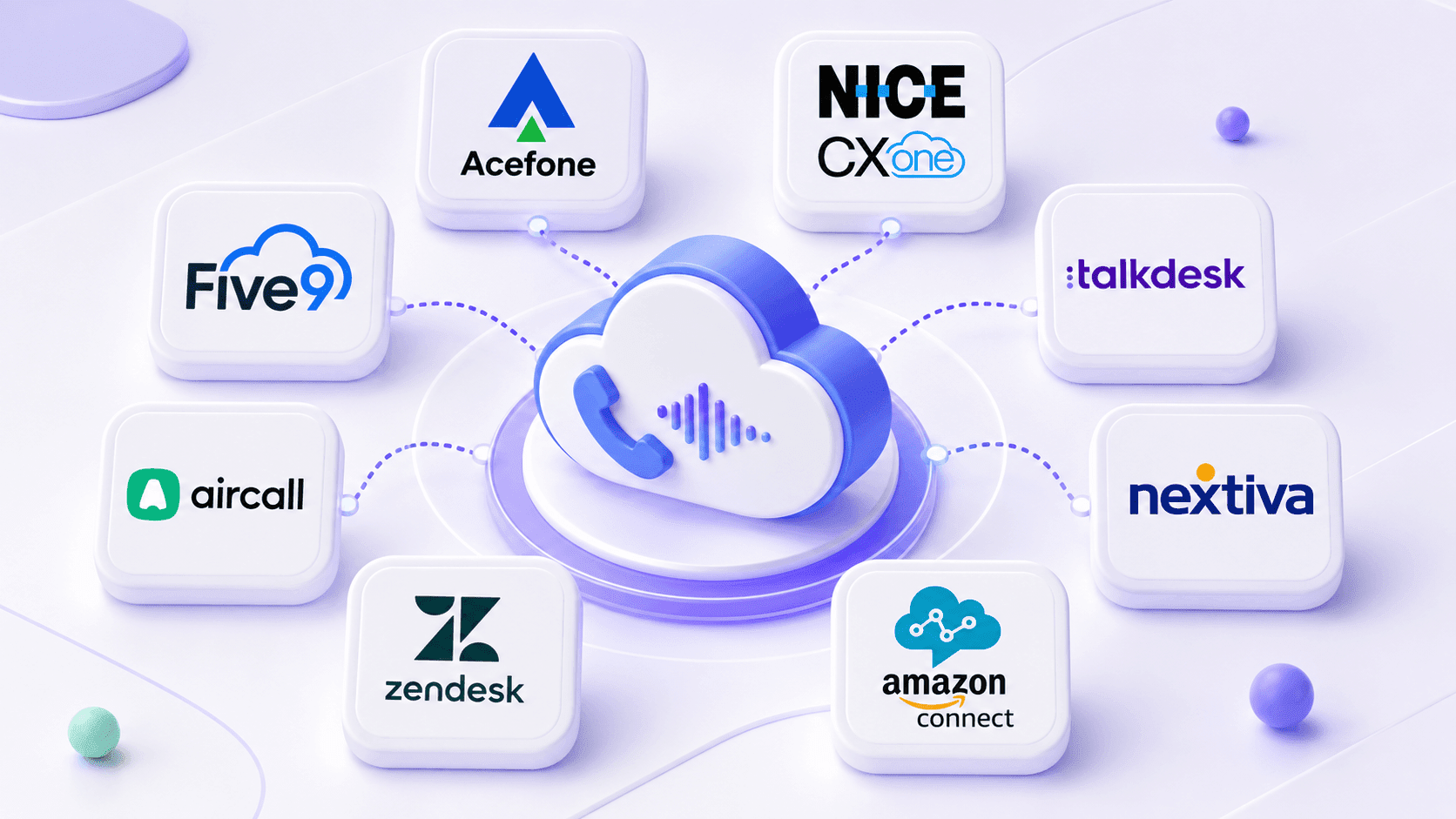
The eight strongest Genesys alternatives in 2026 span India-focused mid-market platforms, enterprise CCaaS competitors and category specialists: Acefone, NICE CXone, Five9, Talkdesk, Nextiva, Aircall, Zendesk and Amazon Connect. Each fits a different buyer. The right one depends on team size, region, and how much of the stack you want in one invoice.
Acefone — Best for Indian BFSI and BPO Teams
Acefone replaces Genesys’s tiered pricing model with a single starting price. Starting at only $17/user/month with 5-6 enterprise minimum requirements, against Genesys’s $75/user/month floor and $2,000 monthly platform commitment.
Acefone’s Contact Center Studio includes five built-in auto dialer modes, not gated behind a premium plan. Acefone is a DoT-licensed Virtual Network Operator with TRAI, ISO-270001, SOC 2 Type II, DPDPA, and GDRP compliance. Most accounts go live in 4 hours. See the full Genesys vs Acefone comparison for a feature-by-feature breakdown.
NICE CXone — Best for Enterprise Scale
NICE CXone is Genesys’s closest peer in the Gartner Magic Quadrant for CCaaS. Its 2024 acquisition of Cognigy added meaningfully to its conversational AI stack. It’s a strong fit for enterprises that need Genesys-level scale but want a second vendor to benchmark pricing against. Although buyers should expect a similar implementation timeline and administrative overhead to Genesys itself.
Five9 — Best for AI-Forward Outbound Teams
Five9 pairs voicebots, IVR and agent-assist tooling to automate call handling. Pricing starts around $119–159 per seat monthly with a 50-seat minimum on every plan. That’s a real barrier for teams under 50 agents, but not a concern for larger outbound-focused sales and support organizations.
See Full Acefone vs Five9 Comparison
Talkdesk — Best for Low-Code AI Customization
Talkdesk’s differentiator is its low-code AI Studio builder, which lets teams configure automation flows without a full engineering project. It’s a reasonable middle ground between Genesys’s enterprise complexity and a fully no-code platform, for teams that want some configuration control without a developer on every change.
Nextiva — Best for Small Business Affordability
Nextiva positions itself as the budget-friendly Genesys alternative for small teams, offering reliable calling, analytics and CRM integrations at a lower price point than enterprise CCaaS platforms. It’s a reasonable fit for small US-based teams. However, like most alternatives on this list, it doesn’t publish an India compliance position.
Aircall — Best for Lightweight Sales Teams
Aircall is built for sales and support teams that want fast setup over deep contact center functionality — a lighter alternative for teams that find Genesys’s feature depth unnecessary for their call volume. It’s not built for large, complex contact center operations, but it’s a fast, low-commitment option for smaller outbound teams.
Zendesk — Best for Helpdesk-First Teams
Zendesk’s contact center features sit inside a broader helpdesk and ticketing suite, making it a natural fit for teams that already run support through Zendesk and want calling added to the same system, rather than adopting a dedicated CCaaS platform. It’s a weaker fit for pure outbound or telesales use cases.
Amazon Connect — Best for Custom-Build, Developer-Led Teams
Amazon Connect is AWS’s pay-as-you-go contact center service, appealing to teams with an in-house engineering function that wants to build custom logic on top of a cloud primitive rather than configure a vendor’s pre-built workflows, per a 2026 comparison by Nexus. It’s a poor fit for ops-manager-led teams without dedicated developer support.
TL;DR: Acefone, NICE CXone and Five9 lead for scale and automation; Talkdesk, Nextiva, Aircall and Zendesk fit narrower team profiles; Amazon Connect suits developer-led teams building custom logic.
[VISUAL SUGGESTION: 8-logo grid with a one-line “best for” tag under each vendor | Alt text: “Eight Genesys alternatives compared by best-fit use case”]
How Do These Alternatives Compare on Price and Compliance?
Pricing and India compliance are where the eight alternatives diverge most. Acefone is the only platform on this list with a native DPDPA, RBI and IRDAI compliance position and no enterprise minimum; every other alternative either requires a seat minimum (Five9: 50 seats) or simply doesn’t publish an India-specific compliance stance.
TL;DR: Acefone is the only alternative on this list with a published India compliance position and no seat minimum — every enterprise-tier competitor gates advanced features behind either a seat floor or a custom quote.
How a Growing D2C Brand Picks a Genesys Alternative
A 35-agent D2C brand in Bengaluru runs customer support and COD confirmation calls through Genesys Cloud CX, inherited from a previous ops lead’s enterprise-wide vendor deal. At 35 agents, they’re paying the $2,000 monthly platform minimum regardless of usage, and the predictive dialer they need for COD follow-ups sits on CX3 — $155 per agent, well above what a 35-seat team should need to pay for that one feature.
The ops manager shortlists three alternatives: NICE CXone (ruled out — same enterprise pricing model, same seat economics), Five9 (ruled out — 50-seat minimum doesn’t fit a 35-agent team), and Acefone (fits — dialer modes included at the base tier, no seat minimum, and the DPDPA compliance the brand’s legal team had already flagged as a blocker with Genesys). The switch takes an afternoon of number-porting, not a quarter of vendor negotiation.
TL;DR: Seat minimums are often the real disqualifier for mid-size teams evaluating Genesys alternatives — not feature gaps.
Conclusion
Genesys remains a legitimate enterprise CCaaS platform — its Gartner Magic Quadrant record isn’t in question. What’s changed is which buyers it actually fits. Three things to take from this comparison: most Genesys alternatives solve for cost or automation, not both, so match the platform to the specific gap you’re closing. Seat minimums (Five9’s 50, Genesys’s own $2,000 floor) disqualify more mid-market teams than missing features do. And India compliance — DPDPA, RBI, IRDAI — remains unaddressed by every alternative on this list except Acefone. For a team evaluating Genesys against real 2026 alternatives, that combination of no seat minimum and native India compliance is worth putting at the top of the shortlist.
Compare in detail: Genesys vs Acefone — pricing, compliance and go-live time. Book a demo to see Acefone live in 4 hours.
Frequently Asked Questions
Not exclusively, but Genesys’s IVR and call routing tools sit inside the same admin complexity reviewers flag across the platform — G2 reviewers describe a steep learning curve for advanced configuration. Alternatives like Acefone let an ops manager build and edit IVR flows directly, without filing a ticket to a certified administrator.
Genesys itself moved away from a standalone cloud PBX or cloud phone system product when it shifted fully to CCaaS — Genesys Cloud Voice now handles telephony as part of the broader platform. Dedicated cloud telephony platforms like Acefone still offer VoIP, click-to-call and toll-free numbering as core, unbundled features.
Yes, though the depth varies. Genesys’s own AI Experience tools support human agents rather than running autonomous calls; Five9 markets voicebot capability as part of its AI suite; and Acefone includes a no-code AI Voice Bot with pre-deployment AI Evaluators — a combination not matched feature-for-feature by the others on this list.
On published pricing, Acefone starts lowest at $17/user/month with no seat minimum. Nextiva and Aircall also target smaller teams, though neither publishes India-specific compliance. Five9’s entry tier looks competitive per seat but requires 50 seats minimum, which raises the real cost floor for small teams.
No. Large enterprises with dedicated IT governance, global operations and complex multi-region routing needs are often well served by Genesys’s depth and its 11 consecutive years as a Gartner CCaaS Leader. The alternatives on this list solve for teams that don’t have that governance structure or that scale requirement — not for every Genesys deployment.
It depends on the target platform. G2 data shows Genesys itself averaging 5 months to implement; alternatives vary from similarly long enterprise timelines (NICE CXone) to same-day migrations for mid-market platforms — Acefone’s migration team ports existing numbers and goes live in 4 hours, without a professional-services engagement.


