


 5 mins read


Most customers who abandon a cart have not changed their minds. They left because of friction, distraction, or a question that went unanswered at the moment of decision. The order was close. It just did not close.
The standard recovery playbook is email. Sometimes SMS. Both are passive. They sit in an inbox and wait. A voice bot does the opposite. It reaches out, starts a conversation, and gives the customer a reason to complete the order right now.
This article covers the use case, a sample recovery script, and the ROI framing operations teams use to justify voice bot investment for cart abandonment.
Why Cart Abandonment Is an Operations Problem, Not Just a Marketing One?
Cart abandonment is usually treated as a marketing metric. Open rates, click-through rates, discount codes. But for operations and CX teams, it shows up differently.
Abandoned carts mean your inventory is held against orders that never complete. Your demand forecasting gets distorted. Your support team fields “I was about to buy but…” calls. And your cost-per-acquisition rises because you spent on acquiring a visitor who did not convert.
For COD-heavy categories, hesitation at checkout is even more common. There is no payment commitment locking the customer in. The customer adds items, reaches the final step, and walks away. Recovering even 10 to 15% of those carts through outbound calls can materially move monthly revenue. The question is whether the recovery channel is fast enough, personal enough, and scalable enough to make the economics work.
Why Voice Outperforms Email and SMS for Cart Recovery?
A 2024 study by Analyzify found that cart abandonment emails achieve an open rate of around 39%, with a purchase conversion rate of just 10.7%. Of those who open, a fraction click through. Of those who click, fewer complete the purchase. Each step loses a portion of the audience.
SMS performs better on open rates but still relies on the customer taking action after reading a message. There is no conversation. There is no moment to handle an objection or answer a question.
Voice is different for three reasons.
First, a call creates immediate engagement. The customer either picks up or does not. There is no passive scroll-past.
Second, a voice bot can handle the reason for abandonment in real time. If the customer says shipping was too expensive, the bot can offer a waiver. If they were confused about a size or variant, the bot can clarify. Passive channels cannot do this.
Third, for COD customers specifically, a voice call with a human-sounding bot feels like a more credible confirmation channel. It closes the trust gap that causes COD hesitation at checkout.
This is not about replacing email or SMS. It is about using voice at the stages where a response actually matters, and where non-response has a direct revenue cost.
The End-to-End Cart Abandonment Recovery Flow
A voice bot cart recovery flow has five stages.
- Trigger. The bot is triggered when a customer adds items to cart, reaches checkout, and exits without completing the order. The trigger window matters. Calling within 30 to 60 minutes of abandonment reaches the customer while intent is still fresh.
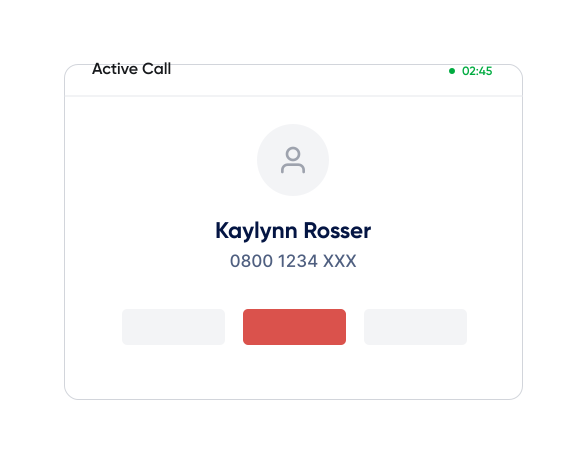
- Outbound call initiation. The bot places an outbound call from your brand’s CLI. The customer sees a recognized number, not an unknown one. This improves answer rates significantly.
- Personalized opening. The bot addresses the customer by name and references the specific cart they left. Generic openers reduce engagement immediately. Specificity signals that the call is relevant, not spam.
- Objection handling. Based on the customer’s response, the bot navigates a short conversational flow. Common objections include shipping cost, payment hesitation, and product uncertainty. The bot can offer a limited-time discount, confirm COD availability, or answer basic product questions using a connected knowledge base.
- Conversion or handoff. If the customer is ready to complete the order, the bot sends a direct checkout link via SMS or WhatsApp during the call. If the customer has a complex question or needs reassurance, the bot transfers to a live agent with full context of the conversation.
Sample Cart Abandonment Recovery Script
The following is a base script for a COD e-commerce use case. Adapt it to your brand tone and product category.
Bot: Hi, am I speaking with Priya?
Customer: Yes.
Bot: Hi Priya, this is [Brand Name] calling. You had some items in your cart that you did not complete. I wanted to check if you needed any help finishing your order.
Customer: I was not sure about the delivery time.
Bot: Understood. Your order would be delivered within 3 to 5 working days to your pin code. We also have cash on delivery available if that is more convenient. Would you like me to send you the checkout link right now?
Customer: Yes, that works.
Bot: Great. I am sending the link to your registered number. You can complete the order in a few taps. Is there anything else I can help with?
If the customer raises a pricing objection:
Bot: I understand. We have a limited offer running today. I can apply a ₹100 discount on your cart if you complete the order in the next 30 minutes. Would you like me to send the updated link?
If the customer is undecided:
Bot: No problem at all. I will send you the cart link so you can come back to it when you are ready. If you have any questions about the products, our team is available on chat as well. Have a good day.\
This script is not a rigid read-through. The bot follows the conversation and adapts based on what the customer says. This is what separates a voice bot from a pre-recorded IVR message.
ROI Framing: How to Measure Cart Recovery Value
Operations teams evaluating voice bot investment for cart abandonment typically look at three numbers.
Recovery rate. What percentage of called customers complete their order? A well-configured voice bot with a relevant script and a timely trigger typically achieves 8 to 15% recovery on connected calls (industry benchmark, estimated). Even at the lower end, this is meaningfully higher than email click-to-purchase rates.
Revenue per recovered order. Take your average order value and multiply by the number of recovered carts per month. For a brand with ₹1,200 average order value recovering 400 carts monthly, that is ₹4.8 lakh in recovered revenue per month.
Cost per recovery call. At AceX pricing of approximately ₹1 per minute, a 2 to 3 minute cart recovery call costs ₹2 to ₹3. Against a recovered order value of ₹1,200, the return on that call is substantial. Even accounting for calls that do not convert, the blended cost per recovered order stays well within acceptable CAC ranges for most categories.
The model also compounds. A recovered customer is more likely to return. Cart recovery via voice creates a touchpoint that email does not. Customers who speak with a bot, even briefly, report higher brand recall in post-purchase surveys (general CX research, estimated).
When to Escalate to a Human Agent?
Not every cart recovery call should stay with the bot. Escalation triggers to configure include customers who express frustration or ask for a supervisor, high-value carts above a defined threshold where personal attention increases conversion probability, complex product questions the bot cannot answer from the knowledge base, and customers who have had a previous service issue with the brand.
When the bot escalates, the agent receives the full transcript and cart details. The customer does not repeat themselves. The agent picks up in context and focuses entirely on closing the order.
Conclusion
Cart abandonment is not a lost cause. Most customers who abandon are still in the consideration window. They just need a nudge at the right moment, through the right channel.
A voice bot reaches them within the hour, addresses the real objection, and either closes the order or hands off to a human who can. Email and SMS sit in the background and hope. Voice creates a conversation.
The economics are straightforward. The recovery rate is measurable. And the setup, from script to deployment, takes hours rather than weeks.
FAQs
It is an AI-powered outbound calling system that contacts customers who left items in their cart without completing the order. The bot personalises the call, handles common objections, offers incentives, and sends a checkout link during the call. No human agent is needed for standard recovery flows.
Within 30 to 60 minutes of abandonment. This is when purchase intent is still high and the customer is most likely to recall what they were looking at. Calls triggered after 24 hours see significantly lower answer and conversion rates.
A well-configured bot with a timely trigger and relevant script typically recovers 8 to 15% of connected calls. This varies by category, average order value, and how well the script addresses the most common abandonment reasons for your customer base.
Yes. The bot can be configured to offer a time-limited discount or waive shipping charges based on cart value or abandonment reason. The offer can be applied automatically and the updated checkout link sent via SMS or WhatsApp during the call.