


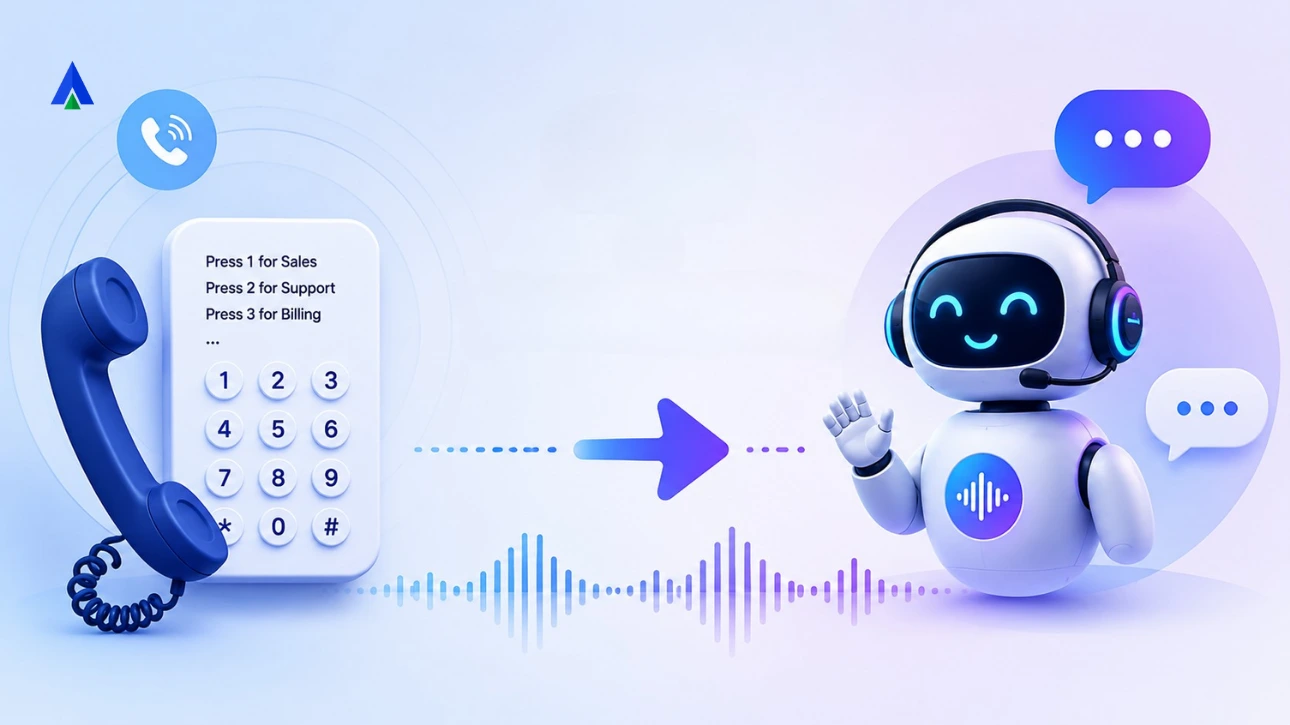


IVR systems have done a lot of work in e-commerce contact centers over the years. They route calls, collect input, and handle basic transactions without agent involvement. For many operations, they are still running (quietly, in the background) handling thousands of interactions a day.
The problem is not that IVR does not work. It is that the gap between what IVR does and what customers now expect has widened. Menu navigation requires the customer to know the right option. It cannot handle a caller who says, “I want to know where my Diwali order is,” it can only handle a caller who presses 2 for order status. That difference matters more than it used to.
This playbook is for operations and CX heads who want to move toward AI voice bots without ripping out existing infrastructure or disrupting agent workflows. The approach is phased, practical, and designed to protect the call flows that are already working while upgrading the ones that are not.
Why the Gap Between IVR and Customer Expectation Has Grown?
IVR was designed for a world where menu navigation was the only viable automation option. It works well for fixed transactions (bill payments, PIN resets, balance checks) where the customer knows exactly what they want and the answer is a single data point.
E-commerce support calls are rarely that clean. A customer calling about an order might want status, might want to reschedule delivery, might want to initiate a return, or might have two of these needs in the same call. A menu tree that handles each of these separately requires the customer to navigate correctly and call back if their need changes.
A 2024 market analysis found that 38% of consumers abandoned calls when IVR systems failed to understand their voice commands, and enterprises with outdated IVR designs reported an 11% drop in customer satisfaction scores. For e-commerce operations managing high call volumes across order, delivery, and returns flows, that abandonment translates directly into unresolved queries and additional inbound contacts.
A voice bot handles this differently. It listens to what the customer says, identifies the intent, retrieves the relevant data, and responds conversationally. It does not require the customer to navigate a menu. It does not dead-end if the customer’s query spans two categories.
The case for migration is not that IVR is obsolete. It is that certain call flows are better served by conversation than by menu selection and identifying those flows is where the migration playbook begins.
Phase 1: Audit Your Current IVR
Before any migration work begins, you need a clear picture of what your IVR is currently doing and how well it is doing it.
A useful IVR audit covers four areas.
- Call volume by menu path. Which options are customers selecting most often? In most e-commerce operations, order status and delivery queries dominate. These are the highest-priority candidates for voice bot migration.
- Drop-off and abandonment points. Where are customers hanging up during the IVR flow? High drop-off on a specific menu level indicates friction either the option is hard to find or the resolution it leads to does not satisfy the query.
- Escalation rate per path. Which IVR paths end in agent transfer most often? A path with a high escalation rate is either poorly designed or handling a query type that genuinely requires conversation. Both are migration candidates.
- Call resolution rate. How many calls that enter a given IVR path are resolved without agent involvement? Low resolution rates on high-volume paths represent the clearest ROI opportunity for voice bot deployment.
This audit does not need to be exhaustive before migration begins. You need enough data to rank your call flows by migration priority. The goal of Phase 1 is a shortlist of two to three flows where voice bot deployment will have the most immediate impact.
Phase 2: Map the Call Flows for Conversion
Once you have your priority flows, the next step is mapping them in enough detail to design a conversational equivalent.
For each flow, document the following.
What the customer is trying to achieve?
Not just the IVR option they selected, but the actual resolution they want. “Press 2 for order status” is an option. “I want to know if my order is arriving today” is the intent. The voice bot handles the intent, not the option.
What data is needed to resolve the query?
Order status requires an OMS lookup. Delivery scheduling requires a logistics API call. Return initiation requires a returns policy check against the order. Each data dependency needs to be mapped and connected before the bot goes live.
What the escalation triggers are?
Every conversational flow needs defined points where the bot stops and transfers to an agent. These might be authentication failures, emotional escalation signals, out-of-policy requests, or query types outside the bot’s scope. Documenting these upfront prevents the bot from holding a customer in a loop it cannot resolve.
What the fallback path is?
If the bot cannot handle a call due to a system outage, an unrecognized intent, or an edge case: what happens? The fallback should return the customer to IVR or queue them for an agent, not end the call.
Phase 3: Prioritize Use Cases for Phased Deployment
Not all call flows should migrate at the same time. A phased approach reduces risk, allows for learning between deployments, and keeps existing operations stable.
A practical prioritization framework ranks use cases on two axes: automation potential and call volume. Flows that score high on both are Phase 1 deployments. Flows with high automation potential but lower volume are Phase 2. Flows with complex escalation requirements or low automation potential stay on IVR until later phases or indefinitely.
For most e-commerce operations, the recommended deployment order looks like this.
Step 1. High volume, high automation potential: WISMO and order status calls, COD confirmation outbound flows, and delivery update notifications. These are scriptable, data-driven, and require no agent judgment for the majority of interactions.
Step 2. Medium volume, moderate automation potential: Return initiation, refund status queries, and delivery rescheduling. These involve slightly more variability but follow consistent enough flows to automate effectively once Phase 1 learnings are applied.
Step 3. Complex or lower-volume flows: Complaint handling, payment disputes, and high-value order exceptions. These may remain with IVR routing to agents for longer or be partially automated with a stronger escalation model.
Phase 4: Build, Integrate, and Test Before Going Live
The bot configuration itself is one part of the migration. The integrations are where most of the work happens.
For e-commerce voice bot deployments, the core integrations are OMS for order status and return eligibility, logistics APIs for live tracking and delivery scheduling, and CRM for customer authentication and interaction history. Without these, the bot can handle a conversation but cannot resolve it, which is worse than a well-functioning IVR.
Testing before go-live should cover three scenarios.
- Happy path testing. The bot follows the expected conversational flow from greeting to resolution. Authentication works. Data retrieval returns the correct result. The closing message is appropriate.
- Edge case testing. The customer gives an unexpected answer, asks an off-script question, or fails authentication. Does the bot handle gracefully or loop? Does it escalate correctly?
- Load testing. Can the bot handle peak concurrency without degradation? For e-commerce operations, test against festive season call volumes, not average day volumes.
AI evaluator tools can automate a significant portion of this testing before any live customer calls are made. This reduces the risk of deploying a bot that fails on common query patterns.
Phase 5: Run IVR and Voice Bot in Parallel During Transition
A hard cutover from IVR to voice bot on day one is not recommended for most operations. A parallel running period (where the voice bot handles a defined proportion of traffic while IVR continues to operate) allows you to validate real-world performance before full migration.
During parallel running, monitor four metrics closely.
- Containment rate. What percentage of calls does the bot resolve without escalating to IVR or an agent? A containment rate below your pre-migration IVR resolution rate signals a configuration problem that needs attention before expanding bot traffic.
- Escalation reason distribution. Why are calls escalating? If a single escalation reason accounts for a large proportion of transfers, it likely indicates a gap in the bot’s coverage that can be closed with a script update or integration fix.
- CSAT on bot-handled calls. Are customers rating bot interactions differently than IVR interactions? Early CSAT data from bot-handled calls is the clearest signal of whether the migration is improving or degrading customer experience.
- Agent feedback on escalated calls. Agents receiving escalations from the bot will quickly identify patterns calls that should not have been escalated, calls that arrived without enough context, calls where the bot gave incorrect information. This feedback loop is as important as the metric data.
Phase 6: Optimize Continuously
IVR configurations are often set and not revisited for months. Voice bot deployments should be treated differently. The conversational model produces data (intent patterns, drop-off points, escalation triggers) that tells you where to improve continuously.
A monthly optimization review should cover the top five escalation reasons, any intent categories with low confidence scores, changes in call volume distribution across flows, and any new query types appearing in call transcripts that the bot is not currently handling.
Customer support automation is not a deployment event. It is an ongoing operational practice. The operations teams that see the strongest results over time are the ones that treat their voice bot as a product with a roadmap — not a system with a go-live date.
Conclusion
Migrating from IVR to voice bot is not a rip-and-replace project. It is a phased operational upgrade that starts with the flows where conversation outperforms menu navigation, builds confidence through parallel running, and expands based on data.
IVR continues to serve the flows it handles well. Voice bots take over the flows where intent recognition, real-time data access, and conversational resolution deliver a better outcome for the customer and a lower cost for the operation.
For e-commerce teams managing growing call volumes across order, delivery, and returns flows, the migration timeline matters. The operations that have already completed Phase 1 deployments are seeing the results. The ones planning to start are still working with the infrastructure of a decade ago.
FAQs
It is the process of replacing menu-driven IVR call flows with conversational AI voice bots for selected use cases. The migration is typically phased, starting with high-volume repetitive flows like order status and COD confirmation, while keeping IVR in place for flows where menu navigation is still appropriate.
No. The recommended approach is to run voice bots alongside existing IVR for specific call flows, not replace the entire system at once. IVR continues handling flows where it performs well. Voice bots handle flows where conversation and real-time data access deliver a better outcome.
Phase 1 deployment for one or two call flows (typically order status and COD confirmation) can be completed in four to eight weeks, including integration, testing, and parallel running. Full migration across all flows depends on the number of use cases and integration complexity.
The core integrations are your OMS for order status and return eligibility, your logistics API for live tracking and delivery scheduling, and your CRM for customer authentication and history. Without these, the bot can hold a conversation but cannot resolve the query.


