




Your operations teams deploying voice bots face a choice that rarely gets named directly. Going live is fast. Testing takes time. And in most deployment timelines, testing loses.
The result is predictable. Within the first two to four weeks after launch, teams begin seeing patterns they did not plan for. Callers rephrase their intent and break the script; bot handles edge cases poorly or escalations where the calls are transferred without context. AI Evaluators exist to close this gap between “configured” and “ready.”
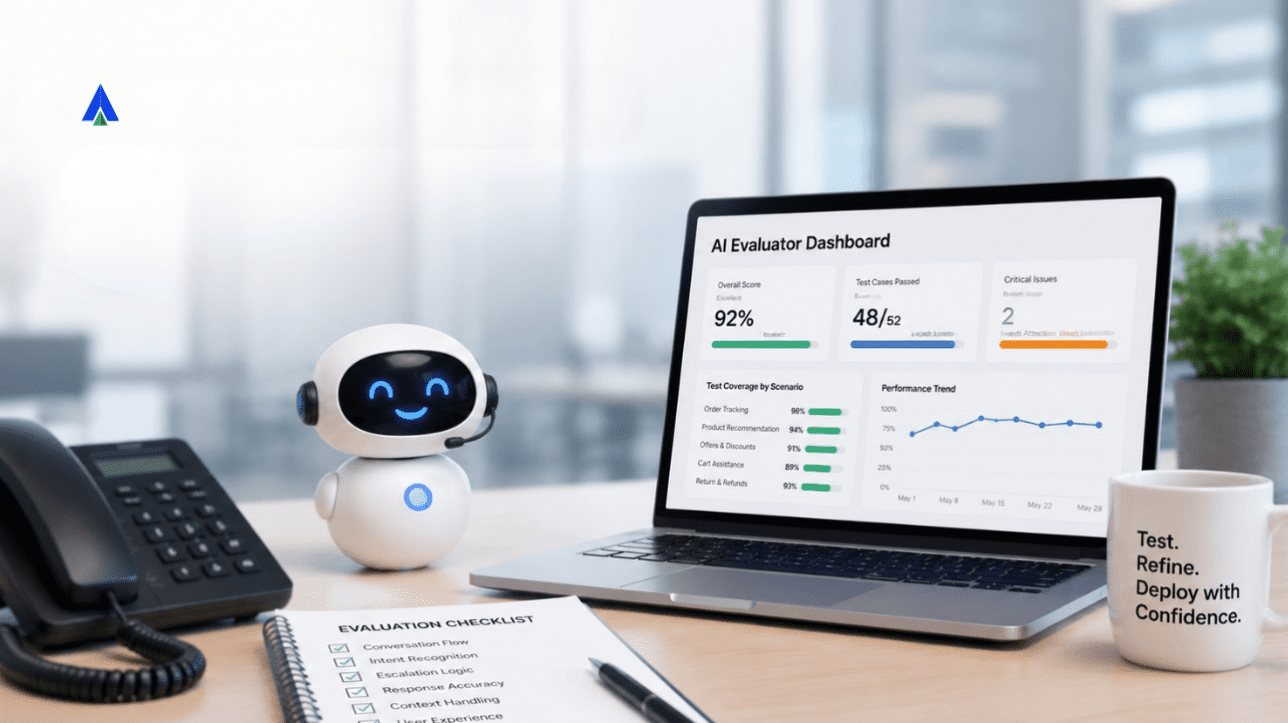
In this blog we will deep dive into AI Evaluators. We will understand what they test, how to define success criteria before running them, and how they apply specifically to e-commerce and BPO deployments.
Read on!
Why Do Voice Bots Fail After Go-Live?
Most voice bot failures after go-live are not model failures. They are design failures. Gaps in script structure, escalation logic, and fallback handling. These issues usually never surface during internal review because it does not involve a simulated real call.
Common post-launch failure patterns, documented across enterprise voice agent deployments, include four repeating modes:
- Dialogue loops: The bot asks the same question repeatedly when it fails to recognize a response, without switching to an alternative prompt or escalating. The caller hears the same re-prompt three times and hangs up.
- Cold handoffs: The bot escalates to a human agent with no transfer of call context. The agent starts the conversation from the beginning, the caller repeats themselves, and both sides lose time. The efficiency argument for the deployment collapses at the point of transfer.
- Latency-driven hang-ups: End-to-end voice-to-voice latency above 1,500ms creates audible pauses that callers interpret as a dropped or frozen call.
- False confirmations: The bot logs a confirmation (for a COD order, an appointment, or a data update) that the caller never explicitly gave. The error is invisible at the bot level but visible downstream: in the OMS, in the CRM, in the delivery schedule.
The business cost of these failure modes compounds at scale. In an e-commerce context where 10,000 COD orders are processed per month, a 5% false confirmation rate means 500 incorrect order statuses.
Each of these becomes a potential RTO event, carrying ₹150–250 in reverse logistics cost. In a BPO context, a cold-handoff escalation rate of 15% means 1,500 calls per month where human agents receive no context and must restart every interaction.
None of these failures produce a visible incident on launch day. All of them erode the cost case and the customer experience the deployment was built to improve.
Suggested reading: Voice Bot Use Cases
How Should Ops Teams Define the Success of AI Evaluators?
Success criteria for a voice bot are not the same as its functional requirements. Functional requirements describe what the bot is configured to do. Success criteria describe how well it must do them and at what failure rate the team considers the deployment not ready.
Without pre-defined success criteria, teams cannot distinguish a bot that needs one more configuration cycle from one that is genuinely ready for production. The AI Evaluator needs a target to measure against, not just a script to run through.
Three categories of success criteria apply to most e-commerce and BPO deployments:
Containment Rate Target
This indicates the percentage of calls the voice bot handles end-to-end without requiring human agent escalation. A call is “contained” when the bot resolves the caller’s intent without transferring.
Organizations with mature AI/RAG deployments average roughly 55–65% containment rates, while traditional rule-based bots perform significantly lower.
Set the minimum acceptable containment rate before launch, not after reviewing the first month’s escalation data. For COD confirmation workflows, where each human-handled call costs ₹150+ versus ₹10–20 for a bot-handled confirmation, a containment rate below 60% means the cost case for the deployment no longer holds.
Failure Scenario Pass Rate
Define the specific failure scenarios that the bot must handle correctly before going live. Set a pass rate threshold (85%+ is the standard target for enterprise deployments) for each failure category. Scenarios below threshold go back to configuration. Scenarios above threshold clear for production.
Latency Ceiling
Set a hard ceiling for voice-to-voice response time. Below 800ms is optimal; below 1,200ms is acceptable; above 1,500ms produces audible pauses that drive abandonment according to industry standards.
Platforms like Acefone’s AceX operate at 500–600ms voice-to-voice latency under standard configurations. But real-world latency varies with tool calling load, CRM integration response times, and concurrent call volume. Define the acceptable ceiling and test for it explicitly before launch.
What Does an AI Evaluator Actually Run?
An AI Evaluator creates a set of synthetic test callers and runs them through the deployed voice bot configuration in conditions that replicate production as closely as possible.
Four scenario categories belong in every voice bot pre-deployment evaluation:
Happy Path Scenarios
Standard cases where the caller’s intent is clear, their response is unambiguous, and the workflow completes as designed. These confirm the bot functions correctly under ideal conditions. They establish the baseline.
Rephrasing and Intent Variation
The same caller intent expressed in eight to twelve different phrasings. A COD confirmation caller may say “yes,” “go ahead,” “fine,” “that’s correct,” “sure please,” or “yes I confirm.” The bot has to recognize all of them as affirmative responses.
A caller who says, “I’m not sure” or “what was the amount again?” must route to a re-prompt, not a confirmation. Rephrasing tests expose whether intent recognition is robust or brittle. And brittle intent recognition is the single most common cause of false confirmations in production.
Edge Cases and Adversarial Inputs
Callers who ask questions outside the script, request a human immediately, or provide responses the bot was not configured to handle. The evaluator confirms that escalation triggers fire correctly, and that transfers include full call context. They also ensure that the bot does not loop when it encounters an unclassifiable input.
Fallback and Re-prompt Handling
Scenarios where the caller’s response is unclear or unrecognized. Does the bot re-prompt with different phrasing? Does it switch from a spoken re-prompt to a keypress option on the second attempt, recovering callers who do not respond well to voice input? Does it escalate gracefully after two failed re-prompts, or loop indefinitely? Fallback logic failures are the most common source of dialogue loops and false confirmations in live deployments.
The AI Evaluator logs each scenario result: pass, fail, or partial. The ops team reviews flagged scenarios, adjusts configuration and re-runs. The iteration cycle repeats until success criteria are met.
How AI Evaluator Testing Applies to E-Commerce and BPO Teams?
The deployment pattern for AI Evaluator testing should follow four stages that any operations team can run without engineering support.
Stage 1 — Define the use case and success criteria
Before configuring the bot, define what it must accomplish, at what containment rate, and against which failure scenarios. For e-commerce teams, this means specifying the COD confirmation workflow, the order tracking dialogue, the address verification step, and the escalation conditions that route to a human agent with full call context.
For BPO teams building client-facing deployments, this means confirming with the client what a successful call looks like before writing a single script line.
Stage 2 — Configure the voice bot
Platforms like Acefone’s AceX allows ops teams to configure a voice bot from a 1–2 line use case description, with no coding required. The configuration includes the knowledge base, the LLM and STT/TTS provider stack, tool calling integration, and the escalation logic.
Stage 3 — Run AI Evaluator scenarios
With the bot configured, the AI Evaluator runs the full scenario set: happy paths, intent variations, edge cases, fallback sequences. Each scenario produces a logged result. The ops team reviews failures, adjusts configuration, and re-runs flagged categories. Ops teams that define success criteria clearly in Stage 1 consistently complete this iteration cycle in hours, not days.
Stage 4 — Monitor with the observability dashboard post-launch
After the AI Evaluator clears the bot for production, you need to build an observability dashboard that provides key details. You should look for per-call monitoring: transcripts, turn-by-turn summaries, latency per component, tool call outcomes, escalation rates, and call completion rates. The success criteria defined before launch become the benchmarks monitored after it.
Operations teams running this four-stage pattern consistently outperform teams that go live without an AI Evaluator cycle. This is because by the time production data reveals a failure pattern, the failure has already been experienced by real customers.
Ready to see Acefone AceX’s AI Evaluator run your specific voice bot scenarios — COD confirmation, order tracking, or BPO client workflow — before a single real customer hears the agent? Book a 30-minute demo and leave with a tested configuration and scored readiness report, not a launch plan.
FAQs
Manual QA testing runs a finite set of scripted scenarios through a human tester who listens to bot responses and flags failures by judgment. It is slow, inconsistent, and does not scale beyond the tester’s scenario list. An AI Evaluator runs hundreds of scenarios (including intent variations and adversarial inputs) automatically, at consistent speed, with logged results that can be re-run identically after every configuration change
Yes. Regression testing after any script, integration, or escalation logic change is standard practice. A change that fixes one failure mode can introduce a regression in an adjacent scenario that passed in the previous cycle.
An AI Evaluator tests a configured agent against defined scenarios under simulated conditions. It does not test production load, the behavior of the bot under thousands of concurrent calls with real infrastructure constraints and latency variation
During the initial rollout, you should closely monitor these three metrics:
- Containment rate: Track the percentage of calls resolved without agent intervention. Your target should stay above the pre-defined benchmark.
- Escalation accuracy: Check whether escalations happen at the right moment, for the right reason, and with complete context transfer.
- Scenario-wise call completion rate: Measure completion rates across use cases such as COD confirmation, order tracking, and appointment scheduling.
If any of these metrics falls by more than 10 percentage points compared to the AI Evaluator baseline within the first two weeks, you should re-run the scenario and review the configuration.


