


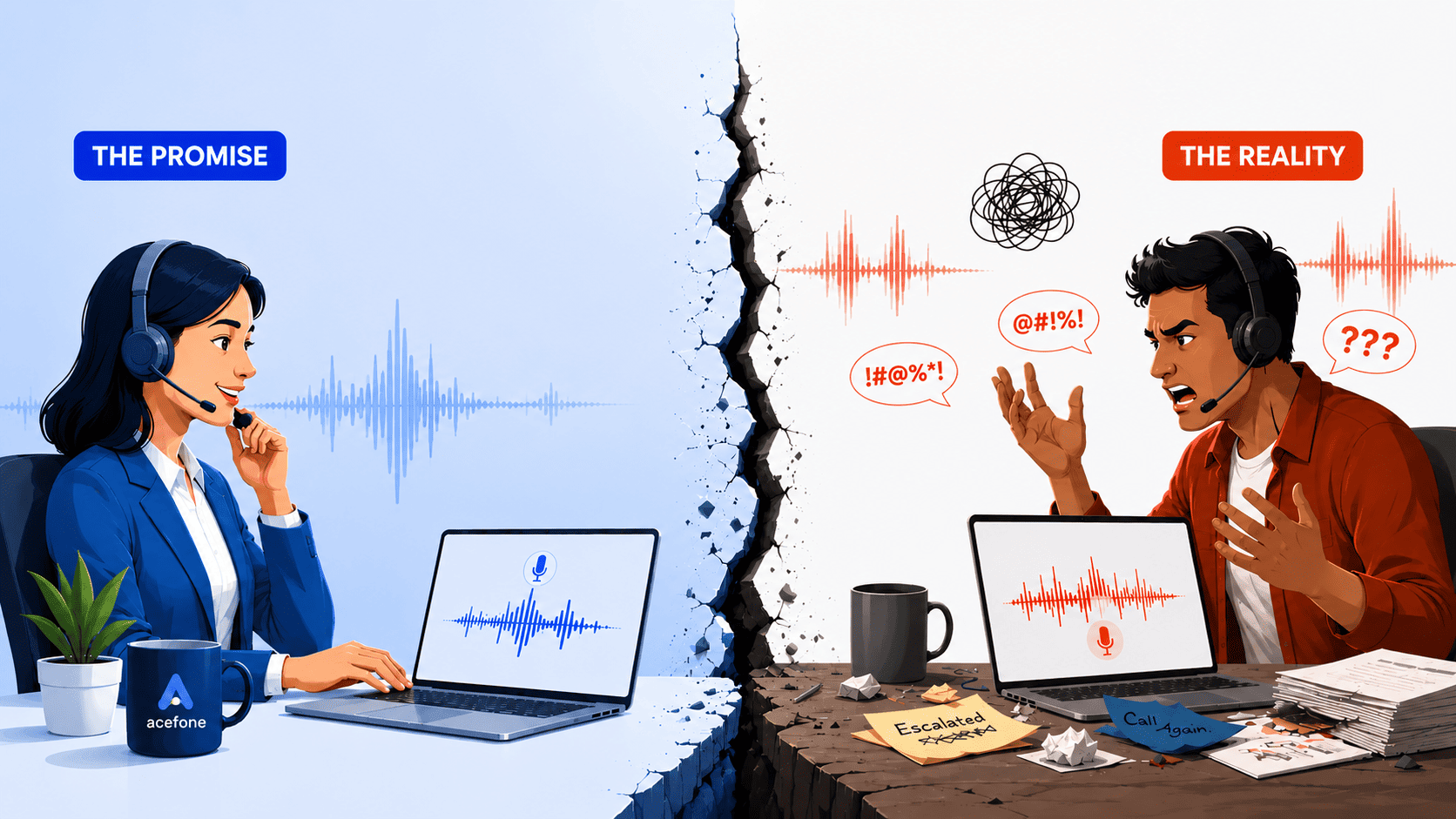


“What if the voice agent goes wrong on a live call?”
That’s the question sitting behind every voice AI demo might have sat through lately. The bot sounded sharp. It handled the script. It survived your trickiest test questions too.
But you don’t have an engineering team behind you to catch what breaks after go-live. So the real question was never “does it work in the demo.” It’s “will it still work when nobody’s watching.”
Why Doesn’t a Voice AI Demo Reassure You?
A demo works because everything is controlled: clean audio, one caller, no real integrations, no real anger. Production removes every one of those safety nets at once.
The MIT NANDA report found 95% of GenAI pilots deliver no measurable profit and loss return. That’s true even after a strong pilot phase. A demo proves the bot can perform once. It doesn’t prove it’ll hold up on caller number 4,000.
We’ve sat in enough vendor calls to know the pattern. A vendor turns on their voice bot, dials a clean number, and it performs beautifully. That’s not fake. It’s just incomplete.
A real caller doesn’t sound like a demo caller. They interrupt. They swear when they’re frustrated. They mix multiple languages in the same conversation. They call from a noisy market, not a quiet office. None of that shows up in a fifteen-minute demo.
This is the exact gap MIT’s Project NANDA measured across enterprise AI deployments in 2025. Ninety-five percent of GenAI pilots produced no measurable profit and loss impact, despite passing internal pilot reviews first. The bot worked. The business case didn’t.
Vendors selling “guarantees” today mostly mean refund guarantees. If the AI underperforms after you’ve deployed it, they credit you back. That’s a real commitment, but it’s still a bet placed after the damage is done. Your customer already had a bad call. Your team already spent the quarter cleaning up the fallout.
A guarantee that only pays you back after failure isn’t a guarantee against failure. It’s compensation for it. And no guarantee can promise a live call will always go perfectly. What can change the odds is how carefully you scrutinize the bot before you sign anything.
What Does a Failed Rollout Actually Cost?
A failed rollout rarely stays contained to one bad call. S&P Global found AI initiative abandonment before production rose from 17% to 42% in a single year. Gartner predicts 60% of AI projects lacking AI-ready data will be scrapped by 2026. Once trust breaks, teams don’t fix the bot. They cancel the project.
Here’s what that abandonment actually looks like on the ground. The US Social Security Administration rolled out an anti-fraud phone verification tool to catch fraudulent benefit claims. It flagged just 2 potentially fraudulent claims out of more than 111,000 reviewed, according to a Senate Finance Committee letter. Worse, it slowed down retirement claim processing by 25% for everyone else.
To be precise, this wasn’t a conversational voice bot. It was a fraud-detection algorithm running on SSA’s phone system. But the lesson holds for any AI system pushed live without proof it works at scale first. It didn’t fail quietly. It failed publicly and slowed down a government service millions of people depend on.
This is the pattern behind Gartner’s 60% figure and S&P Global’s abandonment numbers. Teams don’t abandon AI agents because technology is impossible. They abandon it because nobody proved it would hold up before it went live. By the time problems surface in production, the trust is already gone. Rebuilding that trust costs more than the original rollout did.
For a business scheduling a voice AI demo with no dedicated engineering team with them, this is the real risk. It’s not that the AI fails. It’s that you’re the one explaining why, to leadership, after the fact.
A brilliant voice AI demo won’t save you here. Only checking it against failure before go-live will.
What AI Voice Bot Providers Aren’t Showing You
Every voice AI competitor we’ve reviewed sells on demo polish or infrastructure ownership, not on proof. G2 reviewers describe unpredictable latency, exaggerated claims, and missed ROI across multiple platforms. None of that shows up in a sales demo. It only shows up after the go live. When it’s your problem, not theirs.
Take latency, for example. One widely used voice AI platform gets G2 reviews citing unpredictable response times. Sometimes it’s 800 to 1,000 milliseconds. Other times it stretches to 4 or 5 seconds, with no pattern. On a live call, that gap feels like the bot froze. Your caller doesn’t know it’s a technical hiccup. They just hang up frustrated.
Some complain about bots that “dysfunction multiple times” after go-live. Some describe vendors making promises that don’t hold up once real traffic hits. A recurring theme across reviews: missed return on investment expectations, and poor visibility into how the bot was built.
None of this is unique to one vendor. It’s a pattern across the category. Vendors compete on demo polish and infrastructure ownership, not proof.
We’re not saying this to score points off competitors. We’re saying it because this is the gap you need closed before signing anything. If a vendor can’t show proof before deployment, a demo is the only evidence you have. And a demo was never the question you needed answered in the first place.
Read More: How to choose AI Voice Bot Providers For Your Business
Can Any Voice Bot Provider Guarantee AI Performance?
No, not entirely. Too many things sit outside any provider’s control: your network, your integrations, your data quality. And real-world callers nobody can fully script for. What a provider can offer is rigorous pre-deployment testing you’re allowed to watch. What actually protects you is scrutinizing that testing yourself, not trusting a promise made on a voice AI demo call.
Watching the AI voice agent get tested against the situations that worry you most before you sign anything. Not a claim on a slide. Not a case study from a different company. The actual bot, tested against a random caller, with background noise, or any other challenging case, live, in front of you.
Pre-deployment testing: checking how an AI voice agent handles realistic failure scenarios before go-live, so you see it yourself before any real customer does.
That’s what tools like Acefone’s AI Evaluators are for. We let you watch the voice agent handle these scenarios before go-live. But watching one vendor’s test isn’t enough on its own. Run the same test on every vendor you’re considering. Ask the same tough questions on all of them.
The reassurance you’re looking for doesn’t come from a promise any single AI demo makes. It comes from how carefully you compare what you see, across every voice bot provider on your shortlist.
What Should You Ask Before Booking Your Voice AI Demo?

Before you sign up with any AI voice provider, ask four things. Can they show you the bot handling a scenario it has never seen before you deploy it? Will they let you watch that test happen, and not just describe it? What exactly triggers their guarantee, and when does it pay out? And what happens to your customer while you wait for that payout?
Here’s what we’d tell anyone looking to adopt voice agents or planning a voice AI demo. Ask these four questions before anyone asks for a signature.
- Show me a failure scenario, not a success story. Ask the vendor to run the bot through an angry caller or code-switched sentence. Do it live, before you sign anything.
- Let me watch the test, not read about it. The result deck isn’t proof. A simulation you can see running is.
- Tell me exactly what triggers your guarantee. Vague guarantees, like “we’ll work with you,” aren’t guarantees. Specific triggers, tied to specific metrics, are.
- Tell me what happens to my customer while I wait for a refund. If the answer is “nothing, they just have a bad experience,” that’s the real cost.
You’re not asking for a better voice AI demo. You’re asking to see the truth for yourself. None of these questions are hostile. They’re the questions we’d want asked of us too. A vendor confident in what they’ve built will welcome all four. One who isn’t will change the subject.
What This Looks Like for You
Picture your next voice AI demo. The AI voice bot should be able to understand your product, and switch smoothly between different languages.
Before you sign anything, ask to see how it tested against a genuine case- mixed languages, noise backgrounds, and varying range of emotions.
This is exactly what makes Acefone’s AI voice agent different. It provides you with evaluators that you can run it on before taking a real call. We simulate the messy scenarios your customers actually bring: angry callers, multi-lingual conversations, background noise, and off-script questions.
Read more about- Popular AI voice bot use cases
We won’t tell you this makes us the only safe choice. No single test covers every situation you’ll face. What we will say is this: watch us run it. Then ask every other vendor on your list to do the same. That comparison, not any one vendor’s word, is what actually protects you.
What Should You Take Into Your Next Call?
Here’s what we’d want you to walk away with. No guarantee, ours or anyone else’s, can promise your rollout will go perfectly. Too much sits outside any single vendor’s control.
What actually protects you is scrutiny applied before you sign, not a promise you’re trusting after the fact. A vendor willing to be tested, live, in front of you, is telling you something. That’s more than any guarantee can say.
The next voice AI demo you sit through shouldn’t be the end of your evaluation. It should be the start of your new journey with voice AI.
Frequently Asked Questions
Demos run in controlled conditions: clean audio, one caller, no real integrations. Production removes those safety nets, and MIT’s Project NANDA found 95% of GenAI pilots deliver no measurable P&L return. That gap between demo and deployment is exactly where reliability breaks down.
Not fully and be wary of any provider who claims otherwise. Too many variables, your network, your data, your customers, sit outside a vendor’s control. What a good vendor can offer is live pre-deployment testing you’re free to scrutinize. That’s more useful than a promise on paper.
Run it against simulated callers, not real ones. A strong test throws real scenarios at the AI first: angry callers, mid-call switched language, background noise, off-script questions. Most providers skip this step and rely on the demo call as proof instead.
Not entirely, and we won’t claim otherwise. Performance depends on your data, your integrations, and real-world conditions no vendor fully controls. What we can guarantee is a live test against multiple scenarios before you commit. That way you see the truth yourself, rather than take our word for it.


