


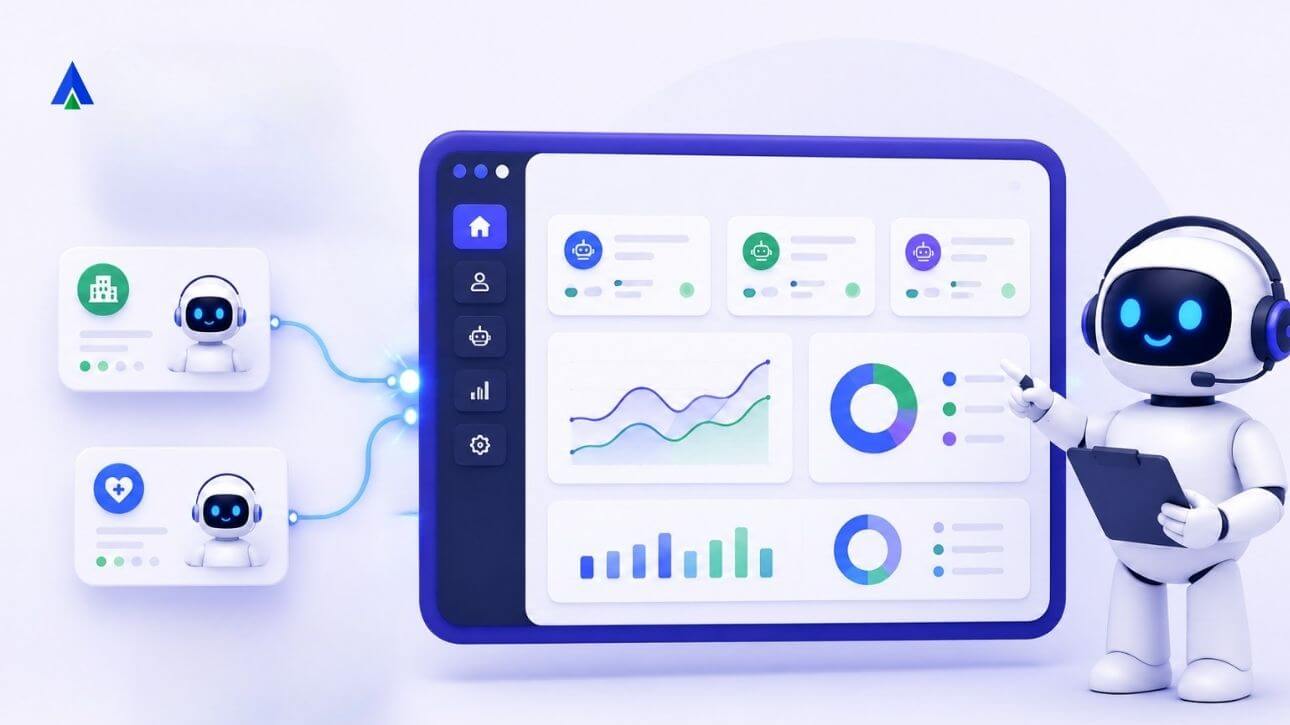


Running multi-client voice bot deployments from a single dashboard requires a centralized operations layer. The goal is to enforce strict data isolation between clients while giving your ops team a single pane of glass for monitoring, tuning, and reporting.
The architecture separates client workspaces at the data model level, each with their own bot configs, CRM integrations, and SLA thresholds. All this, while a shared infrastructure layer handles routing, telephony, and compute. BPOs that achieve this, deploy new client voice bots in 48 hours or less, cut per-call costs, and report across all accounts without ever mixing client data.
The bottleneck is almost never the technology, it is the absence of a management layer.
BPOs running AI voice programs now face a structural challenge human agents never created: the same voice bot infrastructure must serve five, ten, or twenty clients simultaneously. Each of the clients needs different scripts, compliance rules, CRM targets, and SLA commitments.
A very small percentage of voice AI pilots survive the move from demo to production. The reason is not the voice model. It is the ops layer. When majority pilots stall because no one finished the CRM integration, the failure mode is management infrastructure, not AI capability.
Let’s understand how BPOs can architect and operate multi-client voice bot deployments from a single management dashboard.
What is a Multi-Client Voice Bot Deployment?
A multi-client voice bot deployment is a setup where a single voice AI platform serves multiple businesses (clients) from the same underlying infrastructure. All this, while keeping each client’s data, workflows, integrations, and configurations separate. Instead of building and managing a dedicated voice bot system for every customer, providers deploy reusable voice bot templates. They also share resources that can be customized for different use cases. This approach reduces implementation time, lowers costs, simplifies maintenance, and enables faster scaling across clients.
Why Do Multi-Client Voice Bot Programs Break Down?
Without a centralized dashboard, BPO operations teams manage each client’s voice bot as a siloed project. There are separate logins, separate monitoring scripts, and separate reporting exports.
As client count grows, this creates compounding coordination overhead. Incident triage slows because there is no unified alert stream. Cross-client performance benchmarking becomes manual. And onboarding a new client requires rebuilding integrations from scratch rather than instantiating a tested template.
The operational cost of fragmented management compounds quickly. A BPO running voice bots for ten clients without a shared ops layer needs at least one dedicated person per two clients. They also need CRM troubleshooting, and script updates. Approximately five FTE for what should be a one-person task. A recent study found that 74% of enterprises have rolled back or shut down an AI customer communications agent after deployment due to failures.
Three failure patterns appear consistently across fragmented deployments:
- CRM write-back gaps: Without a shared integration framework, each client deployment re-confronts the same API authentication, data-mapping, and retry-logic problems. Teams solve it once, document it poorly, and solve it again for the next client.
- No transcript-grading pipeline: Very few of deployed voice bot programs have an active transcript-grading pipeline that flags low-confidence responses, missed intents, and escalation errors. Without one, quality regression is invisible until a client escalates. A dashboard that surfaces confidence scores and escalation rates across all clients shifts quality from a reactive to a proactive function.
- Absent ops ownership: Centralization forces this. A shared dashboard has a single owner responsible for its uptime, its data, and its outputs. Fragmented deployments distribute accountability so thinly it disappears.
What is an Effective Single Dashboard for Voice Bot Operations?
An effective multi-client voice bot dashboard requires the following five capabilities:
1. Client-Scoped Access Controls
Each client’s data (call recordings, transcripts, CRM payloads, and performance metrics) must be isolated at the data model level, not just filtered by user role. Role-based access that merely restricts UI views leaves underlying data readable by anyone with API access or a misconfigured query. True data isolation means each client operates in a separate data partition where cross-client queries are architecturally impossible, not just restricted. In a separate data partition where cross-client queries are architecturally impossible, not just restricted.
2. A Unified Alert Stream
When a voice bot’s ASR confidence drops below threshold at 2 AM, the ops team needs one alert channel, not ten client-specific dashboards to check manually. A unified alert stream aggregates latency warnings, transcription anomalies, escalation rate spikes, and telephony errors across all clients into a single prioritized feed.
This is the operational difference between a managed service and a portfolio of parallel experiments.
3. Per-Client Configuration Management
Each BPO client has different call flows, compliance rules, and escalation scripts. The dashboard must allow per-client configuration without risk of a config change bleeding into another client’s deployment. Config changes should require explicit client-scope selection and produce an audit trail to satisfy client data processing agreements.
4. SLA Reporting with Client-Level Segmentation
BPO clients pay for outcomes: containment rate, average handle time, first-call resolution. The dashboard must surface these metrics at the client level with the ability to generate client-facing reports without manual data export and reformatting.
5. A Shared Integration Hub
CRM write-back is the most common failure point in voice bot deployments. A shared integration hub means each new client deployment maps to a tested connector rather than building from scratch. Once a connector is certified in the hub, every future deployment using that CRM benefits from prior error-handling, rate-limit logic, and field-mapping work.
How to Protect Client Data Without Slowing Deployment?
Client data isolation in a shared voice bot platform does not require separate infrastructure per client.
It requires architectural separation at the data model level. Each client operates in a dedicated workspace with its own schema, API keys, and integration credentials. All this, while computing, telephony, and routing run on shared infrastructure. This design delivers isolation without multiplying infrastructure overhead and enables new client deployments to be instantiated from a tested template in under 48 hours.
The architecture tension BPOs face is real. Full infrastructure separation per client (dedicated servers, dedicated databases, dedicated telephony integrations) provides the strongest isolation. However, it makes new client onboarding a weeks-long engineering project. Full infrastructure sharing cuts onboarding time but introduces compliance and data-mixing risk that no enterprise client will accept.
The resolution is logical separation on shared infrastructure. A single platform where each client’s data, configuration, and API credentials live in a dedicated workspace partition, while the underlying compute, routing, and telephony infrastructure is shared and centrally managed.
For Indian BPOs, this architecture must address three additional compliance layers: DPDPA 2023 data localization requirements, RBI guidelines for financial services call data, and IRDAI requirements for insurance BPO operations.
Language handling adds a fourth consideration. Indian BPO operations frequently serve clients requiring Hindi, Tamil, Telugu, Bengali, or other regional-language interactions.
How Multi-Client Voice Bot Management Applies to BPO Operations Running AceX?
Acefone’s AceX platform is built for BPO-scale voice AI operations, with multi-tenant architecture designed to address the management challenges outlined above.
Each client account in AceX operates as a separate workspace partition with its own bot configurations, CRM integrations, escalation rules, and API credentials. The shared ops dashboard surfaces real-time performance metrics like containment rate, handle time, escalation rate, and ASR confidence. These are segmented by client, with threshold-based alerts that notify the ops team across all accounts from a single feed.
New client deployments on AceX go live in 48 hours using the no-code bot builder, which templates call flow configuration to eliminate per-client engineering overhead.
See how AceX handles multi-client voice bot operations at scale and whether the architecture fits your current client portfolio.
FAQs
The operational break-even point for a centralized dashboard is lower than most BPOs expect. With two or more active clients running live voice bot deployments, incident triage and reporting overhead justifies centralization.
Quality-of-service isolation in a shared-infrastructure voice bot platform uses compute and telephony resource partitioning to prevent one client’s call surge from consuming resources allocated to other clients.
Yes, provided the platform enforces compliance configuration at the workspace level rather than globally.
An effective escalation architecture requires warm transfer rather than cold transfer, so the receiving agent sees the full transcript before the call connects. You also need sub-second transfer latency to prevent dead air. Other than that, you need per-client escalation routing rules that direct calls to the correct agent group based on call intent, not just availability.
Centralized management creates genuine risk in one specific scenario: when client contracts include infrastructure isolation clauses, mandating that a client’s voice bot run on dedicated, client-exclusive servers rather than shared infrastructure.


