


 8 mins read


Ever hung up on an IVR because the voice sounded like a dial-up modem reading a phone book? Most callers have. Picking the right text to speech software isn’t a checkbox exercise anymore. It decides whether a caller stays on the line or hangs up before reaching an agent.
We run TTS across IVR, voice broadcast and post-call systems every day, and we’ve seen the difference a good engine makes to first-call resolution. This guide walks through what actually matters for call centers, ranks the engines worth your budget, and tells you when TTS isn’t the right call at all.
What Makes Text-to-Speech Software Good for Call Centers?
Good call center TTS needs four things: low latency, natural-sounding voices, wide language coverage, and clean integration with your IVR or CRM. Miss any one, and callers notice within seconds.
Latency is the first filter. The response needs to feel immediate and conversational, without awkward pauses between the caller’s input and the voice response. Even a noticeable delay can disrupt the flow of a conversation. The lower the latency, the more natural the interaction feels.
The delay between a system deciding what to say and the first sound reaching the caller’s ear.
Voice naturalism matters just as much. Neural TTS has replaced the old concatenative engines that spliced together pre-recorded clips. Sequence-to-sequence models generate waveforms directly, which is why modern IVR voices sound like a person, not a robot reading a script.
Beyond that, check: does the engine plug into your existing IVR builder without custom development? Does it support the languages your customers actually speak? Can it run on-premise if you handle regulated data? These four checks decide whether an engine fits a call center or just a demo reel.
Top 10 Text-to-Speech Software for Call Centers in 2026
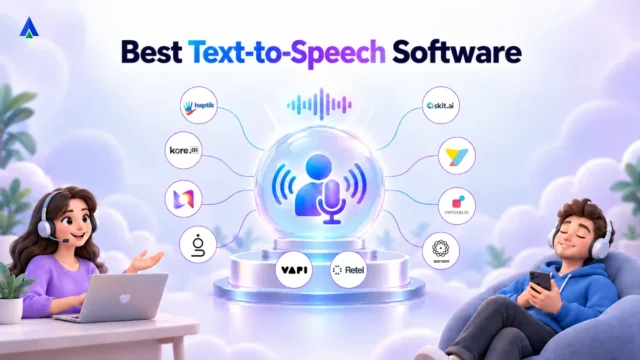
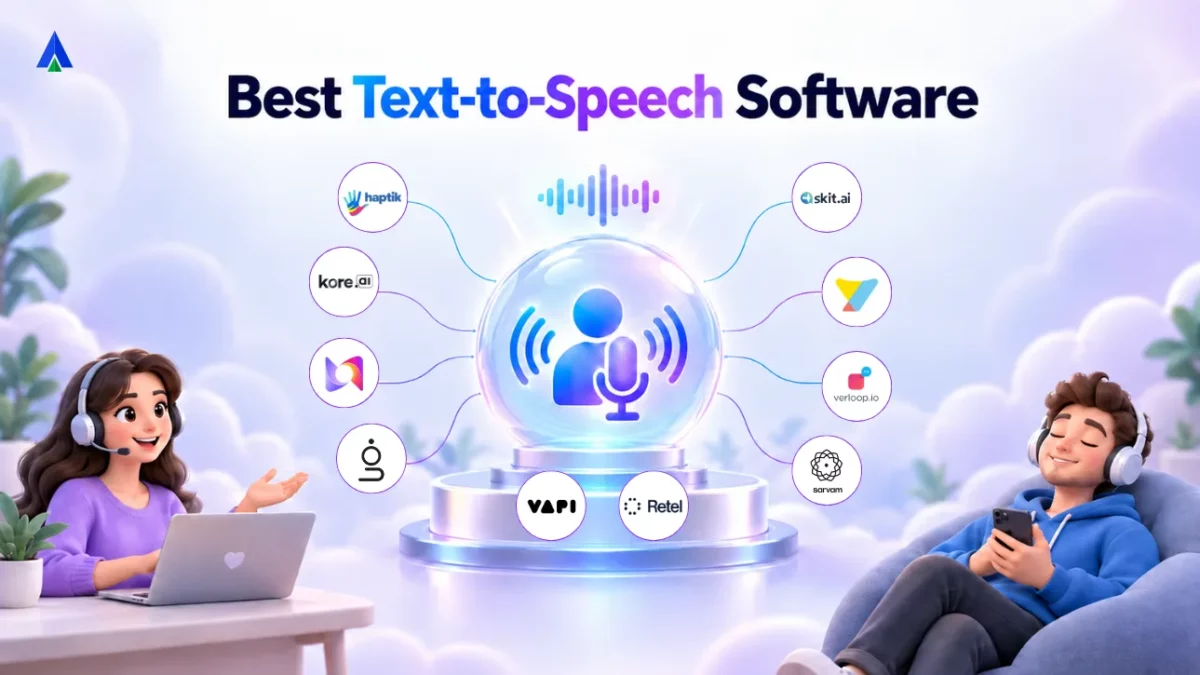
Murf AI, Vapi, Haptik, Kore.ai, Gnani.ai, Skit.ai, Verloop.io, Yellow.ai, Retell AI and Sarvam AI make up the top 10 voice AI providers Indian call centers are actually deploying in 2026, each suited to a different call volume, language mix or compliance need.
| Platform | Key Features | Go-Live Speed |
| Murf AI | Falcon TTS core engine, sub-100ms latency, on-prem option | Days (devs) |
| Vapi | Developer-first, sub-500ms (vendor claim) | Days (devs) |
| Haptik | Enterprise scale, BFSI experience | Weeks |
| Kore.ai | Governance and orchestration | Weeks |
| Gnani.ai | Regional Indian language accuracy | Days-weeks |
| Skit.ai | Collections workflows | Days-weeks |
| Verloop.io | Combined chat and voice | Days-weeks |
| Yellow.ai | Multi-channel, multi-LLM | Weeks |
| Retell AI | 600ms latency (vendor claim), SIP trunking | Days (devs) |
| Sarvam AI | Indian-language depth, sovereign infra | Days-weeks |
1. Murf AI
Murf AI is a text-to-speech and voice generation company built around its own proprietary speech models (Falcon and Gen2), covering both a Studio editor for voiceover production and a production-grade TTS API for real-time voice agents.
Does well:
- Falcon 2 returns first audio in under 100ms in independent testing, ranking ahead of ElevenLabs, Cartesia, Deepgram and Sarvam on the same benchmark.
- Falcon TTS handles up to 10,000 concurrent calls at the same latency, at roughly 1 cent per minute.
- Covers 150-plus voices across 35-plus languages, with an on-premise deployment option for banks, hospitals and government bodies that can’t send audio outside their network.
- Holds SOC 2 Type II, ISO 27001 and GDPR compliance, with infrastructure hosted on AWS.
Best suited for: Businesses that want a dedicated, high-accuracy TTS engine to plug into their own IVR, dialer or voice agent build, rather than a full contact centre platform.
2. Vapi
Vapi is a developer-first platform for building, testing and deploying voice AI agents, built around an API-first architecture that plugs into 25-plus services including OpenAI, Anthropic, ElevenLabs, Deepgram, Salesforce and HubSpot.
Does well:
- Claims sub-500ms average latency (vendor figure, not independently verified).
- Offers enterprise features like SSO and RBAC for access control.
- Holds SOC 2, HIPAA and PCI compliance, useful for regulated global deployments.
- Gives technical teams full control to mix and match providers at each layer of the voice stack.
Best suited for: Technical teams that want full ownership of their voice AI stack and are comfortable building India-specific compliance, telephony and number sourcing themselves, since Vapi has no dedicated Indian telephony layer or TRAI, RBI and DPDPA compliance built in.
3. Haptik
Haptik, part of the Reliance Jio group, has built conversational AI for large Indian enterprises for close to a decade. Its voice agent product extends that same enterprise focus from chat onto live phone calls.
Does well:
- Deep experience with large-scale Indian deployments, particularly in telecom, BFSI and e-commerce.
- Integrations built for enterprise CRM and ticketing stacks already common at large Indian companies.
- Enterprise-grade reliability backed by Jio’s infrastructure and scale.
Best suited for: Enterprises that already run other Haptik products and want voice added to an existing conversational AI setup, though go-live timelines run into weeks and self-serve options stay limited for smaller teams wanting to start narrow.
4. Kore.ai
Kore.ai is a global conversational AI company with a strong Indian presence, offering voice agents alongside chat and virtual assistant products for enterprise clients across industries.
Does well:
- Strong governance and orchestration tooling for businesses running AI agents across multiple departments.
- Granular control over conversation flows, useful where compliance or brand teams need sign-off on every path.
- Broad enterprise feature set built for complex, multi-team ownership.
Best suited for: Large, multi-department enterprises with an in-house technical team to configure and maintain complex flows, since the barrier to entry is higher for smaller businesses without dedicated engineering support.
5. Gnani.ai
Gnani.ai focuses specifically on Indian language voice AI, with speech recognition and voice agent products trained on Indian accents and regional languages rather than English-first models with translation layered on top.
Does well:
- Meaningful investment in regional Indian language accuracy as the core product focus.
- Trained on real Indian speech patterns, not textbook or formal-only language.
Best suited for: Businesses whose primary call volume runs in a regional Indian language and need accuracy in that language above everything else, though coverage outside voice AI (chat, omnichannel) stays limited compared to broader platforms.
6. Skit.ai
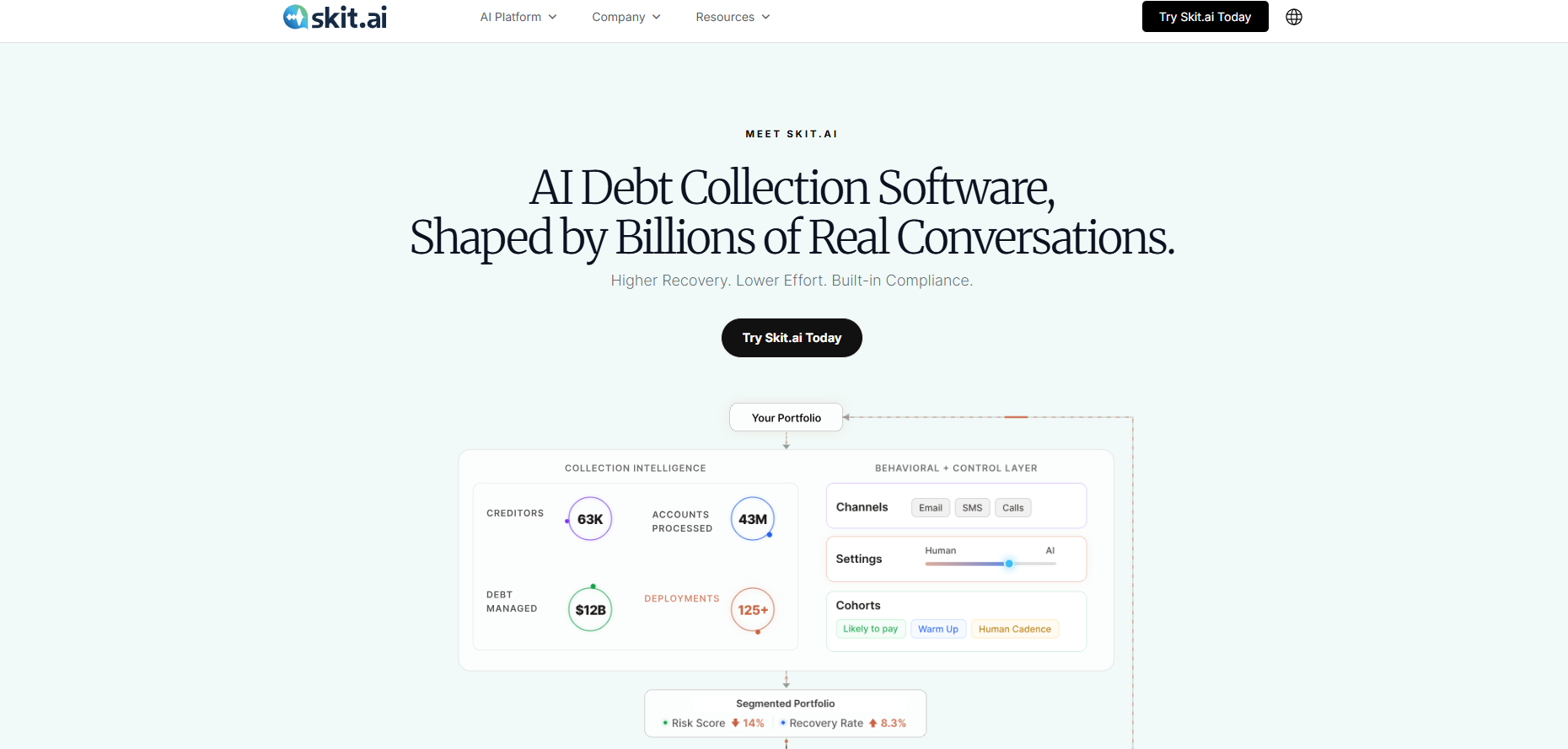
Skit.ai (formerly Vernacular.ai) builds voice AI focused on collections and lending, handling high-volume outbound calling for payment reminders and follow-ups for BFSI and NBFC clients.
Does well:
- Purpose-built workflows for collections calling specifically, not adapted from a general-purpose product.
- Compliance features aimed squarely at lending and recovery businesses.
Best suited for: NBFCs and lenders running high-volume collections calling as their primary use case, since the narrow focus makes it a weaker fit for businesses needing voice AI across sales, support and collections together.
7. Verloop.io
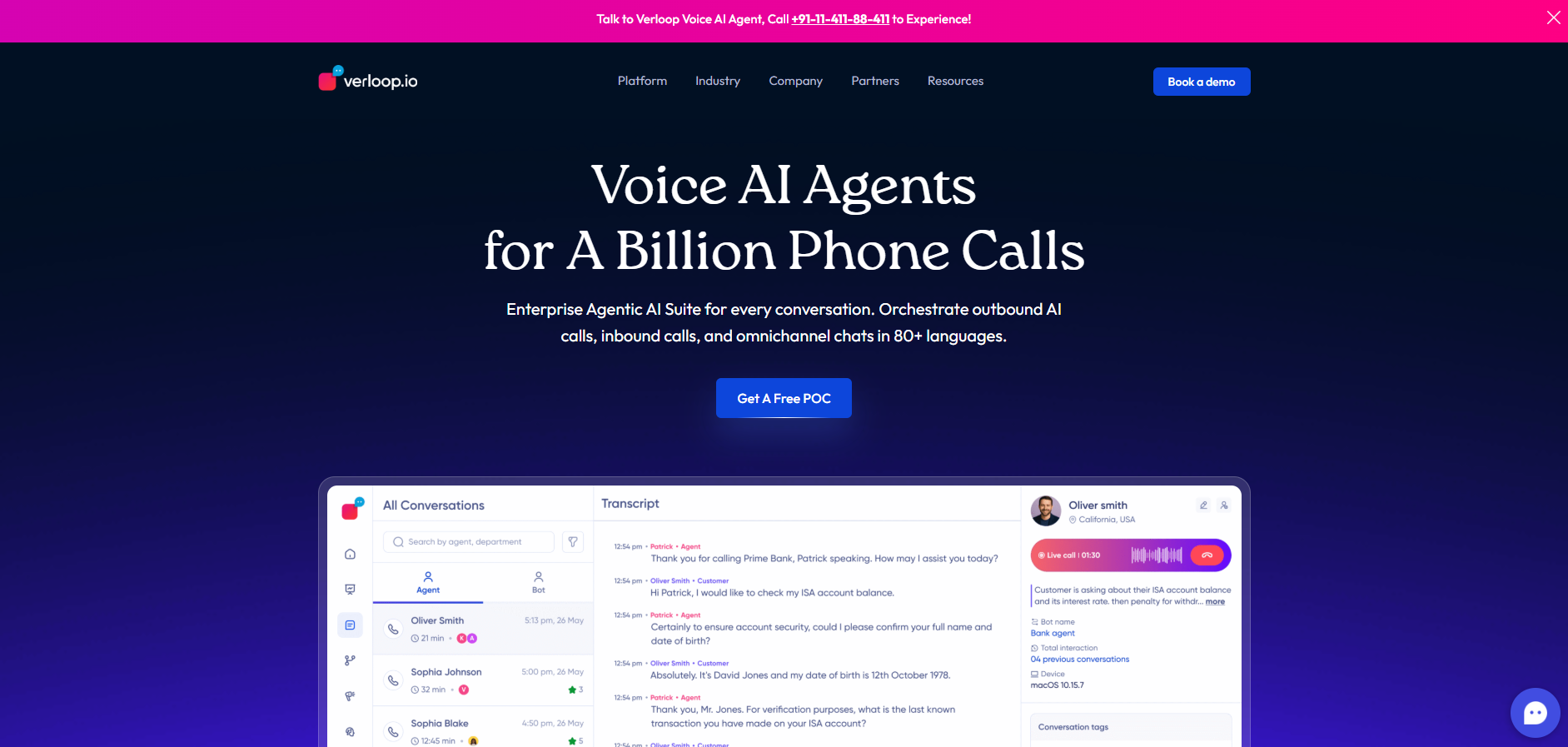
Verloop.io started as a chat automation platform and has extended into voice, giving businesses that already use it for support chat a path to add voice without switching vendors.
Does well:
- Keeps customer experience consistent across chat and voice for support-heavy businesses on one vendor.
- Lower switching cost for teams already invested in the Verloop chat product.
Best suited for: Support teams that want chat and voice automation under one vendor relationship, though voice is a newer addition here, so language depth and latency on Indian calls trail more specialized voice-first vendors.
8. Yellow.ai
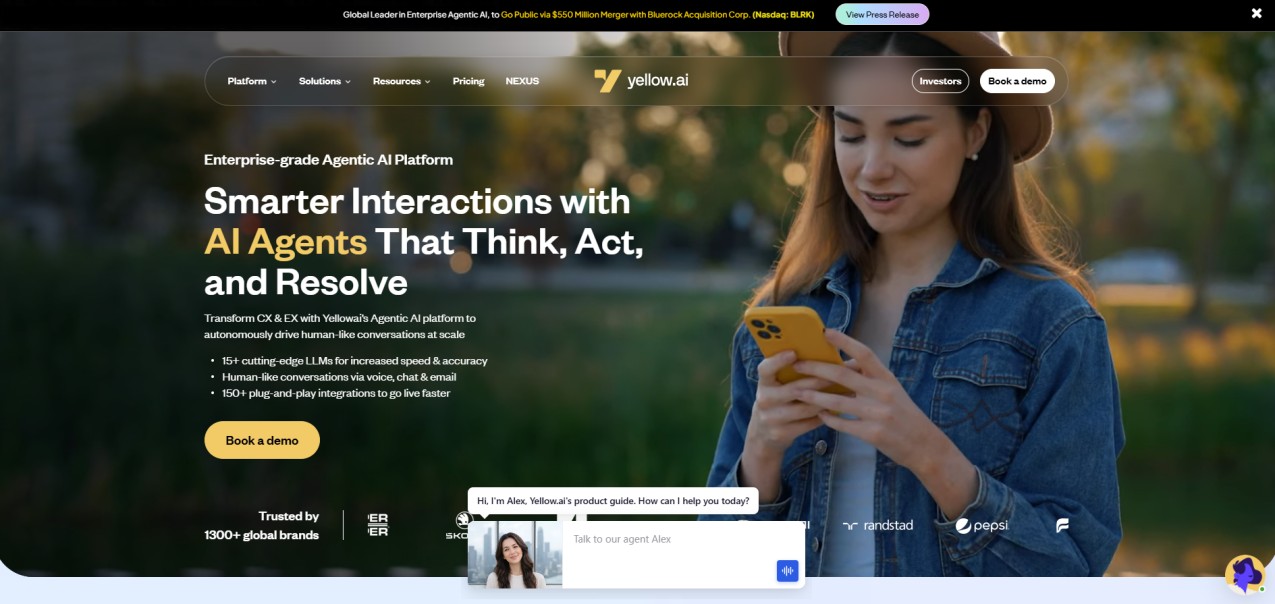
Yellow.ai is one of India’s largest conversational AI companies, covering voice, chat, WhatsApp and email under one account. Its voice product includes multi-LLM support and claims coverage across 20 Indian languages.
Does well:
- Broad channel coverage beyond voice, useful for teams standardizing on one CX vendor.
- Enterprise-grade implementation support for large, multi-department rollouts.
- Backed by a large existing enterprise customer base.
Best suited for: Large enterprises with a dedicated CX or AI team and budget for a multi-channel deployment, since implementation is sales-led with multi-week onboarding and pricing isn’t published.
9. Retell AI
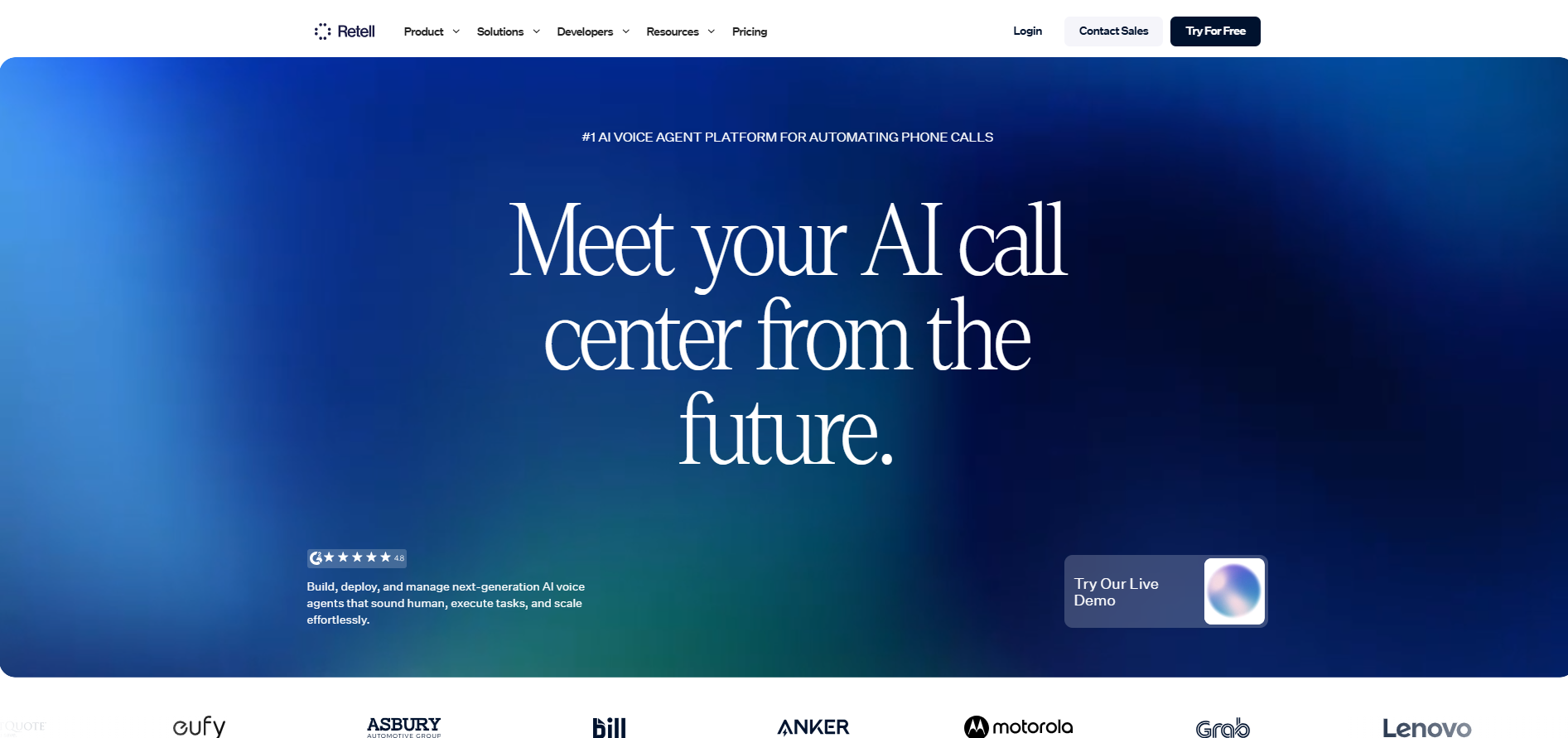
Retell AI is a developer-focused voice agent platform built around low latency and natural turn-taking, with SIP trunking support that connects to existing phone numbers through providers like Twilio and Vonage.
Does well:
- Claims around 600ms latency (vendor figure, not independently verified).
- IVR navigation, call transfer to human agents and batch outbound calling.
- Webhook-based integrations for custom workflows built by engineering teams.
Best suited for: Engineering-led teams that want to build a custom voice agent on their own telephony stack, since Retell AI is a global infrastructure layer, not an India-ready product, leaving TRAI, DPDPA and RBI compliance to the business.
10. Sarvam AI
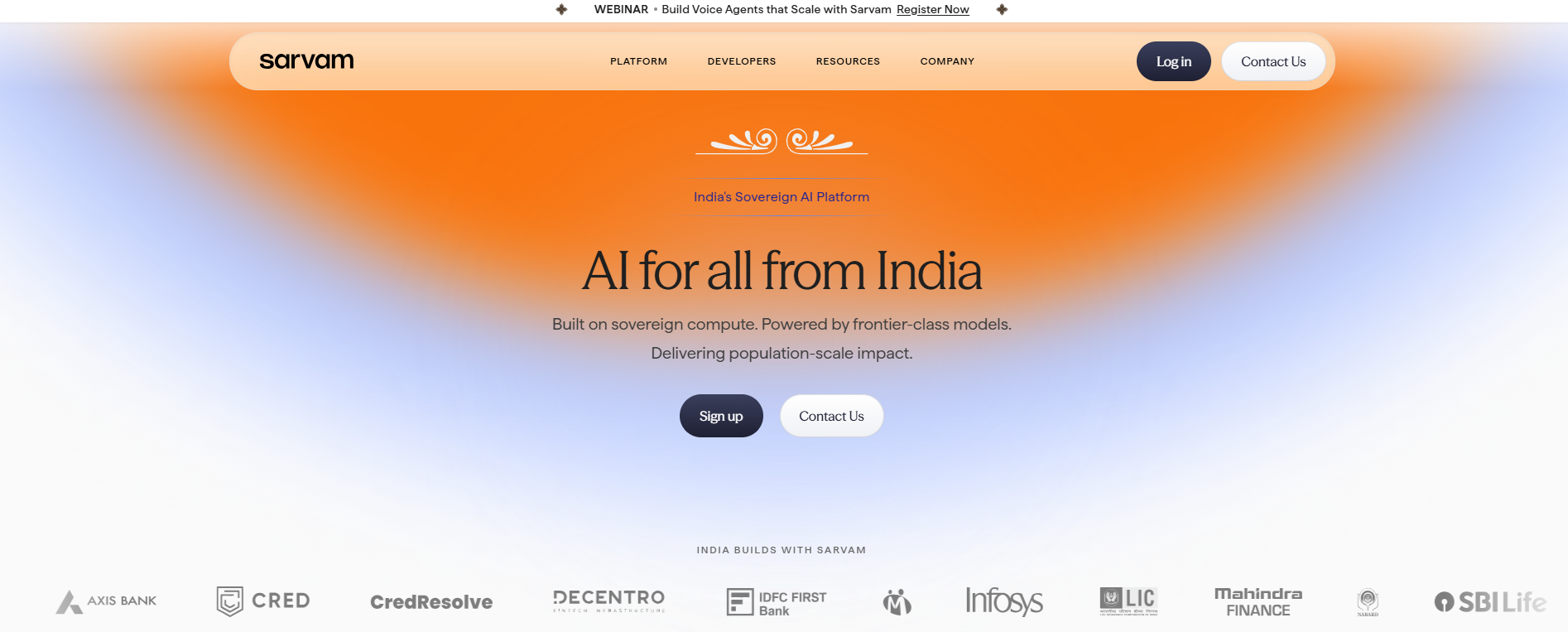
Sarvam AI is a Bengaluru-based company building sovereign, India-first AI models, including voice agents with support for around 22 Indian languages and strong handling of code-mixed, Hinglish-style speech.
Does well:
- Strongest language depth in the list, with real traction among regulated and government entities.
- Flexible deployment including private VPC and on-premises options for data residency needs.
Best suited for: BFSI, government and large enterprises where Indian-language accuracy and data sovereignty matter more than an out-of-the-box telephony setup, since Sarvam is primarily a language and model layer, not a full contact center product.
Why Acefone Goes Beyond a Standalone TTS Pick
Most vendors on the list above solve one piece of the voice AI puzzle: a bot, a language model, or a telephony layer. Acefone was built differently. It’s a full omnichannel communication platform with TTS-powered voice AI as one part of a much wider stack, not a bolt-on feature competing for a single line item in a comparison table.
- AceX Voicebot, powered by native TTS: Acefone’s Ai voice agents handles customer calls in real time, understanding queries, following predefined flows, and managing routine work like answering questions, qualifying leads, scheduling callbacks and handling requests. The TTS engine sits natively inside Acefone’s own IVR and dialer, so a script change or a new accent selection doesn’t need a separate integration project.
- Interactions Hub (one inbox for every channel): Beyond voice, Acefone’s Interactions Hub brings voice, WhatsApp, SMS, email and video into a single workspace, so agents see a customer’s full conversation history regardless of which channel they used last. A customer who messaged on WhatsApp Monday and calls Thursday gets an agent who already has the thread on screen, not one starting from zero.
- Contact Center Studio (blended inbound and outbound in one place): Contact Center Studio combines inbound and outbound calling operations, with dialers, skill-based routing, and supervisor tools like whisper and barge for live coaching during calls, so quality assurance doesn’t wait for a post-call review.
- API Connect and Campaigns: API Connect gives developers programmable access to voice, SMS and click-to-call, useful for teams that want to build custom workflows on top of Acefone’s telephony layer instead of a generic global API. Campaigns handles proactive outreach, automating outbound calls, follow-up scheduling and interaction tracking for marketing and retention pushes.
- Xtract: AI-powered post-call analytics: Xtract turns every recorded call into structured data, flagging customer intent, sentiment and agent performance automatically. That closes the loop between what TTS says on a call and what a business actually learns from it afterward.
- Compliance and scale built for the Indian market: Acefone’s Interactions Hub is DoT/TRAI compliant, ISO certified, and VAPT tested by CERT-IN empanelled vendors, with data kept on India-based infrastructure. The platform runs more than 2.5 billion calls a year and is trusted by 15,000-plus businesses, backed by India-based support teams for when a live campaign needs a fix at 11 p.m., not a ticket queue.
Put together, this is why call centers evaluating “best TTS software” often end up comparing something bigger: a platform where TTS, IVR, omnichannel messaging, outbound campaigns and post-call analytics all share one data layer, instead of five separate vendor contracts.
Cloud or Self-Hosted TTS: Which Fits Your Call Center?
Most call centers should default to cloud TTS for lower costs and faster setup. Self-hosted or on-premise solutions are better suited to regulated industries such as banking and healthcare.
Cloud TTS typically offers a lower total cost of ownership. There is no hardware to maintain, scaling is simpler and pricing can align with usage.
On-premise deployment makes sense when audio data cannot leave your network. It can be useful for organizations handling sensitive customer information, financial transactions, healthcare conversations, or confidential government communications. However, this approach requires more infrastructure and maintenance, which can make implementation more complex.
There is also a third option: orchestration layers that connect your call center with multiple TTS providers. This gives teams greater flexibility to switch between providers without managing the entire voice infrastructure themselves.
How Does Text-to-Speech Software Apply to Call Center Operations?
Take a mid-size support team running a multilingual IVR across India, the Gulf and Southeast Asia. They need a welcome greeting in Hindi, Arabic and English, a message-on-hold that doesn’t sound stitched together, and an outbound campaign in the same three languages during a product recall.
With Acefone, that’s a voice and accent selection in the IVR builder, plus a Voice API call for the recall broadcast, both using the same TTS layer and the same brand voice. No separate vendor contract for broadcast versus IVR, no re-recording every time a script changes. That consistency matters more than it sounds. A caller who hears the same voice on the IVR and the recall call trusts the brand more than one bounced between two different synthetic voices.
Key Takeaways: Choosing TTS Software for Your Call Center
Latency and naturalism decide whether a caller stays on the line, so benchmark any TTS engine under real call load, not a demo. Accessibility law is now a genuine compliance driver, which means neural TTS adoption isn’t optional for regulated markets. And for call centers specifically, TTS built into your IVR and dialer (like Acefone’s) beats stitching together a standalone API, because one voice layer across every channel is simpler to manage and sounds more consistent to the caller.
If your IVR still sounds like it’s reading from a script written for a fax machine, it’s worth seeing what a native setup looks like instead of another API integration.
See how Acefone’s TTS-powered voicebot handles multilingual greetings and voice broadcasts in one setup. Book a 15-minute walkthrough with our team.
FAQs: Text-to-Speech Software for Call Centers
It depends on where TTS needs to live. For call centers, Acefone leads because TTS is built into the voicebot, which integrates into the dialer natively. For standalone API use, Amazon Polly, Google Cloud TTS and Microsoft Azure are strong general-purpose picks.
Modern neural TTS comes close. Engines like Murf and ElevenLabs report sub-second latency with natural inflection, though quality still varies by language and script complexity.
Most cloud TTS engines need integration work to plug in. Platforms like Acefone build TTS directly into their system, so no separate development is required.
Skip TTS for high-stakes emotional calls, like bereavement or serious complaints, where a recorded human voice builds more trust. TTS also struggles with heavy regional slang or code-switching mid-sentence.
Standalone APIs like Polly and Google offer free tiers before charging per million characters. Platforms like Acefone bundle TTS into a comprehensive voice bot. You can connect with our sales team to learn more about the pricing.