


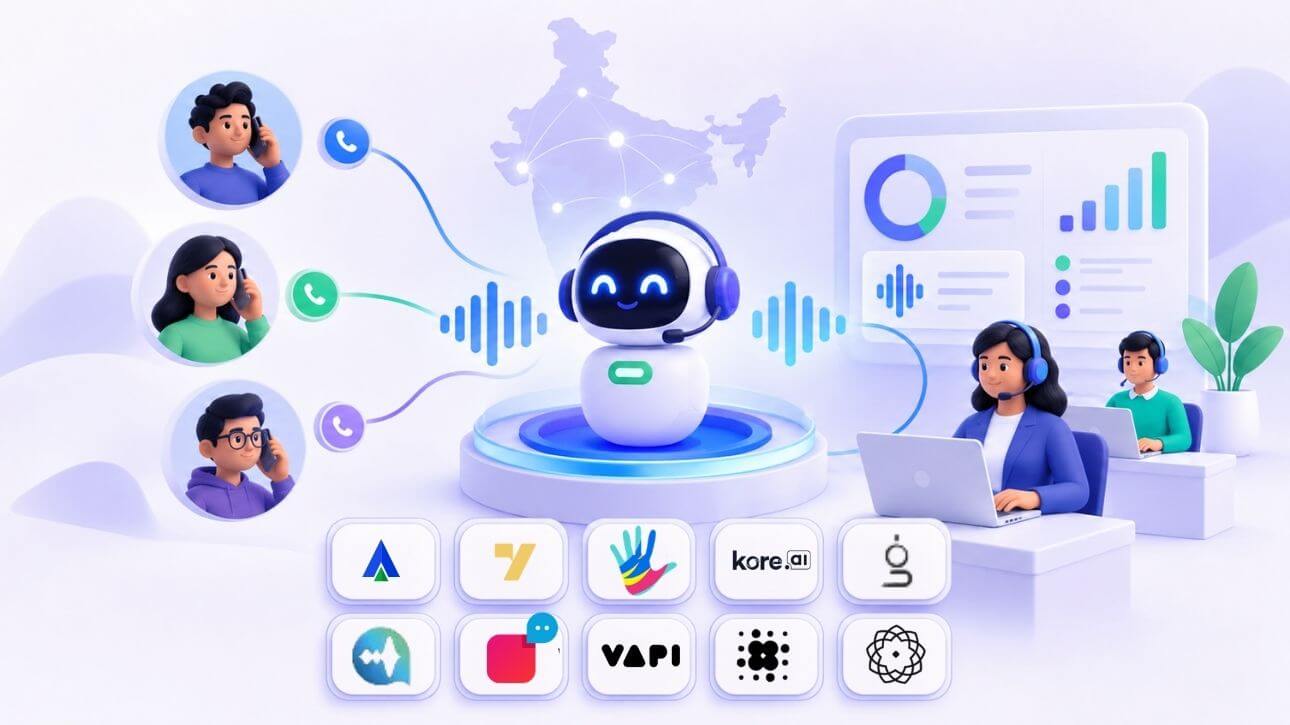


Indian businesses are handling record call volumes in 2026, and most are still doing it with the same headcount they had two years ago. That gap is why AI voice agents have moved from a pilot project to a line item on the CFO’s dashboard. But the market is crowded, every vendor claims the highest pickup rate and the widest language support, and the fine print rarely matches the pitch deck.
This guide compares the AI voice agent platforms Indian businesses are actually deploying in 2026, what each one does well, where it falls short, and how to pick one that fits your call volume, your compliance obligations, and your budget, not just the demo.
What Is a AI Voice Agent Platform?
AI Voice Agent Platform is the software layer that builds, deploys, and runs AI voice agents on live phone calls. It combines speech-to-text, a language model, text-to-speech and dialogue orchestration with telephony, so an agent can answer, understand, act in backend systems, and escalate to a human
AI Voice Agent Platforms in India Compared by Use Case
| Platform | Core strength | Go-live speed | Best fit |
| Acefone | Native telephony and IVR integration, RBI-ready call recording | Days, on existing numbers | BFSI, healthcare, D2C running Acefone telephony |
| Yellow.ai | Multi-channel coverage, multi-LLM | Weeks | Large enterprise, multi-department |
| Haptik | Enterprise scale, telecom and BFSI experience | Weeks | Large enterprise on existing Haptik stack |
| Kore.ai | Governance and orchestration | Weeks | Large enterprise with in-house technical team |
| Gnani.ai | Regional Indian language accuracy | Days to weeks | Regional-language-first call volume |
| Skit.ai | Collections-specific workflows | Days to weeks | NBFCs and lenders |
| Verloop.io | Combined chat and voice | Days to weeks | Support teams already on Verloop chat |
| Vapi | Developer-first build speed, 25+ integrations, sub-500ms latency (vendor claim) | Days for developers; longer to add India compliance | Technical teams building a custom voice agent from scratch |
| Retell AI | ~600ms latency, SIP trunking, natural turn-taking (vendor claim) | Days for developers | Engineering-led teams building on their own telephony stack |
| Sarvam AI | Deepest Indian-language and code-mixed speech coverage, sovereign infrastructure | Days to weeks depending on integration | BFSI, government, and enterprises prioritising language accuracy and data residency |
Top 10 Voice AI Providers in India 2026
Here’s our list of the Best 10 AI VoiceBot providers in India, compared based on features, AI capabilities, use cases, scalability, and business suitability:
1. Acefone 

Acefone is trusted AI voice agent platform which is an intelligent, conversational voice solution that can handle customer calls in real time. It understands customer queries, responds naturally, follows predefined conversation flows, and can manage routine interactions such as answering questions, qualifying leads, scheduling callbacks, and handling customer requests. You can use the solution to automate repetitive voice conversations while maintaining consistent, context-aware interactions at scale.
What it does well:
- Native integration with Acefone’s IVR, call recording, and CRM connectors, so the AI voice agent shares data with your existing contact center setup instead of running as a separate tool.
- Call recording and storage built to support the RBI call recording mandate for BFSI callers, with retrieval and retention controls built in.
- Indian numbers with local presence dialing, which improves pickup rates on outbound calling compared to routing through a generic VoIP number.
- Support teams based in India, which matters when a live campaign breaks at 11 p.m. and you need a fix, not a ticket queue.
Best suited for: BFSI, healthcare, and D2C businesses that already run their call center operations on Acefone or want a single vendor for both cloud telephony and AI voice automation.
2. Vapi

Vapi is a developer-first AI VoiceBot providers for building, testing, and deploying voice AI agents, built around an API-first architecture that plugs into 25+ services, including OpenAI, Anthropic, ElevenLabs, Deepgram, Salesforce, and HubSpot.
What it does well: Vapi says its platform supports sub-500ms average latency, and offers enterprise features such as SSO, RBAC, and SOC 2, HIPAA, and PCI compliance for regulated global deployments.
Where it falls short: Vapi is built for global, English-first use cases. It has no dedicated Indian telephony layer, local number sourcing, or TRAI, RBI, and DPDPA compliance built in, so Indian businesses need to assemble that layer themselves.
Best suited for: Technical teams that want full control over their voice AI stack and are comfortable building India-specific compliance and telephony on top of a developer platform.
3. Haptik

Haptik, part of the Reliance Jio group, has built conversational AI for large Indian enterprises for close to a decade, and its voice agent product extends that same enterprise focus to phone calls.
What it does well: Deep experience with large-scale Indian deployments, particularly in telecom, BFSI, and e-commerce, with integrations built for enterprise CRM and ticketing stacks.
Where it falls short: Like most enterprise-first platforms, go-live timelines run into weeks, and self-serve options are limited for smaller teams that want to start with a narrow use case.
Best suited for: Enterprises that already run other Haptik products and want voice added to an existing conversational AI setup.
4. Kore.ai

Kore.ai is a global conversational AI company with a strong presence in India, offering voice agents alongside chat and virtual assistant products for enterprise clients across industries.
What it does well: Strong governance and orchestration tooling for businesses running AI agents across multiple departments, with granular control over conversation flows.
Where it falls short: The platform is built for teams with in-house technical resources to configure and maintain complex flows, which raises the barrier for smaller businesses.
Best suited for: Large, multi-department enterprises with an internal team to own the build and ongoing tuning.
5. Gnani.ai

Gnani.ai focuses specifically on Indian language voice AI, with speech recognition and voice agent products trained on Indian accents and regional languages.
What it does well: Language depth is the core strength here, with meaningful investment in regional Indian language accuracy rather than English-first models with translation layered on top.
Where it falls short: Coverage outside voice AI, such as chat or omnichannel support, is limited compared to broader conversational AI platforms.
Best suited for: Businesses whose primary call volume runs in a regional Indian language and need accuracy in that language above everything else.
6. Skit.ai

Skit.ai (formerly Vernacular.ai) builds voice AI focused on collections and lending use cases for BFSI and NBFC clients, handling high-volume outbound calling for payment reminders and follow-ups.
What it does well: Purpose-built workflows for collections calling, with compliance features aimed squarely at lending businesses.
Where it falls short: The narrow use case focus means it is a weaker fit for businesses that need voice AI across sales, support, and collections rather than collections alone.
Best suited for: NBFCs and lenders running high-volume collections calling as their primary use case.
7. Verloop.io

Verloop.io started as a chat automation platform and has extended into voice, giving businesses that already use it for customer support chat a path to add voice without switching vendors.
What it does well: Consistent customer experience across chat and voice for support-heavy businesses already using Verloop for one channel.
Where it falls short: Voice is a newer addition to the product line compared to platforms built voice-first, so language depth and latency on Indian calls trail more specialized voice AI vendors.
Best suited for: Support teams that want chat and voice automation under one vendor relationship.
8. Yellow.ai

Yellow.ai is one of India’s largest conversational AI companies, covering voice, chat, WhatsApp, and email under one account. Its voice product includes multi-LLM support and claims coverage across 20 Indian languages, backed by a large enterprise customer base.
What it does well: Broad channel coverage beyond voice, and enterprise-grade implementation support for large, multi-department rollouts.
Where it falls short: Implementation is sales-led with multi-week onboarding, and pricing is not published, which makes it a harder fit for businesses that want to test and scale quickly rather than commit to a long enterprise contract.
Best suited for: Large enterprises with a dedicated CX or AI team and the budget for a multi-channel deployment.
9. Retell AI

Retell AI is a developer-focused voice agent platform built around low latency and natural turn-taking, with SIP trunking support that connects to existing phone numbers through providers like Twilio and Vonage.
What it does well: Retell AI says it delivers around 600ms latency, along with IVR navigation, call transfer to human agents, batch outbound calling, and webhook-based integrations for custom workflows.
Where it falls short: Like other developer-first platforms, Retell AI is a global infrastructure layer, not an India-ready product. Businesses still need to handle TRAI registration, DPDPA and RBI compliance, and Indian number sourcing on their own.
Best suited for: Engineering-led teams that want to build a custom voice agent on their own telephony stack rather than adopt a ready-made Indian deployment.
10. Sarvam AI

Sarvam AI is a Bengaluru-based company building sovereign, India-first AI models, including voice agents with support for around 22 Indian languages and strong handling of code-mixed, Hinglish-style speech.
What it does well: Language depth is the strongest differentiator, backed by traction with regulated and government clients such as Aadhaar, SBI Life, AXIS Bank, and NABARD, plus flexible deployment options including private VPC and on-premises for data residency needs.
Where it falls short: Sarvam AI is primarily a language and model layer, not a full contact center product, so businesses still need a telephony, CRM, or IVR partner to run day-to-day outbound and inbound calling.
Best suited for: BFSI, government, and large enterprises where Indian-language accuracy and data sovereignty matter more than an out-of-the-box telephony setup.
What Should You Check Before Shortlisting an AI Voice Agent Platform?
Before comparing vendors, get clear on the five things that decide whether an AI voice agent works on your calls or just in the sales demo.
- Indian language depth: Hindi support that only recognizes formal, textbook Hindi will fail on a real customer call. Ask whether the platform handles Hinglish and code-switching mid-sentence and ask for a live call in your target language, not a script.
- Latency on Indian mobile networks: A voice agent that pauses for 2 to 3 seconds before responding to sounds broken to a caller, especially on 4G in tier 2 and tier 3 cities. Ask for latency numbers measured on Indian carriers, not lab conditions.
- Telephony integration: Does the AI voice agent sit on top of your existing number and dialer, or does it require you to rip out your current telephony setup? This decides your go-live time.
- Compliance: Outbound calling in India sits under TRAI’s regulatory framework, and BFSI and healthcare callers have additional obligations under the RBI call recording mandate and DPDPA. A platform that cannot show you where call recordings are stored and for how long is a compliance risk, not a shortcut.
- Pricing you can actually plan around: Per-minute pricing that looks cheap on a small pilot can multiply fast at scale. Ask for the total cost at your real monthly call volume, not the headline rate.
Choosing the Right Platform for Your Business
The right choice depends on where your call volume actually sits today. If you are already running your contact center on cloud telephony and want AI voice agents that plug into your existing IVR, numbers, and call recording without a separate integration project, that points toward a telephony-native platform like Acefone.
If you need broad multi-channel coverage across an enterprise with dedicated implementation resources, the larger conversational AI platforms are built for that scale. If your volume is concentrated in one function, such as collections, or one regional language, the specialists in that category will outperform generalist tools.
Whichever platform you shortlist, insist on a live test call in your actual use case and language before signing, not a scripted demo. That single step catches more mismatches than any feature comparison sheet.
Ready to see how an AI voice agent performs on your own call flows?
FAQs
AI voice agent platforms combine speech recognition, a language model, and text-to-speech to hold real-time phone conversations. They answer or place calls, understand caller intent, pull data from a CRM or knowledge base, and reply in a natural voice, without a human agent on the line for routine queries.
Check Indian language depth including Hinglish, latency on Indian mobile networks, whether the platform integrates with your existing telephony and numbers, compliance support for TRAI, the RBI call recording mandate, and DPDPA, and real cost at your actual call volume rather than pilot-scale pricing.
The terms overlap in marketing, but the difference is the interface. A voice bot and an AI call bot both handle live phone calls, while a voice chatbot usually means voice input inside a chat app or website. For call centers, real phone-call performance matters more than the label.
Prioritize platforms trained on real Indian call recordings, not textbook language, so they handle Hinglish and mid-sentence code-switching. Test with a live call in your actual regional language and accent, ask for latency numbers on Indian mobile networks, and keep a human handoff for calls the agent cannot resolve.
Common pitfalls include testing only in English, ignoring latency on 4G networks in tier 2 and tier 3 cities, skipping compliance checks on call recording, and going live without a human fallback path. Pilot with real call volume and real accents before a full rollout, not a scripted demo.
For India, telephony-native platforms like Acefone integrate directly with existing numbers, while developer platforms like Vapi and Retell AI suit technical teams building custom flows. Sarvam AI leads on Indian-language depth. The best fit depends on your language mix, call volume, and compliance needs, not a single leaderboard.
India’s leading voice AI vendors include Acefone, Yellow.ai, Haptik, Kore.ai, Gnani.ai, Skit.ai, Verloop.io, and Sarvam AI, alongside global developer platforms like Vapi and Retell AI that Indian teams use to build custom agents. The right fit depends on your use case, from telephony integration to regional language depth.
Look beyond a language count on a slide. Ask for a live call in Hindi or your regional language with natural code-switching, not scripted formal speech. Check accuracy on real Indian accents and background noise, and confirm the provider trains on Indian call data rather than translating English models.
Outbound calling in India falls under TRAI’s regulatory framework, and BFSI and healthcare callers face added obligations under the RBI call recording mandate and DPDPA. Ask any platform where call recordings are stored, for how long, and who can access them, before treating compliance as a checkbox item.
Acefone’s AI voice agent sits directly on its own cloud telephony services and IVR infrastructure, so Indian businesses go live on existing numbers without a separate integration project. Developer platforms like Vapi and Retell AI offer more flexibility but require technical teams to build telephony, compliance, and integrations themselves.


