


 7 mins read


Vapi Review Summary:
- Vapi is developer infrastructure. It links speech-to-text, an LLM and a voice, but your team builds everything around them.
- No-code got harder in 2026. Vapi retired its visual Workflows builder in August, so production agents now need engineers.
- Provider costs, Success Packages and engineering hours drive the real bill.
- Indian teams face extra gaps. Free numbers are US-only, Indian numbers need a SIP import and base support runs on Discord.
- Pick by team, not features. Engineering-led teams can pilot Vapi; ops teams without developers need a no-code, India-ready alternative.
Can a team with no engineers run an AI voice agent on Vapi? It’s the question we hear most from multiple teams in the market. The demos make it look easy. You type a prompt, pick a voice and take a test call in minutes. Then the real work shows up: CRM lookups, call transfers, Indian numbers and bills from four providers.
This Vapi review answers one question for teams without developers. We’ll cover what Vapi AI is, how it works on a live call and what it really costs.
You’ll also see exactly where a non-technical team hits a wall, and what to do instead.
What Is Vapi AI and What Is It Used For?
Vapi AI is a developer-first orchestration layer for building AI voice agents over phone and web. It connects a speech-to-text engine, a large language model, and a text-to-speech voice into one real-time pipeline. Vapi doesn’t ship a finished phone system. Your team picks the providers, writes the prompts, and wires up the integrations. Treat it as a programmable infrastructure, not a ready-made contact center tool.
Orchestration layer: software that coordinates several separate AI services, so they work as one conversation.
According to TechCrunch, Vapi raised a $50 million Series B led by Peak XV Partners in May 2026. A person familiar with the deal put its post-money valuation at around $500 million. The same report says Amazon Ring evaluated more than 40 AI voice vendors before choosing Vapi for inbound support.
How Does a Vapi AI Voice Agent Work on Live Calls?
A Vapi AI voice agent runs every call through a three-stage loop. A transcriber turns the caller’s speech into text. A language model reads that text and decides the reply. A voice provider speaks the reply. Vapi manages the timing between stages, including interruptions and turn-taking. Developers configure each stage, plus the tools the agent can use mid-call.
Speech-to-text (STT): a model that converts spoken audio into written text in real time.
Text-to-speech (TTS): a model that converts written text into natural-sounding spoken audio.
So where does your team come in? Vapi’s Workflows migration guide lays out the building blocks it now recommends:
- Assistants hold one agent’s prompt, model, voice, transcriber and tools.
- Squads link several Assistants, so a call can move from intake to scheduling.
- Handoff tools decide when one Assistant passes the caller to the next.
- API Request and Function tools let an agent fetch or update data during the call.
The trickiest setting for new teams is usually endpointing.
Endpointing: the logic that decides when a caller has finished speaking and the agent should reply.
Set endpointing too slow and callers hear dead air. Set it too fast and the agent talks over them. In Acefone’s deployment our agents do this automatically through backchannel detection and barge-in and interruption capabilities.
What Are the Most Useful Vapi AI Voice Agent Features?
Vapi’s popular features cover the full call: provider choice, tool calls, knowledge bases, languages and post-call analysis. Each one is powerful in a developer’s hands. Each one also needs configuring through the dashboard, the API or both. Here’s what teams lean on most.
- Bring-your-own providers: pick your own transcriber, language model and voice for each agent. Vapi passes model costs through at provider rates, per its pricing page.
- Built-in call tools: default tools let an agent transfer a call, end it or dial a keypad. API Request tools fetch or update data mid-call.
- Knowledge bases: upload files, and the agent searches them mid-call through a Query Tool. Vapi’s knowledge base docs cover the setup.
- Multilingual agents: Vapi’s multilingual guide shows an agent that detects the caller’s language and switches mid-conversation. Coverage depends on the transcriber and voice you choose.
- Call analysis and recording: after each call, Vapi can summarize and evaluate how it went. Recordings can stay with Vapi or go to your own storage.
In our experience, multilingual setup is where Indian teams spend the most time. Hinglish callers switch languages mid-sentence. Provider choice decides how well the agent keeps up.
Next step: Considering a multilingual AI voice agent? Compare real Hinglish call behaviour before choosing a provider.
Is Vapi AI Free? How Much Does Vapi Cost per Minute?
No. Vapi gives new accounts $5 in starter credits and one free US inbound number. After that, you pay $0.05 per minute for hosting, plus transcription, model and voice costs at provider rates. Vapi’s calculator estimates 1,000 minutes at about $82–$129 a month.
Is Vapi Good for Building AI Voice Agents Without Developers?
Non-developers can build a basic Vapi agent, but they’ll struggle to run one in production. The dashboard covers a prompt, a voice and a test call. Anything beyond that needs code: API calls, conditional routing, data passed between agents and error handling. Vapi’s 2026 decision to retire its visual Workflows builder widens that gap for teams without engineers.
What Changed When Vapi Retired Workflows in August 2026?
Vapi retired Workflows on 18 August 2026, and existing workflows stopped running the next day. Workflows was the visual, node-and-edge builder many no-code teams leaned on. Vapi now points users to Assistants for simple calls and Squads for multi-step flows.
Vapi’s own migration guide shows what that shift asks of you. Every transfer between agents needs a Handoff tool with a written transfer condition. Data moves between agents through extraction schemas. Vapi describes that extraction as best-effort, not deterministic, and asks teams to test business-critical values.
How Do You Connect a Vapi AI Agent to a CRM or Phone Number?
- Connecting the agent to your CRM, loan system or calendar through API tools and webhooks
- Handling failed API calls, retries and empty variables without dropping the caller
- Importing a carrier number, configuring SIP and managing provider keys
SIP trunk: a virtual phone line that connects a voice application to a telecom carrier over the internet.
Vapi does offer Composer, an AI assistant inside the dashboard that drafts configurations from plain-language requests. Vapi still labels Composer pre-release. We wouldn’t put a live customer line on it yet.
What Do Users Say About Vapi on Review Platforms?
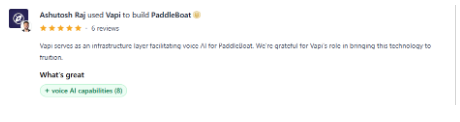
Public reviews split along the same line as this review. On Product Hunt, a largely developer audience rates Vapi 4.9 out of 5. On Trustpilot, Vapi scores 2.4 out of 5 with 67% at one star.
What Are the Pros of Vapi AI?


What Are the Cons of Vapi AI?
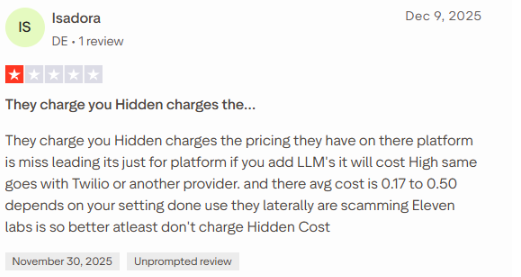
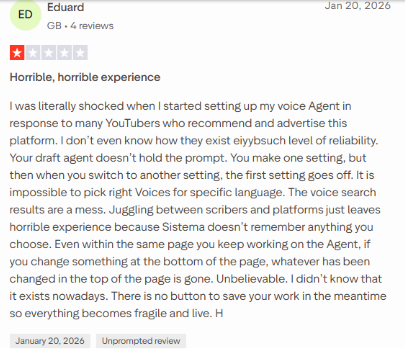
The pattern is clear. Developers praise the build speed. Teams running live calls report support delays, surprise costs and settings that don’t stick. A team without engineers sits on the second side of that split.
The pattern is clear. Developers praise the build speed. Teams running live calls report support delays, surprise costs and settings that don’t stick. A team without engineers sits on the second side of that split.
Does Vapi AI Work With Indian Phone Numbers and Compliance?
Indian teams without engineers hit three walls on Vapi. Free Vapi numbers are US-only and inbound-only, so Indian numbers need an imported carrier or SIP trunk. Base-tier support runs through a Discord community, and email carries no response SLA. Raw call data is kept for only 14 days unless you buy a Success Package.
The number problem trips teams up first. Vapi’s phone number docs state that free numbers use US area codes and support inbound calls only. For international use, Vapi tells you to import a number from another provider. That means a separate telephony contract, SIP setup and someone who can debug it when calls fail.
Support is the second gap. Response SLAs start only with paid Success Packages. For a live collections line, a Discord thread isn’t an escalation plan.
Then there’s local compliance. Outbound calling in India runs under TRAI regulations. On a US-first stack with an imported number, keeping that traffic compliant becomes your team’s job.
Suggested readings: 140 Number Series: Essential TRAI Compliance Guide for Commercial Calling (2026)
Vapi vs Acefone: What Does a No-Code Team Get?
Vapi leaves four gaps for teams without engineers: Indian numbers, build effort, language handling and billing. Agent Stu dio, our AI voice agent platform, closes them on one stack. Acefone is a DoT-licensed Virtual Network Operator, so the agent and your Indian numbers come from the same provider.
| Gap on Vapi | What it means for your team | How Agent Studio covers it |
|---|---|---|
| Phone numbers | Free numbers are US-only and inbound-only. Indian numbers need a carrier import and SIP. | Indian DIDs for inbound and CLIs for outbound, on our own network |
| Build effort | Handoffs, API tools and error handling need code. | No-code creation from a one- or two-line use case, with setup under 10 minutes |
| Language | Handling depends on the providers you assemble and tune. | 12+ languages, auto-detection and Hindi-English switching within one call |
Take an NBFC running early collections reminders (DPD 1–30) with no engineer on the team. On Vapi, the ops head needs a carrier, SIP setup, three AI providers and someone to build handoffs. On Agent Studio, they describe the reminder flow, attach an Indian number and test with AI Evaluators. Or they hand the whole build to our managed team.
Which Vapi AI Alternative Fits Indian Operations Teams?
Picture a mid-sized NBFC that wants an AI voice agent for early collections reminders (DPD 1–30). The ops head owns the target. There’s no engineer on the team.
On Vapi, the path looks like this:
- Buy an Indian number from a third-party carrier, then import it and configure SIP.
- Choose and manage separate transcription, model and voice providers.
- Build Assistants, handoff rules and API tools for the loan management system.
- Own testing, monitoring and escalations through Discord or a paid package.
On Agent Studio, our voice agent builder, the path is shorter because we own the telephony underneath. Acefone is a DoT-licensed Virtual Network Operator, so Indian numbers and the agent run on the same stack. Here’s what that changes for the NBFC:
- No-code creation: describe the use case in a line or two, and agent setup takes under 10 minutes.
- Hinglish handling: agents auto-detect language and handle Hindi-English switching within one call, across 12+ languages.
- Pre-launch testing: AI Evaluators simulate callers across scenarios before the agent goes live.
- Managed option: if the team would rather not build at all, our team configures and runs the agent.
The ops head gets a working reminder line without hiring an engineer for it.
Vapi Review Verdict: Is It Worth It Without Developers?
So, is Vapi a fit for teams without developers? For most, no. Here’s what to take from this Vapi review:
- Vapi is infrastructure, not a finished product. It rewards engineers who want control over every layer of a call.
- The real cost sits beyond the $0.05 fee. Provider charges, Success Packages and engineering hours drive the actual bill.
- Non-technical Indian teams need more than a builder. They need Indian numbers, local compliance and support that answers.
If you have an engineering team and a mostly US call base, Vapi deserves a pilot. If you don’t, start with a tool like Acefone which is built for your team’s skills and your market.
Running collections, COD confirmation or support calls without a developer on the team? See how Agent Studio puts an AI voice agent live on Indian numbers, no code required.
Vapi AI FAQs
Vapi AI is used to build voice agents for phone calls and web apps. Common uses include inbound support, appointment scheduling, lead qualification and outbound calling. Developers connect the agent to business systems so it can look up records or complete actions during a call.
In our experience, no production-grade voice agent offers unlimited free calls. Every minute uses telephony and AI compute, so most tools give trial credits instead. For Indian teams, compare total cost per minute, including numbers and compliance.
Not for production use. A non-developer can create a basic Vapi agent and make a test call. But integrations, handoffs and error handling need code, especially since Vapi retired visual Workflows in August 2026. Teams without engineers should look at no-code or managed alternatives.
Not natively. Vapi’s free numbers use US area codes and support inbound calls only. To use an Indian number, you must import one from another provider or connect a SIP trunk. Your team then manages that carrier contract and its compliance separately.
Skip Vapi if no one on your team can own integrations, testing and monitoring. It’s also a weak fit when you need Indian numbers, single-vendor billing or support SLAs on a small budget. Vapi suits engineering-led teams building custom voice products, not ops teams that need a working agent fast.