


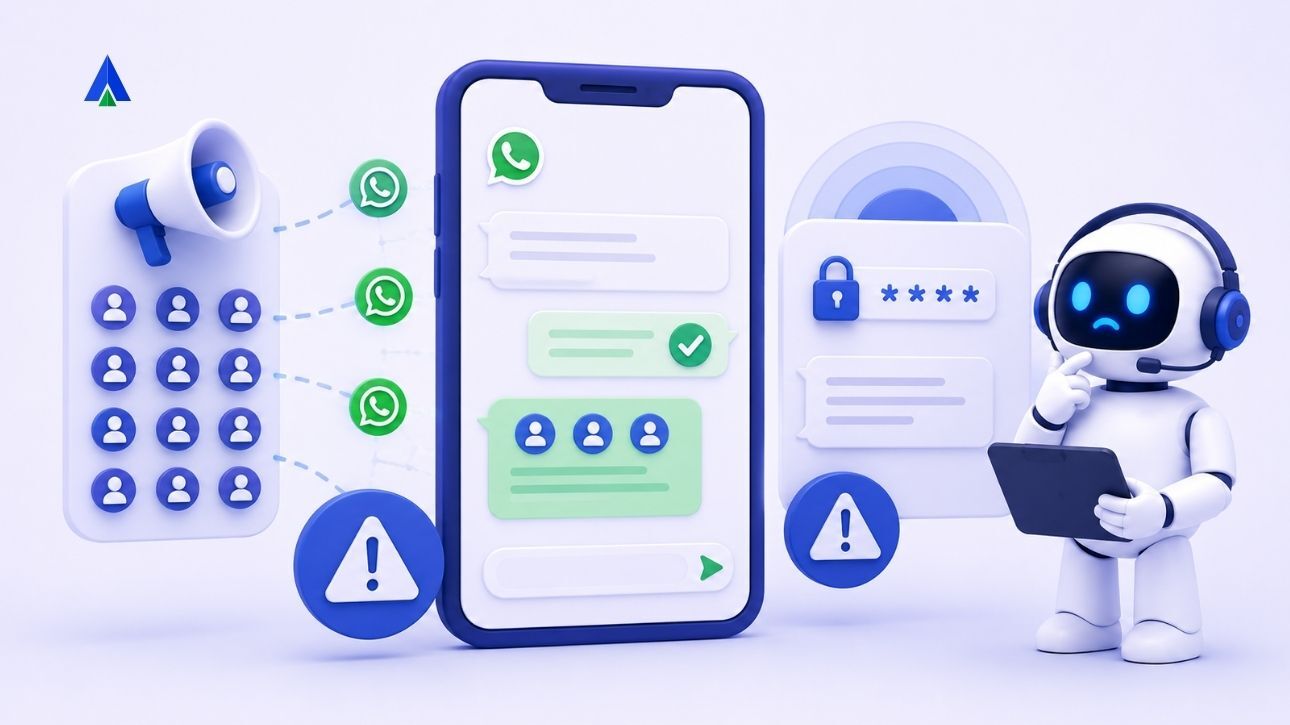


Sending a WhatsApp message looks simple. Open the app, type, hit send. But running WhatsApp as a business channel is a different game. Especially for OTPs and bulk messaging. It sits inside a web of Meta, TRAI, and DPDPA rules. Most businesses underestimate all three.
If you’re still sending OTPs from a personal WhatsApp number, you’re carrying more risk than you think. The same goes for routing messages through an unofficial API. This guide breaks down what compliant whatsApp message sender actually requires in India. It also explains why the fastest route often isn’t the safest one.
Why Personal WhatsApp Numbers Fail for WhatsApp OTP?
Many SMBs start their WhatsApp marketing journey the same way. A team member’s phone. A personal number. A manual process for order updates or verification codes. It works, until it doesn’t.
Sending OTPs or promotional messages from a personal WhatsApp number violates Meta’s Business Messaging Policy. So does routing traffic through an unofficial or grey-market API. Meta actively monitors sending patterns. Numbers flagged for bulk or automated behavior can be banned. Often permanently, with no warning and limited recourse.
For a business that depends on WhatsApp for verification or order updates, a banned number isn’t a minor setback. It’s a communication blackout. And it can happen overnight.
Why Choose a Meta-Verified WhatsApp OTP Sender?
The compliant path to bulk WhatsApp messaging in India runs through a Meta-verified Tech Service Provider, or TSP. This is not the same as a grey-market API reseller.
A genuine TSP has been vetted and approved by Meta for WhatsApp Business API access. It follows Meta’s messaging policies, template approval processes, and rate limits by design. A reseller operating outside this structure may offer lower prices or fewer restrictions. That flexibility usually signals non-compliance, not efficiency.
Before choosing a WhatsApp business messaging provider, ask one direct question. Do they hold verified TSP status with Meta? This single question filters out most of the risk.
Does WhatsApp Message Sender Need TRAI’s DLT Registration?
In India, sending transactional or promotional messages at scale requires registration on TRAI’s Distributed Ledger Technology (DLT) platform. This includes OTPs. It applies across SMS and, increasingly, other messaging channels too.
DLT registration exists to curb spam. It gives regulators a traceable record of who is sending what, to whom. Skipping this step doesn’t just risk a fine. It can get your message delivery blocked entirely, since telecom operators check DLT registration before allowing bulk traffic through.
If your business is already DLT-registered for SMS, extend that same posture to WhatsApp. Treat your WhatsApp OTP sender setup as part of the same compliance project, not a separate one.
Recommended Page : Whatsapp call center
Does WhatsApp Message Sender Need to Honor DND Preferences?
Do Not Disturb, or DND registration has traditionally been an SMS and voice concept in India. That’s changing. Regulators increasingly treat messaging channels the same way for consent purposes. WhatsApp is no exception.
A customer who has opted out of promotional communication expects that preference honored everywhere. Not just on the channel where they first registered it. Businesses sending bulk WhatsApp messages without checking DND status are exposed to real regulatory risk. The same risk that applies to non-compliant SMS senders.
Suggested Reading: All You Need to Know About DND Scrubbing
How Does DPDPA Change WhatsApp Message Sender OTP Logs?
The Digital Personal Data Protection Act, or DPDPA 2023, requires explicit and revocable consent. This applies before a business stores or processes a customer’s phone number and message history. It has direct implications for how OTP logs and WhatsApp conversation data get handled.
It’s no longer enough to collect a phone number and use it indefinitely. Consent needs to be explicit. Customers need a real way to revoke it. That means your systems need to track consent state, not just message content. They also need to act on a withdrawal request without manual intervention.
For any business handling OTP verification at scale, this is an architecture decision. Not a legal footnote.
Why Do Most WhatsApp Message Sender Setups Skip Audit Trails?
Delivery confirmation isn’t proof of compliance. Regulators, and in disputes, courts, increasingly expect more. They want evidence of consent, delivery, and opt-out for every message sent. Not just a green tick.
This means your WhatsApp sending infrastructure needs to log:
- When and how consent was captured
- Every message sent, with timestamp and template used
- Delivery and read status
- Every opt-out request, and when it was honored
Most businesses stitching together a WhatsApp API and a separate OTP gateway don’t have this level of traceability. It exists in fragments. Spread across tools that were never designed to talk to each other.
Recommended Blog: WhatsApp API for Business
Why Does OTP Speed Matter for WhatsApp Message Sender?
WhatsApp OTP verification lives or dies on speed. A code that arrives ten seconds late is functionally useless. By then, the customer has likely abandoned checkout or given up on the login attempt.
Sub-second delivery reliability isn’t a nice-to-have for a WhatsApp OTP sender. It’s the difference between a completed transaction and a lost customer. Businesses evaluating OTP providers should ask for real delivery latency data. Not just uptime percentages, since the two measure very different things.
Why a Unified Customer Communication Platform Wins?
Many businesses end up running three separate systems. A WhatsApp API for messaging. A separate SMS or OTP gateway. A manual spreadsheet for tracking consent. Each piece works on its own. But the seams between them are where compliance gaps show up.
A unified platform handles WhatsApp, OTP delivery, and consent tracking in one place. It removes those seams entirely. It reduces integration overhead for IT teams. And it gives a single, consistent audit trail across every message sent, rather than three inconsistent ones.
This is also where a contact center helps. Verification messages, support conversations, and promotional outreach often need to sit in the same customer timeline. That’s how agents get full context.
The Real Risk Isn’t the Fine
It’s tempting to treat WhatsApp compliance as a background legal concern. Something to worry about only if a regulator comes knocking. That framing misses the bigger threat.
The real business risk is losing WhatsApp Business API access entirely. Meta can and does flag accounts showing non-compliant sending patterns. That could mean unverified TSP usage, spam-like volume, or repeated user complaints. When that happens, access can be suspended with little warning. That cuts off a channel your customers now expect as the default way to hear from you.
For a business built around WhatsApp for OTPs, order updates, or support, that kind of interruption doesn’t just cost messages. It costs trust. And it costs the operational continuity your team depends on.
Getting This Right from the Start
The businesses that avoid this risk aren’t necessarily the most compliance-obsessed. They’re the ones that chose the right infrastructure from day one. Verified TSP status. Correct DLT registration. Built-in DND checks. DPDPA-aligned consent tracking. Full audit trails as a default, not an add-on.
If your team is juggling a personal WhatsApp number, a separate OTP gateway, and manual consent tracking, it’s worth a pause. Ask whether that setup can actually hold up to scrutiny.
Book a demo of Interactions Hub. It’s Acefone’s unified WhatsApp, voice, and email workspace. See what compliant WhatsApp messaging looks like when it’s built into the platform, not bolted on.
FAQs
No. Meta’s Business Messaging Policy prohibits sending OTPs or bulk messages from personal WhatsApp numbers. Doing so risks a permanent ban with little recourse. Businesses must use the WhatsApp Business API through a Meta-verified Tech Service Provider (TSP) to send OTPs and transactional messages compliantly and reliablyat scale.
DLT registration, mandated by TRAI, applies across messaging channels, not just SMS. If your business sends bulk WhatsApp messages or OTPs in India, you need DLT registration. Telecom operators check this before allowing traffic through, so skipping it can block delivery entirely, not just risk a fine.
DPDPA 2023 requires explicit, revocable consent before storing or processing phone numbers and message history. Businesses must track consent status, not just message content, and act on withdrawal requests automatically. This makes consent management an architecture requirement, not a legal afterthought, for any WhatsApp message sender.
Meta can suspend or ban accounts showing non-compliant patterns, unverified TSP usage, or spam-like volume, often without warning. This cuts off a primary communication channel instantly, disrupting OTP delivery, order updates, and support. The real cost isn’t a fine; it’s lost trust and operational continuity for the business.
Stitching together a WhatsApp API, separate OTP gateway, and manual consent tracking creates compliance gaps between systems. A unified platform combines messaging, OTP delivery, and consent tracking in one place, giving a single audit trail, reducing IT overhead, & keeping verification and support in the same customer timeline.


