


 7 mins read


TL;DR
- Live call audio reaches your AI as the call happens. Its reply plays back to the caller.
- Low latency decides how natural a voice agent sounds. Acefone audio streaming forwards call audio to your endpoint in 50-75 ms. Your speech and AI stack add the rest.
- Plan AI-to-human handoff early. Pass context so callers never repeat themselves.
- Check the license, data location, consent, and security safeguards before you sign.
- Get concurrency limits in writing. Then build with engineers or start no-code with Acefone Agent Studio.
Can your voice agent hear a caller while they are still talking? It can, if call audio reaches it live.
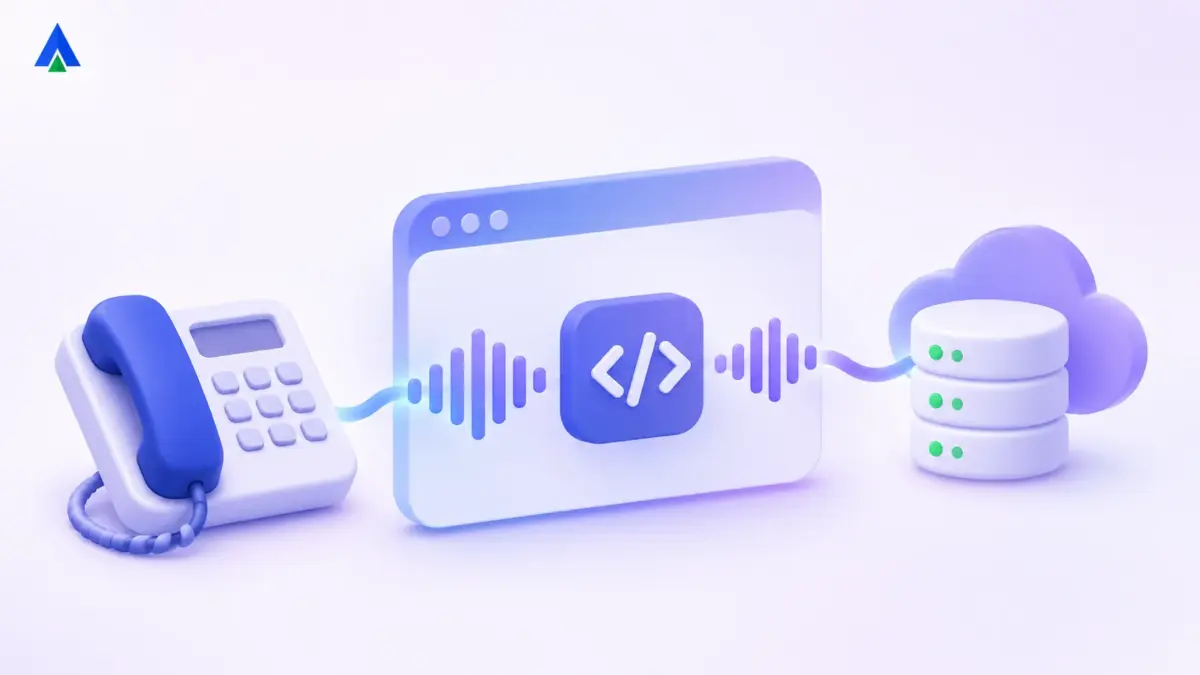
An audio streaming API for telephony sends live call audio to your software as the call happens. It then plays your software’s reply back to the caller.
Without it, an agent works from recordings after the call ends. Replies arrive late, and callers talk over them.
Acefone offers audio streaming over its telephony network. This guide covers how it works, what to check before you buy, and how to scale past a pilot. It is written for enterprise teams in India.
What Is an Audio Streaming API for Telephony?
An audio streaming API for telephony sends live call audio to your software in real time. Your voice agent, transcription engine, or analytics tool hears the conversation as it happens, then sends a reply back. Call recording is different: it hands you a file after the call has ended, too late to act.
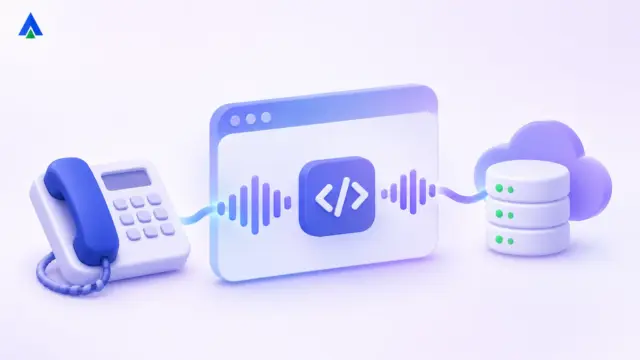
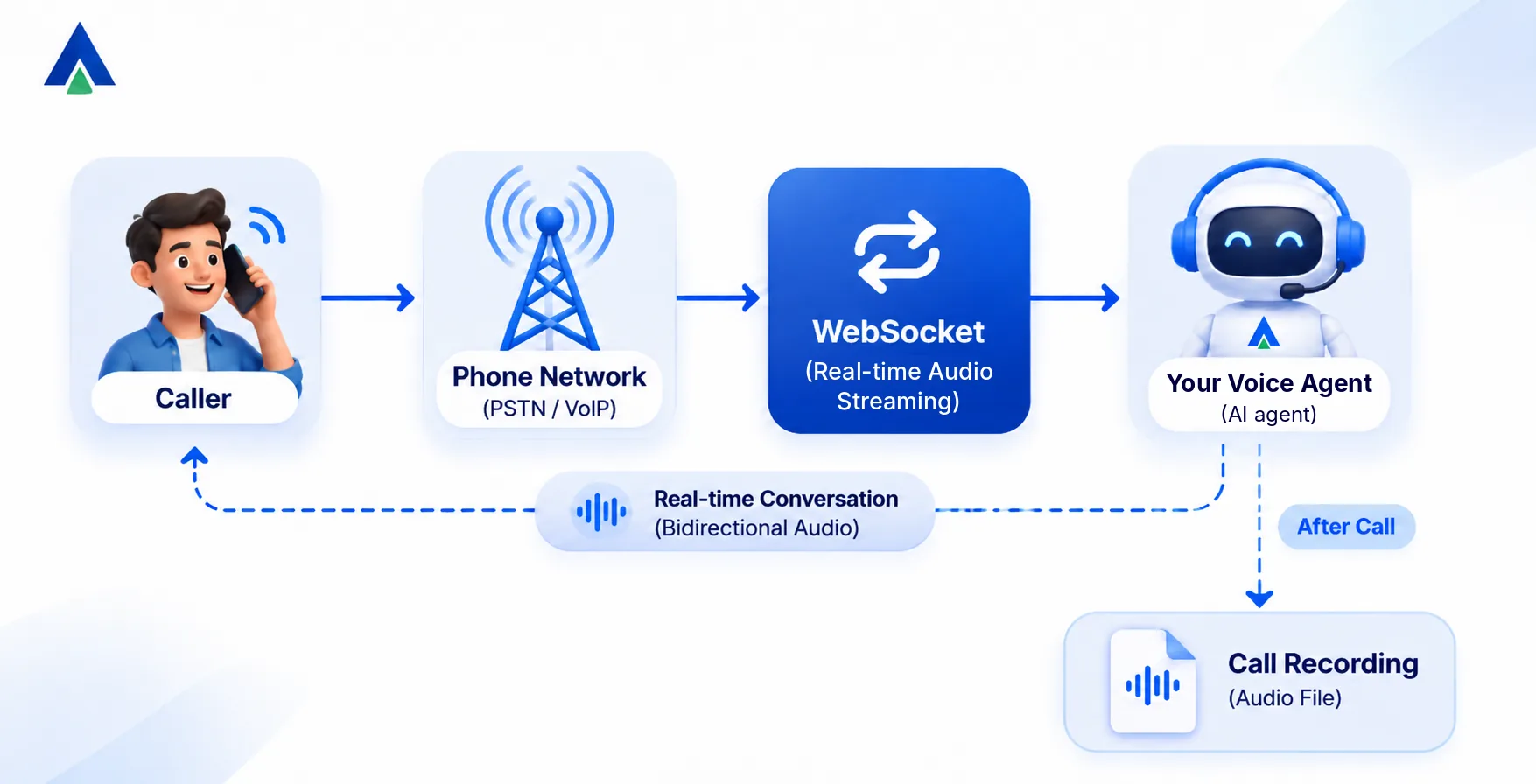
A caller dials your number. Acefone audio streaming opens a WebSocket connection to your server and forwards the audio. Your system listens, decides what to say, and sends audio back.
WebSocket: A persistent two-way connection that lets two systems exchange data continuously.
Phone networks carry calls over SIP (Session Initiation Protocol) and RTP (Real-time Transport Protocol). Most cloud apps do not speak those directly. Acefone audio streaming works over WebSocket and SIP trunking, in both directions.
You choose the codec and sample rate, so the stream matches your speech engine. A REST API handles authentication. WebSocket events report call state, transfer triggers, and session metadata.
Do not confuse audio streaming with a Voice API. A Voice API controls calls: dialing, routing, number masking, and menus. Audio streaming carries the sound itself, so most teams use both.
Gartner predicts agentic AI will resolve 80% of common customer service issues without human intervention by 2029. Resolving issues on a live call needs audio that arrives while the caller speaks.
TL;DR: Live call audio goes to your AI, and its reply goes back to the caller.
Why Does Low Latency Matter for Voice AI?
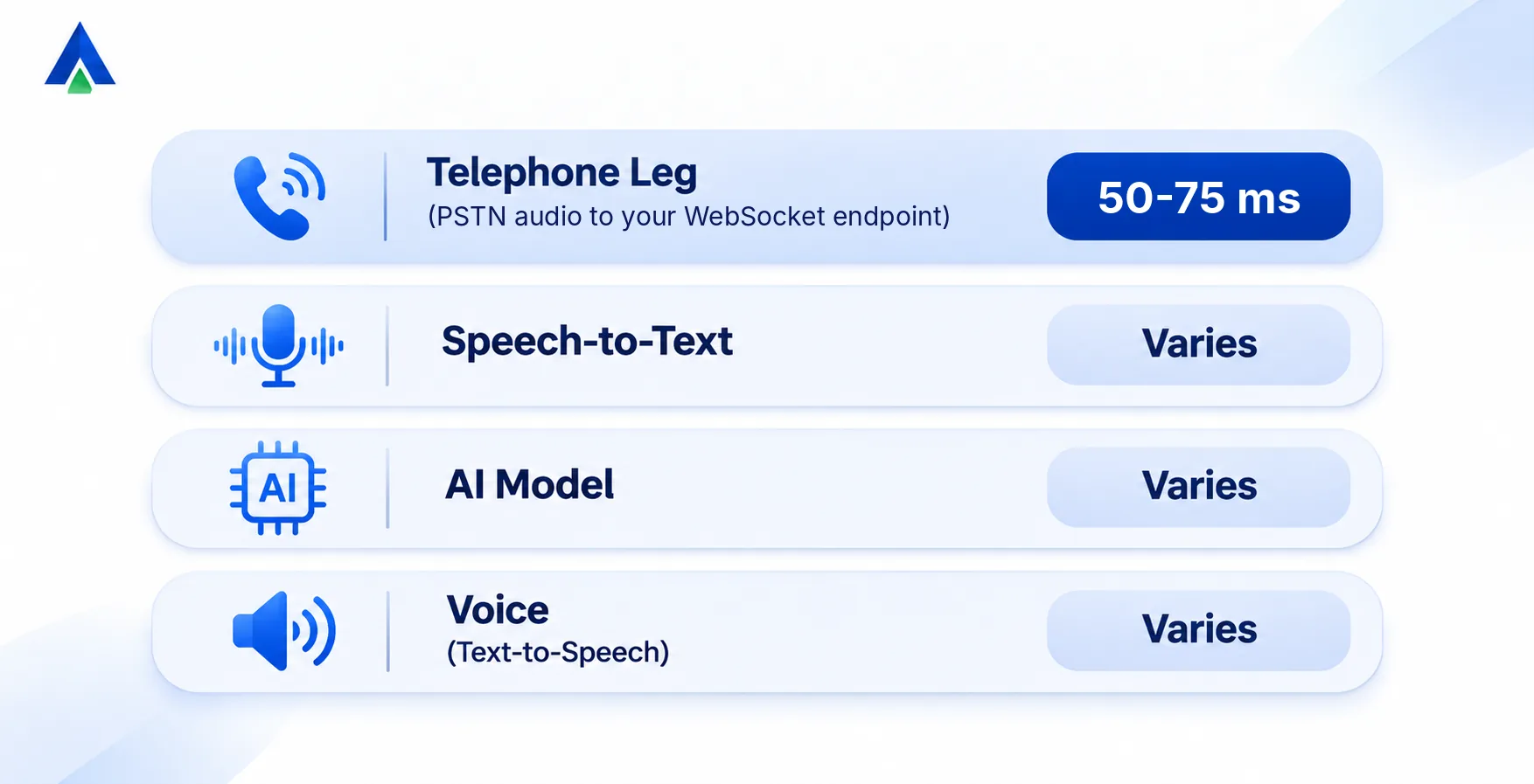
Low latency decides whether a voice agent sounds natural to callers or sounds broken. Callers judge the total delay between finishing a sentence and hearing a reply, not any single step. The telephone leg is one part of that delay, and your speech, AI, and voice stack add the rest.
Latency: The delay between a caller finishing a sentence and hearing the reply.
| Step | What happens | Who controls it |
| Telephone leg | Call audio travels from the public switched telephone network (PSTN) to your WebSocket endpoint | Your telephony provider. Acefone forwards it in 50-75 ms |
| Speech-to-text (STT) | The caller’s speech becomes text | Your speech engine |
| AI model | The agent decides on a reply | Your model and prompt |
| Text-to-speech (TTS) | The reply becomes audio | Your voice engine |
| Return path | Reply audio travels back to the caller | Your server and telephony provider |
Acefone audio streaming forwards PSTN audio to your WebSocket endpoint with 50-75 ms of latency. That figure covers the telephone leg, not the whole call. Acefone Agent Studio, a no-code voice agent builder, responds in under 800 ms voice-to-voice.
Streaming also sends call audio to speech-to-text in real time. That gives you live transcription for agent assist, compliance alerts, and instant summaries. You do not wait for the call to end.
Test with real Indian numbers, accents, and background noise. A lab demo hides what a busy Tuesday shows.
Check how the stream handles jitter (uneven packet arrival) and reconnects after a drop. Confirm your agent stops talking when a caller interrupts.
If you build with a voice framework, our setup guide shows the steps.
TL;DR: Fast streaming keeps agent replies natural. Acefone’s telephone leg adds 50-75 ms.
How Does AI-to-Human Handoff Keep Context?
AI-to-human handoff with context passes what the voice agent learned to the human agent as the call connects. The agent sees the caller’s intent, the details collected, and the actions taken, so the caller never repeats themselves. Without context, a handoff is just a transfer, and callers feel the difference.
Your voice agent will hand calls to people. Gartner predicts that by 2028, none of the Fortune 500 will have fully eliminated human customer service. It also expects AI regulation to lift assisted service volume by 30% by 2028.
The design question is how well you hand off, not whether. Good context has four parts: why they called, what they confirmed, what the agent did, and what they want. Anything less sends the human back to basic questions.
Acefone audio streaming supports mid-call transfer with full context. In Acefone AI Voice Agent, voice agents are natively integrated with Acefone telephony. Handoff runs through the Transfer tool, as a blind or warm transfer.
A warm transfer shares a short summary and transcript. Agent Studio call logs show where each handoff happened.
If you build on a streaming API, ask each vendor how context travels with the transfer. Your agent must pass the details, and the telephony side must route the call to the right queue. Ask for a live demo with real caller data.
TL;DR: Plan handoffs early. Context decides whether callers feel helped or just transferred.
What Should Indian Enterprises Check for Compliance?
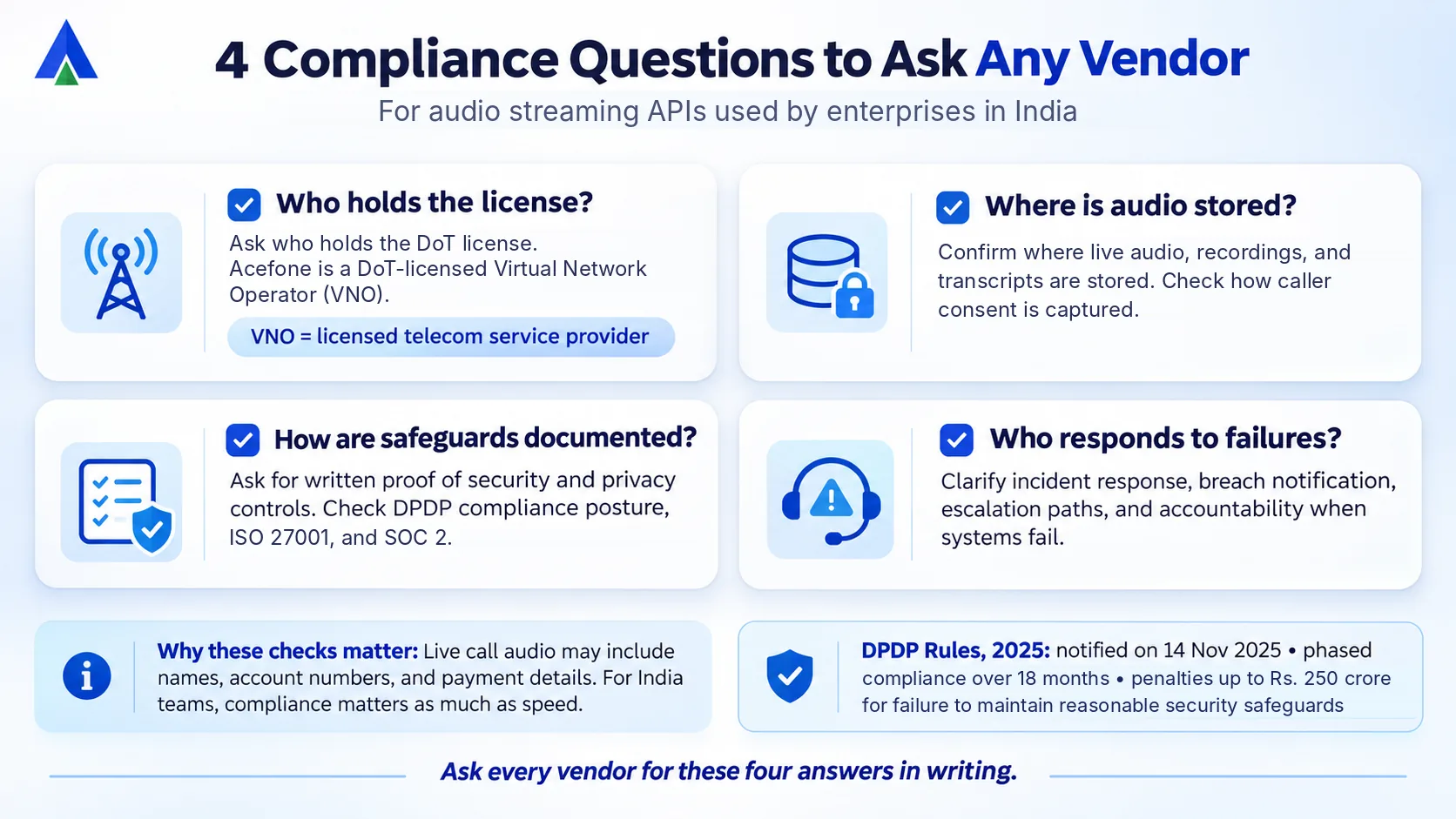
Check four things in writing: the license, data location and consent, security safeguards, and who responds to failures. An audio streaming API carries live customer speech, so these checks come before speed or price. Your compliance remains your responsibility, and a good vendor helps you meet it with documents, not promises.
Start with the license. Acefone is a DoT-licensed Virtual Network Operator (VNO), a telecom provider licensed by India’s Department of Telecommunications. In our experience, RFPs treat DoT and TRAI (Telecom Regulatory Authority of India) rules as hard requirements.
Next, data location. Live call audio can carry names, account numbers, and payment dates. Ask where the live stream, recordings, and transcripts are stored, and map every system that touches the audio.
Then check consent. Streamed audio can be personal data, and recording it adds risk. Tell callers the call is recorded or processed, and why.
India notified the DPDP (Digital Personal Data Protection) Rules in November 2025. Consent Manager provisions took effect in November 2026, and the main obligations follow in May 2027. Penalties reach up to Rs. 250 crore for failing to keep reasonable security safeguards.
Check security next. Ask whether the stream uses encrypted WebSocket (WSS), how your server authenticates, and who can access recordings. Acefone is DPDPA 2023 compliant and holds SOC 2, ISO 27001, ISO 27017, ISO 27108, and ISO 20000 credentials.
TL;DR: Check the license, data location, consent, safeguards, and escalation path before you sign.
How Do You Scale Beyond a Pilot?
Scale by getting concurrency limits, and the process for raising them, in writing before the pilot ends. A pilot with ten calls hides the ceiling, and a collections campaign at 10 AM exposes it. Confirm the account limit, how fast it can rise, and what happens to calls above the limit.
Concurrency: The number of calls running at the same moment.
Ask four questions:
- What is the limit per account?
- How quickly can you raise it?
- What happens to call 101 when the limit is 100?
- Who do you call at 10 PM when it fails?
Then run a load test at your expected peak plus a safety margin. Confirm that your speech engine and AI model handle the same volume.
Use this checklist when you compare vendors.
| Check | What good looks like |
| Protocols | WebSocket and SIP trunking, in both directions |
| Codecs and sample rates | You choose them to match your speech engine |
| Events | Call state, transfer triggers, and session metadata over WebSocket |
| Handoff | Mid-call transfer that carries full context |
| Concurrency | Limit, raise process, and behavior at the limit, all in writing |
Then decide who builds the agent. A telephony API gives your engineers full control and full ownership of the work. Acefone Agent Studio gives non-engineering teams a no-code route.
The Agent Studio Starter plan begins at Rs. 1,000 per month with 2 concurrent calls. Enterprise concurrency is custom, and telephony is billed separately.
TL;DR: Get concurrency limits in writing, then choose who builds the agent.
How Does Audio Streaming Help BFSI Collections?
Audio streaming lets a voice agent act during an EMI reminder call, not after the call has ended. The agent confirms a payment date and notes a promise to pay on the same call. Disputes and hardship cases move to a human agent with the details already captured and logged.
Here is an illustrative workflow, not a customer case. An NBFC (non-banking financial company) runs EMI (equated monthly installment) reminder calls before due dates. Each call streams to a speech engine and the team’s voice agent.
Borrowers switch between Hindi and English mid-sentence, so the speech engine must handle both. Acefone Agent Studio supports Hindi-English code-switching and 12+ languages.
The agent can book a callback if the borrower misses the date. When the borrower disputes the amount, the call moves to a human agent.
Your compliance team still decides what the agent may say. You set the script, the consent language, and the escalation rules. RBI instructions also limit the hours for recovery calls.
Agent Studio campaigns are timezone-aware, so they never dial outside the hours you set. Agent Studio call logs show each handoff, with the recording and transcript. Afterward, Xtract transcribes recorded calls and scores human agents on quality.
Start with one campaign and one language pair. Measure answer rates, handoff rates, and outcomes before you add more.
TL;DR: Live audio lets the agent confirm dates mid-call and pass disputes to people.
Conclusion
An audio streaming API for telephony turns every call into live data your AI can use. That works when the audio is fast, the handoff keeps context, and the vendor documents its compliance. Three takeaways matter most.
- Judge vendors on total response time and on how well a call reaches a human.
- Get the license, data location, consent process, and concurrency limits in writing.
- Match the build to your team. Engineers can build on a telephony API, and everyone else can start with Acefone Agent Studio.
Test all three on your own calls before you commit. A pilot with real numbers, accents, and peak volume tells you more than any demo.
Ready to test live call audio on your own traffic? Book a demo and we will walk through your call volumes, handoff flow, and concurrency needs.
Frequently Asked Questions
An audio streaming API for telephony sends live call audio to your software over a WebSocket connection. Your software can transcribe it, run a voice bot, or analyze it, then send audio back. The call stays live the whole time. Recording differs: it delivers a file afterward.
Telephony audio streaming starts when a caller dials your number. The network opens a WebSocket connection to your server and forwards the audio in small chunks. Your system transcribes the speech, decides on a reply, and sends audio back. The same connection stays open until the call ends.
A programmable voice API controls the call: dialing, routing, masking numbers, and playing menus. Audio streaming carries the sound itself, live, to your software. Many teams use both. A voice streaming API for telephony pairs call control with live audio. Your bot can then hear callers and act.
Phone networks carry calls over SIP and RTP. SIP sets up the call, and RTP carries the audio. Cloud apps rarely speak those directly. WebSocket call streaming bridges the gap. The provider converts call audio into a WebSocket feed your software can read like any web connection.
Telephone audio is narrowband, usually 8 kHz, encoded as G.711 μ-law or A-law. Some providers also offer 16-bit linear PCM, which speech engines can read directly. Check which formats your provider supports and which your speech engine expects. Matching them avoids conversion steps that add delay.
Low latency voice streaming for AI agents depends on the telephone leg plus your own speech and AI stack. Our Voice Streaming forwards call audio to your endpoint in 50-75ms. Your speech engine, AI model, and voice add more. Test the full round trip on real calls, because callers judge total delay.
Yes. You can stream call audio to speech-to-text in real time, then feed the transcript to an AI model. That powers voice agents, a live call transcription API for agent assist, and instant summaries. A telephony API for AI makes the connection. Your engine just needs to read the audio format you receive.
It can be, if your provider documents its controls. Ask about encrypted connections, access controls, data location, and licensing. We’re a DoT-licensed VNO with an India-based stack, DPDPA 2023 compliance, ISO 27001, and SOC 2 Type 2. Your own compliance duties remain yours, and we help you meet them.
Several do. Compare any audio streaming API for telephony on four points. Check the DoT license, India-based data handling, written concurrency limits, and handoff to human agents. We offer WebSocket audio streaming through Voice Streaming, on our own licensed network. Run every shortlist through those four points before a pilot.
Scaling to thousands of calls starts with audio streaming API concurrency limits. Get the account limit, the process for raising it, and the behavior at the limit in writing. Load-test with realistic peaks, not average days. Then confirm your speech engine and AI model handle the same volume.
Build on a telephony API for custom voice bots if you have engineers and need custom logic. Buy if your team lacks engineers, wants to launch in hours, or needs one vendor for telephony and AI. Agent Studio starts at ₹1,000 per month, and telephony bills separately. Don’t build just because you can.